Frequently Asked Questions
Q: Why is Miriam's death mentioned in the Torah?
A: Miriam's death is mentioned in the Torah (Numbers 20:1) because she was a great leader and prophetess of Israel. According to Rashi and the Midrash, her passing marked the end of the 'Well of Miriam,' a miraculous well that provided water for the Israelites in the desert in her merit (Taanit 9a). This teaches us about the importance of righteous women in Jewish history.
Q: What month did the Israelites arrive in the desert of Zin?
A: The verse states that the Israelites arrived in the desert of Zin in 'the first month' (Numbers 20:1). According to Rashi, this refers to the month of Nisan, the same month they originally left Egypt. This timing is significant because it shows they had been wandering for nearly 40 years since the Exodus.
Q: Why is the location Kadesh important in this verse?
A: Kadesh is significant because it was a central location during the Israelites' wilderness journey. The Talmud (Sotah 34a) identifies it as the place where the spies were sent from (Numbers 13). Here in Numbers 20:1, it becomes the place where Miriam dies, marking a transition point before the nation prepares to enter the Land of Israel.
Q: What can we learn from how the Torah mentions Miriam's death?
A: The simple mention of Miriam's death teaches us about the Torah's honesty in recording history, even difficult moments. The Rambam explains that the Torah doesn't hide the challenges the Jewish people faced. Additionally, the juxtaposition with the water crisis that follows (Numbers 20:2) teaches that the people's water came in Miriam's merit (Taanit 9a), showing how one righteous person can sustain a nation.
Q: Why does the Torah say 'the whole congregation' arrived in the desert of Zin?
A: The phrase 'the whole congregation' emphasizes that this was the generation born in the wilderness who would enter Israel, unlike their parents who died in the desert due to the sin of the spies. Rashi notes this marks a new phase in Israel's journey, showing the transition between generations is significant in Jewish history.

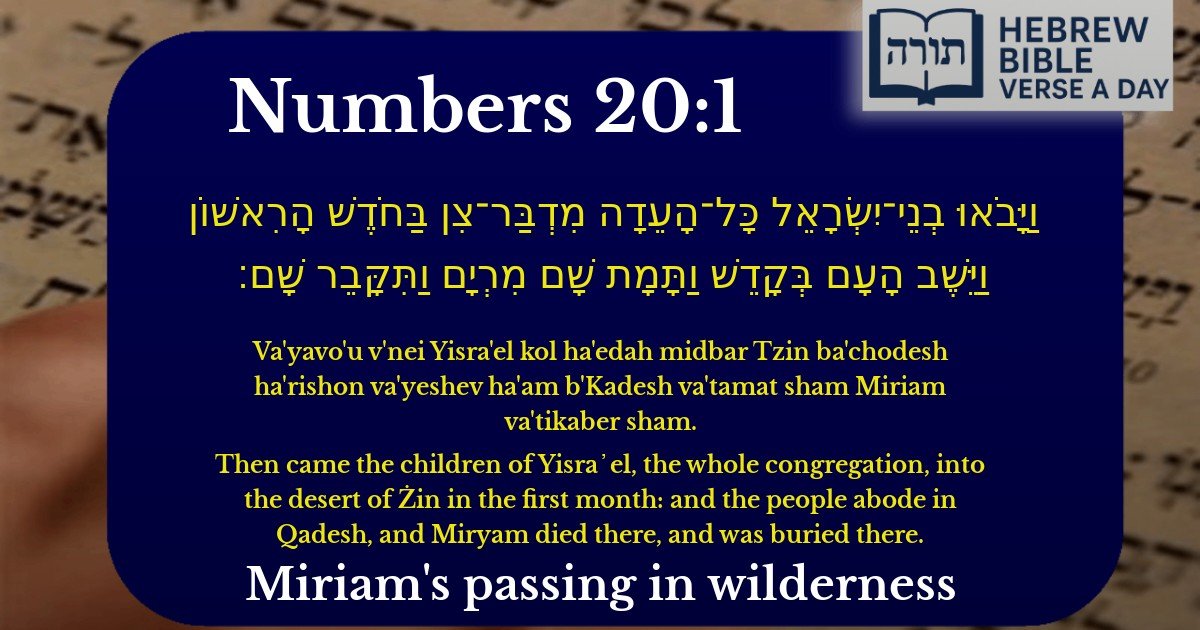

Location and Timing of Miriam's Passing
The verse states that Bnei Yisrael arrived in the wilderness of Tzin in the first month (Nisan) and settled in Kadesh, where Miriam died and was buried. Rashi (Bamidbar 20:1) notes that this event occurred in the 40th year of wandering, as the Torah previously recorded events from earlier years. The Sifrei (Chukat 1) explains that the mention of the "first month" emphasizes that Miriam's death occurred shortly before the people were to enter Eretz Yisrael, marking a transitional period.
The Significance of Miriam's Death
Miriam's passing is mentioned briefly, yet our Sages attach great importance to it. The Talmud (Taanit 9a) teaches that Miriam's merit provided Bnei Yisrael with the "Well of Miriam," a miraculous water source that accompanied them in the desert. When she died, the well ceased, leading to the subsequent incident where Moshe struck the rock (Bamidbar 20:11). Ramban (Bamidbar 20:2) connects her death to the people's complaint about water, showing how the loss of a righteous leader affects the community.
Burial in Kadesh
The verse emphasizes that Miriam was buried "there" (שָׁם), in Kadesh. The Midrash (Bamidbar Rabbah 19:16) comments that her burial was modest, without public fanfare, reflecting the humility of righteous individuals. This contrasts with the elaborate burials of secular leaders, teaching that true greatness lies in deeds, not ceremony.
Chronological Context