Frequently Asked Questions
Q: Why did Noah send out a dove after the flood?
A: Noah sent the dove to check if the floodwaters had receded enough for life to return to the land. Unlike the raven (sent earlier), which flew back and forth without returning, the dove would only return if it couldn't find dry land (Rashi on Genesis 8:8-9). This showed Noah that the earth was not yet ready for them to leave the ark.
Q: What is the significance of the dove in this verse?
A: The dove symbolizes peace and purity in Jewish tradition. Its behavior—returning when it couldn't find rest—demonstrated that the world was still in a state of destruction. Later, when it brought back an olive leaf (Genesis 8:11), it became a sign of hope and renewal (Midrash Bereishit Rabbah 33:6).
Q: Why didn't Noah send the dove first instead of the raven?
A: Noah first sent a raven, an unclean bird (according to Torah law), because it could survive harsh conditions. The dove, a clean bird, was sent afterward to test if the land was habitable for pure creatures (Rashi on Genesis 8:7-8). This teaches that Noah carefully assessed the world's readiness for renewal.
Q: How does this verse teach us about patience after hardship?
A: Noah waited and sent the dove multiple times (Genesis 8:8-12) to confirm the land was truly ready. This teaches that after a crisis, we must be patient and verify that conditions are safe before moving forward (Talmud Sanhedrin 108b).
Q: What lesson can we learn from the dove returning with nothing?
A: When the dove returned empty (Genesis 8:9), it showed that even after hardship, recovery takes time. This teaches that rebuilding—whether after a flood or personal struggles—requires perseverance and trust in Hashem's plan (Midrash Tanchuma, Noach 5).

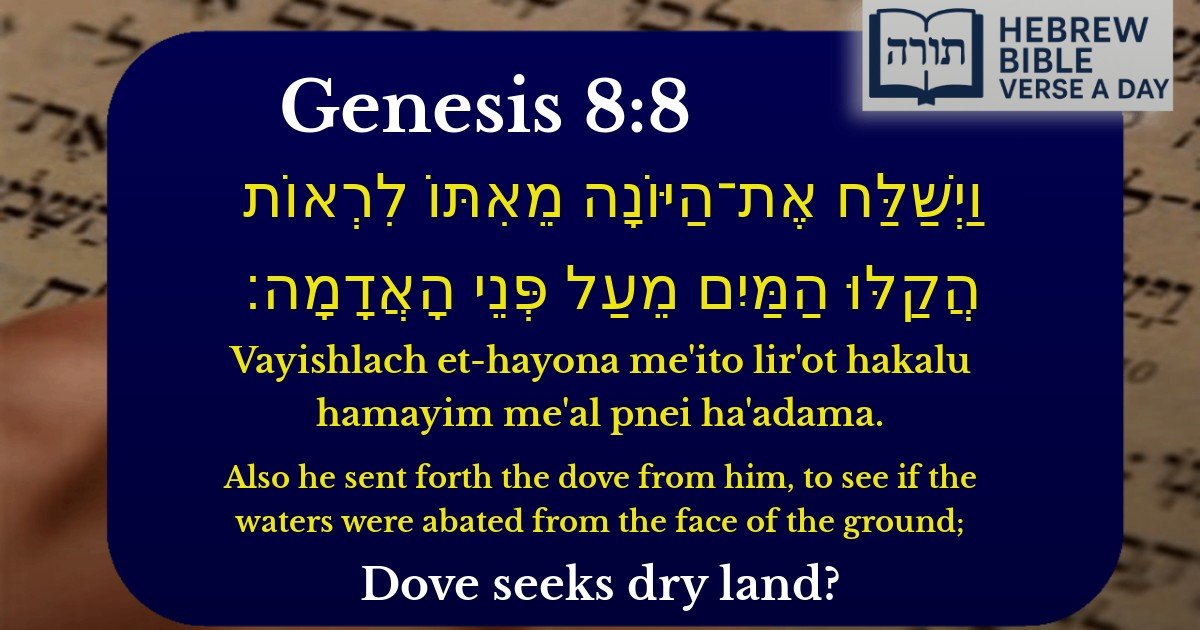

Rashi's Explanation
Rashi (Bereshit 8:8) explains that Noach sent the dove after the raven because the dove is a more docile and faithful creature, unlike the raven which had already demonstrated rebellious behavior. The phrase "מֵאִתּוֹ" ("from him") implies that the dove remained close to Noach, symbolizing its loyalty. Rashi further notes that the dove was sent to determine if the floodwaters had receded enough for vegetation to grow again, as the dove would only return if it found no dry land.
Symbolism of the Dove
The Midrash (Bereshit Rabbah 33:6) teaches that the dove represents the Jewish people, who are compared to a dove in Shir HaShirim (2:14). Just as the dove is faithful to its mate, the Jewish people remain faithful to Hashem even in times of hardship. The act of sending the dove symbolizes Noach's hope for renewal and divine mercy after the destruction of the flood.
Rambam's Perspective on Divine Providence
Rambam (Moreh Nevuchim 2:48) discusses how Noach's actions demonstrate human responsibility within divine providence. Though Hashem could have directly informed Noach when the waters receded, Noach was instructed to take initiative—sending the dove to observe natural signs. This teaches that humans must actively seek understanding and not rely solely on miracles.
Talmudic Insights
Malbim's Linguistic Analysis
The Malbim highlights the phrasing "לִרְאוֹת הֲקַלּוּ הַמַּיִם" ("to see if the waters were abated"). The term "הֲקַלּוּ" suggests not just a physical lessening but a spiritual lightening—indicating that the flood's judgment had been lifted. The dove's mission thus served as a test of both physical and metaphysical conditions.