Frequently Asked Questions
Q: What does Genesis 9:4 mean when it says not to eat flesh with its blood?
A: This verse prohibits consuming meat that still contains blood, as blood represents the life force (nefesh) of the animal. According to Jewish law (halacha), this is the foundation for the requirement to properly slaughter animals (shechita) and drain the blood before consumption. Rashi explains that this commandment was given to Noah and applies to all humanity (the Noahide Laws).
Q: Why is the prohibition against eating blood important in Judaism?
A: The Torah considers blood sacred because it contains the life force (Leviticus 17:11). This prohibition teaches respect for life and creates a distinction between humans and animals. The Rambam (Hilchot Ma'achalot Asurot 6:1) explains that consuming blood would make one cruel and violent, going against the sanctity of life that Judaism upholds.
Q: How do Jews practically observe the prohibition against eating blood today?
A: There are several methods to remove blood from meat according to halacha: 1) Proper slaughter (shechita) which drains most blood, 2) Salting and rinsing the meat (melicha), and 3) Roasting over fire. The Shulchan Aruch (Yoreh De'ah 69) details these processes. Kosher butchers perform these procedures before selling meat.
Q: Does Genesis 9:4 apply to all people or just Jews?
A: This commandment was given to Noah after the flood, making it one of the Seven Noahide Laws that apply to all humanity. The Talmud (Sanhedrin 56b) lists this as one of the universal commandments. For Jews, there are additional Torah laws about blood found in Leviticus and Deuteronomy that expand on this principle.
Q: What's the difference between this prohibition and kosher slaughter laws?
A: Genesis 9:4 establishes the basic principle against consuming blood, while later Torah commandments (like Deuteronomy 12:23) provide the specific Jewish laws (shechita) for humane slaughter and complete blood removal. The Talmud (Chullin) elaborates on the detailed procedures for making meat kosher according to these principles.


Prohibition of Eating Blood
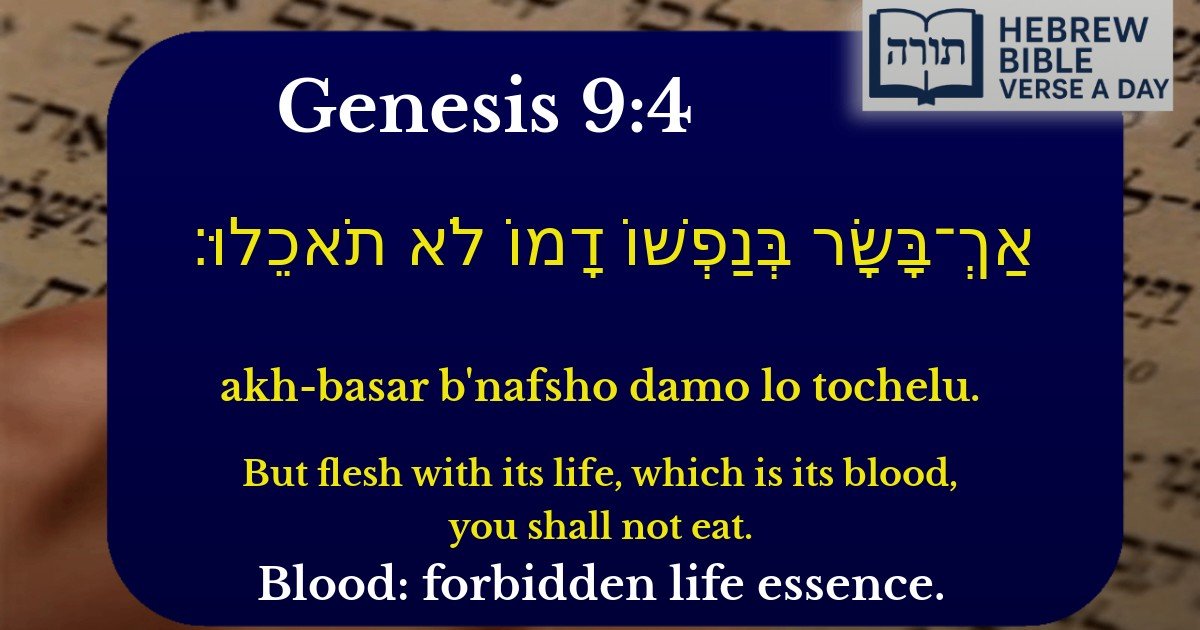
The verse "אַךְ־בָּשָׂר בְּנַפְשׁוֹ דָמוֹ לֹא תֹאכֵלוּ" (But flesh with its life, which is its blood, you shall not eat) establishes a fundamental prohibition in Jewish law against consuming blood. This commandment appears in Bereishit (Genesis) 9:4 as part of the Sheva Mitzvot B'nei Noach (Seven Noahide Laws) and is later reinforced in the Torah for Bnei Yisrael in Vayikra (Leviticus) 17:10-14 and Devarim (Deuteronomy) 12:23.
Explanation from Rashi
Rashi comments on this verse that the prohibition applies to "flesh torn from a living animal" (ever min hachai), as the blood represents the life force (nefesh) of the creature. He emphasizes that consuming blood is akin to consuming the soul of the animal, which is forbidden. This aligns with the Torah's broader principle that "the life of the flesh is in the blood" (Vayikra 17:11).
Rambam's Legal Perspective
Rambam (Maimonides) discusses this prohibition in Hilchot Ma'achalot Asurot (Laws of Forbidden Foods), where he explains that blood is one of the primary forbidden substances, alongside fat (chelev) and the sciatic nerve (gid hanasheh). He states that even a small amount of blood is prohibited, and the Torah requires kashering (salting and rinsing meat) to remove blood before consumption (Mishneh Torah, Ma'achalot Asurot 6:1-2).
Midrashic Interpretation
The Midrash Bereishit Rabbah (34:13) elaborates on the severity of this prohibition, teaching that blood represents the sanctity of life, which belongs solely to Hashem. By refraining from consuming blood, humanity acknowledges that life is sacred and not subject to human dominion. This idea is echoed in Vayikra 17:11, where blood is designated for atonement on the altar rather than for human consumption.
Practical Halachic Implications
Philosophical and Ethical Dimensions
The prohibition against consuming blood serves as a moral lesson about the sanctity of life. The Sefer HaChinuch (Mitzvah 148) explains that this law trains humanity to respect life and avoid cruelty, as blood symbolizes the essence of a living being. By abstaining from blood, Jews and Noahides alike affirm that life is sacred and not to be treated as mere sustenance.