
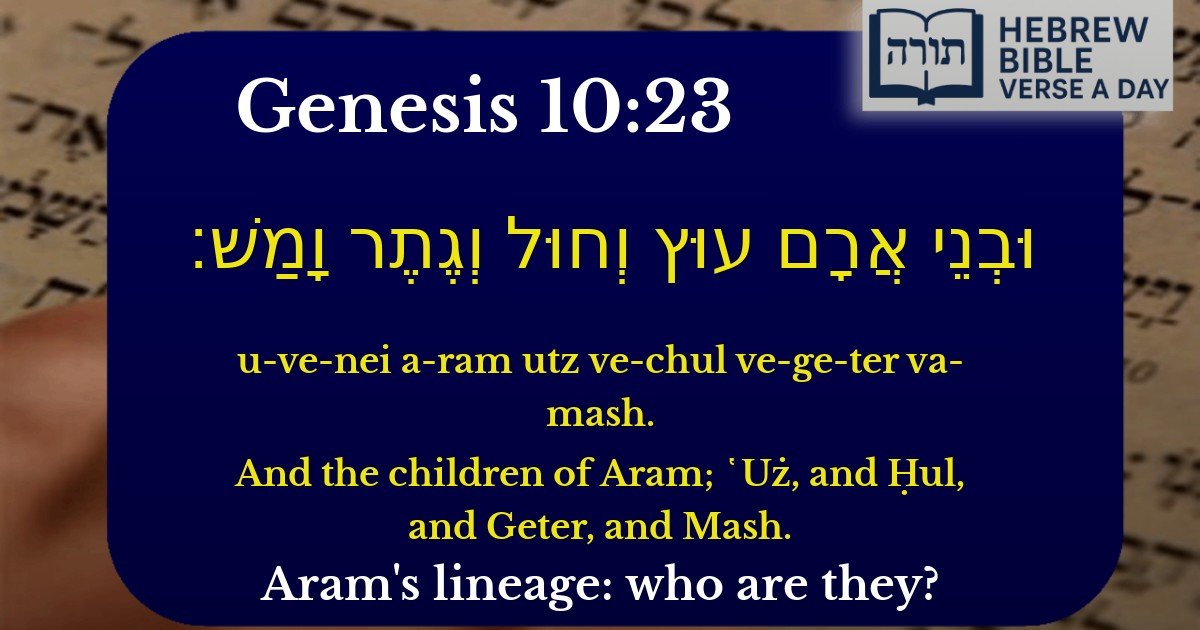

Genesis 10:23 - Aram's lineage: who are they?

Genesis 10:23 - בראשית 10:23

Hebrew Text

וּבְנֵי אֲרָם עוּץ וְחוּל וְגֶתֶר וָמַשׁ׃

English Translation

And the children of Aram; ῾Uż, and Ḥul, and Geter, and Mash.

Transliteration

U-ve-nei a-ram utz ve-chul ve-ge-ter va-mash.

Hebrew Leining Text

וּבְנֵ֖י אֲרָ֑ם ע֥וּץ וְח֖וּל וְגֶ֥תֶר וָמַֽשׁ׃

🎵 Listen to leining

Parasha Commentary

Context in Sefer Bereishit

The verse (Bereishit 10:23) lists the descendants of Aram, son of Shem, as part of the genealogical record of Noah's descendants following the flood. This section establishes the origins of various nations, which is foundational for understanding later biblical narratives.

Rashi's Commentary

Rashi (Rabbi Shlomo Yitzchaki) notes that these names—Uz, Hul, Geter, and Mash—represent regions or nations descended from Aram. He connects them to later biblical references:

  • Uz: Identified with the land where Iyov (Job) lived (Iyov 1:1), suggesting a geographical link to Aram.
  • Hul: Rashi associates this with "Chulya," a region near the Sea of Galilee (Talmud Megillah 6a).
  • Geter and Mash: These are less clearly identified but are understood as distinct Aramean territories.

Midrashic Insights

The Midrash (Bereishit Rabbah 37:4) elaborates on the significance of these names, suggesting they hint at historical or moral traits of these nations:

  • Uz (עוץ): Derived from "etz" (עץ, "tree"), symbolizing strength or stubbornness, possibly alluding to their resilience or defiance.
  • Hul (חול): Linked to "chol" (חול, "sand"), representing multiplicity or instability, as sand is abundant yet shifting.

Rambam's Perspective

Rambam (Maimonides), in his historical approach, views such genealogies as establishing the diversity of human nations and their roles in divine providence. The Aramean descendants are part of the broader narrative of human dispersion and cultural development.

Significance in Jewish Tradition

These names are not merely historical records but are referenced in later Jewish texts. For example, the Talmud (Yoma 10a) discusses the Arameans as neighbors and sometimes adversaries of Israel, emphasizing the ongoing relationship between these nations and the Jewish people.

📚 Talmud Citations

This verse is not quoted in the Talmud.

Frequently Asked Questions

Q: Who were the children of Aram mentioned in Genesis 10:23?
A: The children of Aram mentioned in Genesis 10:23 were Uz, Hul, Geter, and Mash. According to Rashi, these were the descendants of Aram, who was the son of Shem and grandson of Noah. These names represent nations or regions that descended from Aram.
Q: Why is the lineage of Aram important in the Torah?
A: The lineage of Aram is important because it traces the descendants of Shem, one of Noah's sons, and shows how nations branched out after the Flood. This helps us understand the origins of various peoples in the ancient world, as explained in the Talmud and Midrash.
Q: What can we learn from the mention of Aram's children in the Torah?
A: We learn that the Torah carefully documents the origins of nations, emphasizing the importance of family and lineage in Jewish tradition. Rambam teaches that understanding these genealogies helps us appreciate the diversity of humanity while recognizing our shared roots.
Q: Where is the land of Aram mentioned in the Torah?
A: The land of Aram, associated with Aram's descendants, is often linked to areas in the northern part of the ancient Near East. Rashi and other commentators identify it with regions like Aram-Naharaim, which is mentioned later in the Torah in connection with figures like Abraham and Jacob.