Frequently Asked Questions
Q: Why does the Torah mention that Sarai (Sarah) didn't have children?
A: The Torah mentions this to set the stage for the story of Hagar and the birth of Yishmael (Ishmael), showing the challenge of childlessness that Avraham and Sarah faced despite God's promise of descendants. Rashi explains that this detail emphasizes Sarah's righteousness and her willingness to find a solution through Hagar.
Q: Who was Hagar, and why was she important?
A: Hagar was Sarah's Egyptian maidservant. According to the Midrash (Bereishit Rabbah), she was actually Pharaoh's daughter, given to Sarah when they went down to Egypt. She became important because Sarah gave her to Avraham as a wife to bear a child when Sarah was initially unable to conceive.
Q: Why did Sarah give Hagar to Avraham as a wife?
A: Sarah, seeing that she had not yet borne children, followed the custom of the time where a wife could give her maidservant to her husband to bear children on her behalf (similar to later laws in the Torah regarding yibum). Ramban explains that Sarah acted out of deep faith, believing that through Hagar, Avraham could still fulfill God's promise of offspring.
Q: What can we learn from Sarah's decision regarding Hagar?
A: We learn about Sarah's selflessness and dedication to fulfilling God's promise of descendants for Avraham. However, the Talmud (Yevamot 65b) also teaches that this decision led to complications, reminding us that even well-intentioned actions can have unforeseen consequences.
Q: How does this verse relate to Jewish tradition today?
A: This verse is part of the foundational story of the Jewish people, showing the origins of Yishmael's lineage and the challenges in Avraham's household. Jewish tradition learns from Sarah's patience and faith, as well as the importance of trusting in God's timing, even when facing difficulties like childlessness.

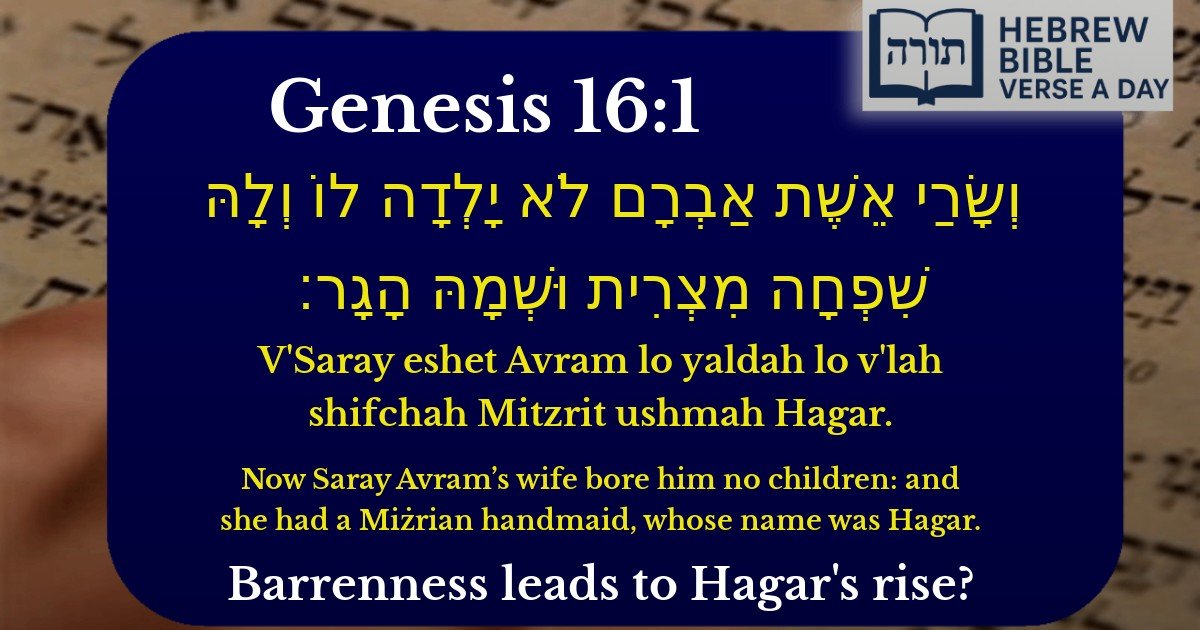

Sarai's Childlessness and Hagar's Introduction
The verse states, "Now Sarai, Avram’s wife, bore him no children: and she had an Egyptian handmaid, whose name was Hagar" (Bereishit 16:1). This introduces a pivotal moment in the narrative of Avraham and Sarah’s lineage, as their inability to conceive leads to the introduction of Hagar as a potential solution.
Rashi's Commentary on Sarai's Childlessness
Rashi explains that the Torah emphasizes Sarai's childlessness to highlight her righteousness and the divine plan at work. He notes that the phrase "bore him no children" (לֹא יָלְדָה לוֹ) underscores that she had not borne children to Avram, but this does not imply she was incapable of bearing children in general. This sets the stage for the eventual miracle of Yitzchak's birth, demonstrating that her childlessness was temporary and part of Hashem’s greater design (Rashi on Bereishit 16:1).
The Significance of Hagar's Egyptian Origins
The verse specifies that Hagar was an Egyptian handmaid. The Midrash (Bereishit Rabbah 45:1) elaborates that Hagar was Pharaoh’s daughter, given to Sarai when Pharaoh recognized Sarai’s greatness after the incident in Egypt (Bereishit 12). This detail elevates Hagar’s status, suggesting she was not an ordinary maidservant but of noble lineage, which may explain her later boldness in dealing with Sarai.
Hagar's Role in Fulfilling the Divine Promise
The Ramban (Nachmanides) discusses how Sarai’s decision to give Hagar to Avram was motivated by her deep faith in Hashem’s promise of offspring (Bereishit 15:4-5). Since she had not yet conceived, she sought to fulfill the promise through her maidservant, a practice common in ancient times (Ramban on Bereishit 16:2). This act reflects Sarai’s selflessness and commitment to Avram’s legacy, even at personal cost.
Lessons from the Verse