Frequently Asked Questions
Q: What is happening in Genesis 21:15?
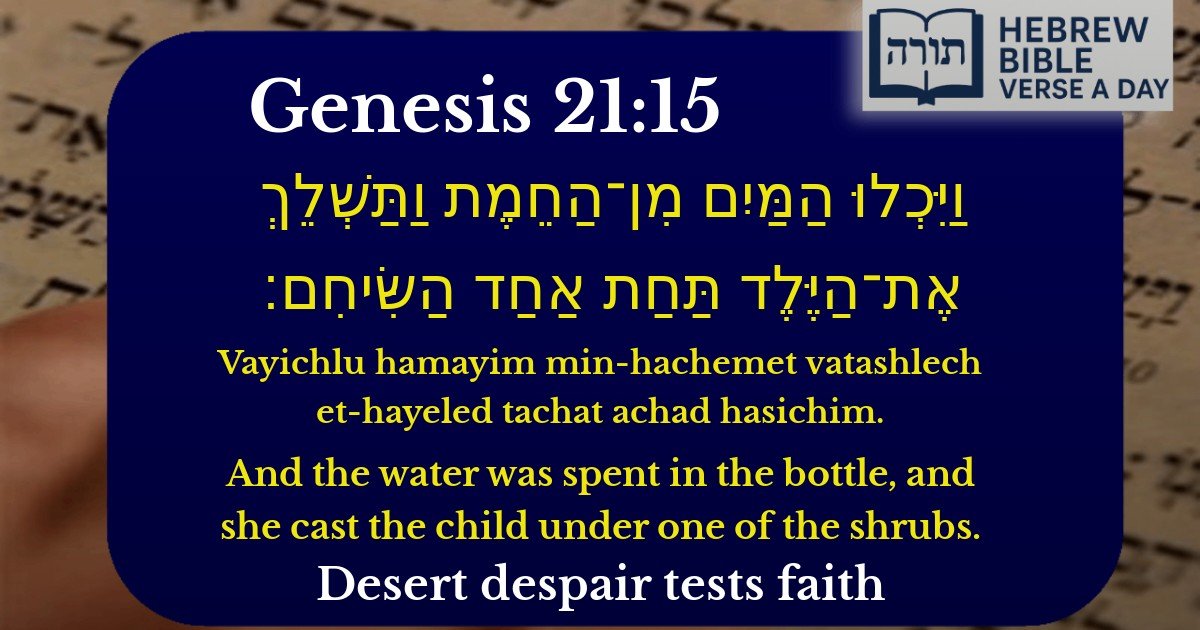
A: In Genesis 21:15, Hagar and her son Yishmael (Ishmael) are in the wilderness after being sent away by Avraham (Abraham). Their water runs out, and in desperation, Hagar places Yishmael under a shrub to shield him from the sun, fearing he might die. This moment shows her distress and the severity of their situation.
Q: Why did Hagar place Yishmael under a shrub?
A: According to Rashi, Hagar placed Yishmael under a shrub to protect him from the harsh desert sun. She could not bear to watch him suffer, so she distanced herself, as the verse continues to say she sat 'a bowshot away' (Genesis 21:16). The Midrash (Bereishit Rabbah 53:13) explains that she did this out of despair, thinking he might die.
Q: What lesson can we learn from Genesis 21:15?
A: This verse teaches us about human vulnerability and the importance of trusting in Hashem (God) even in desperate situations. Though Hagar felt hopeless, Hashem later provided water and saved Yishmael (Genesis 21:19). The Talmud (Rosh Hashanah 16b) also connects this event to divine mercy, showing that even in moments of despair, Hashem hears prayers.
Q: How does this verse relate to Jewish tradition?
A: This event is part of the larger narrative of Avraham’s family and the origins of the Jewish people. The Midrash (Pirkei DeRabbi Eliezer 30) discusses how Yishmael’s survival was part of Hashem’s plan, as he became the ancestor of nations. Jewish tradition also sees this as a lesson in compassion—even when Hagar and Yishmael faced hardship, Hashem intervened to save them.
Q: Why is water so significant in this verse?
A: Water symbolizes life in the Torah, and its absence represents desperation and impending death. The Rambam (Hilchot Ta’anit 1:1-3) explains that water shortages are among the greatest crises, highlighting the severity of Hagar and Yishmael’s situation. Later, when Hashem provides a well (Genesis 21:19), it shows divine intervention sustaining life.


Context in the Torah
The verse (Genesis 21:15) describes Hagar's desperate situation after being sent away by Avraham, when the water in her bottle ran out in the wilderness of Be'er Sheva. This occurs after Sarah insists that Yishmael not inherit alongside Yitzchak, leading Avraham to send Hagar and Yishmael away with limited provisions.
Rashi's Commentary
Rashi explains that the phrase "וַיִּכְלוּ הַמַּיִם מִן־הַחֵמֶת" ("the water was spent in the bottle") indicates that Hagar and Yishmael had exhausted all their resources. He notes that the term "חֵמֶת" (usually translated as "bottle") can also imply a container made of animal skin, emphasizing their dire circumstances in the desert.
Ibn Ezra's Insight
Ibn Ezra highlights that Hagar's act of placing Yishmael "תַּחַת אַחַד הַשִּׂיחִם" ("under one of the shrubs") was an attempt to shield him from the scorching sun. He suggests that this demonstrates a mother's compassion even in moments of despair, as she sought whatever minimal protection nature could offer.
Midrashic Interpretation (Bereishit Rabbah)
The Midrash elaborates on the severity of their suffering, teaching that the angels protested to Hashem, questioning how He could allow Yishmael to perish from thirst. The Midrash emphasizes that despite Yishmael's future actions, his merit as Avraham's son invoked divine mercy, leading to the subsequent miracle of the well (Genesis 21:19).
Rambam's Perspective
Rambam (Hilchot Teshuva 3:1) indirectly references this episode when discussing divine providence. He teaches that Hashem's response to human suffering is measured according to individual circumstances, and Yishmael's salvation demonstrates that even in seemingly hopeless situations, divine intervention is possible.
Symbolism of the Shrub