Frequently Asked Questions
Q: Why did Sarah die in Hebron?
A: According to Rashi, Sarah died in Hebron (also called Kiryat Arba) because this was where she and Abraham lived at the time. The Torah emphasizes that she died in the Land of Canaan, showing her connection to the Promised Land. Some Midrashim suggest that her death was related to the news of the binding of Isaac (Akeidat Yitzchak), which caused her great distress.
Q: Why did Abraham come to mourn and weep for Sarah?
A: Abraham came to mourn and weep for Sarah because she was his beloved wife and life partner. The Talmud (Sanhedrin 22b) teaches that mourning is a proper expression of grief for the loss of a loved one. Abraham's actions set an example for proper mourning practices in Jewish tradition.
Q: What is the significance of Sarah's death being recorded in the Torah?
A: Sarah's death is significant because she was the first of the Matriarchs and a key figure in Jewish history. The Torah records her passing to honor her righteousness and her role in establishing the Jewish people. The Midrash (Bereishit Rabbah 58:1) highlights her importance by comparing her life to Shabbat candles that bring light to the world.
Q: Why is Hebron called Kiryat Arba in this verse?
A: Rashi explains that Hebron is called Kiryat Arba ('City of Four') for several reasons: 1) It was named after Arba, a giant who lived there (Joshua 14:15), 2) It refers to the four couples buried there (Adam & Chava, Abraham & Sarah, Isaac & Rivka, Yaakov & Leah), or 3) It was a city with four quarters. The dual name emphasizes its importance in Jewish history.
Q: What can we learn from Abraham's mourning for Sarah?
A: We learn several important lessons: 1) Even great people like Abraham properly mourn their loved ones, showing that grief is natural and important. 2) The order 'to mourn for Sarah and to weep for her' (first formal mourning, then personal weeping) teaches about the structure of Jewish mourning practices. 3) The Rambam (Hilchot Avel) derives from here that comforting mourners is a mitzvah, as Abraham needed comfort after Sarah's death.

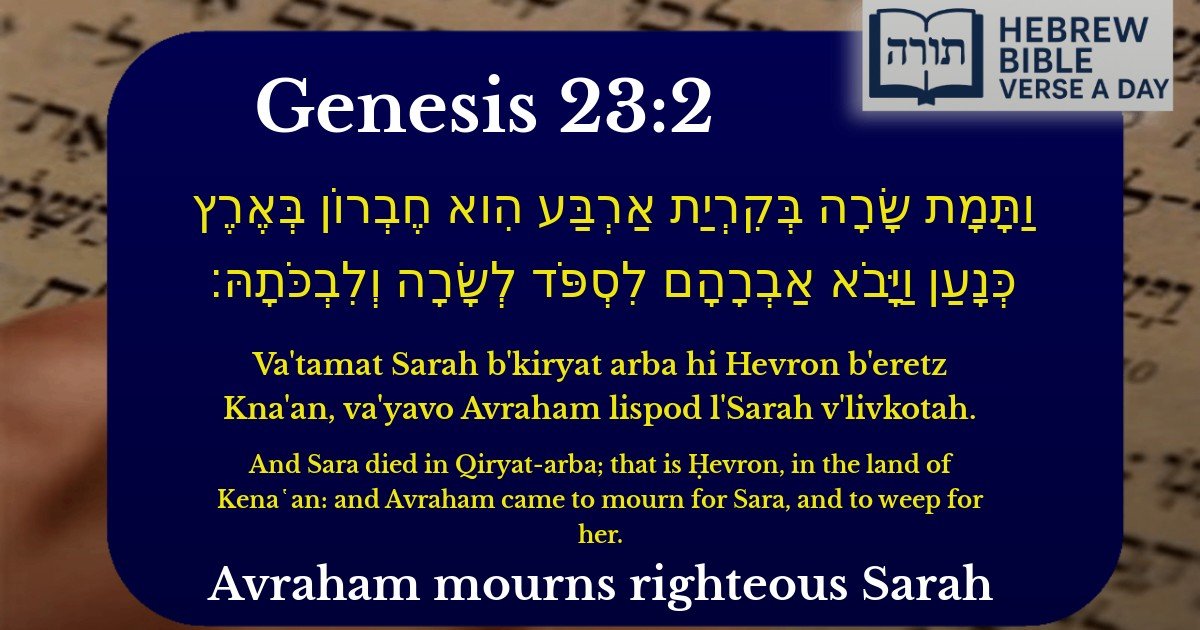

The Passing of Sarah
The verse states, "And Sarah died in Kiryat Arba, that is Hebron, in the land of Canaan." Rashi (Bereshit 23:2) explains that Kiryat Arba ("City of Four") is called so because of four giants who lived there—Anak and his three sons—or because four couples were buried there: Adam and Chava, Avraham and Sarah, Yitzchak and Rivka, and Yaakov and Leah. The Midrash (Bereshit Rabbah 58:4) further connects this location to the future resting place of the Patriarchs and Matriarchs in the Cave of Machpelah.
Avraham's Mourning
The verse continues, "And Avraham came to mourn for Sarah and to weep for her." The Rambam (Hilchot Avel 13:11) teaches that mourning is a mitzvah, demonstrating proper respect for the deceased. The Talmud (Moed Katan 27b) explains that "to mourn" (lispod) refers to eulogizing Sarah, while "to weep" (livkotah) refers to Avraham's personal grief. The Kli Yakar (Bereshit 23:2) notes that Avraham's weeping came after the eulogy, showing that public honor precedes private sorrow.
Sarah's Virtues
The Midrash (Bereshit Rabbah 58:1) elaborates on Sarah's righteousness, stating that her death was connected to the Akeidah (Binding of Yitzchak), as the shock of hearing about it may have hastened her passing. Alternatively, the Zohar (1:122b) teaches that Sarah's soul departed in purity, making her death as precious as her life. Rashi (Bereshit 23:1) also highlights that Sarah's years were equally good, reflecting her consistent righteousness.
Significance of Hebron