Frequently Asked Questions
Q: Why does Rivka mention her family lineage in Genesis 24:24?
A: Rivka mentions her lineage ('I am the daughter of Betu’el the son of Milka, whom she bore to Nahor') to establish her connection to Avraham’s family. According to Rashi, this shows she was from a noble and righteous lineage, as Nahor was Avraham’s brother. This was important because Avraham wanted Yitzchak to marry someone from his own family (Genesis 24:4).
Q: What is the significance of Rivka identifying herself as the daughter of Betu’el in this verse?
A: Rivka identifies herself as the daughter of Betu’el to clarify her family ties. The Midrash (Bereishit Rabbah 60:5) explains that she wanted to show she was from Avraham’s extended family, ensuring Eliezer (Avraham’s servant) that she was a suitable match for Yitzchak. This also highlights the importance of marrying within one’s family in biblical times to maintain spiritual and moral values.
Q: Why does Rivka mention Milka and Nahor in her response?
A: Rivka mentions Milka and Nahor to emphasize her direct lineage from Avraham’s family. Nahor was Avraham’s brother, and Milka was his wife (Genesis 11:29). The Ramban explains that this detail was crucial because Avraham instructed his servant to find a wife for Yitzchak specifically from his relatives (Genesis 24:4), ensuring the continuity of their righteous heritage.
Q: How does Rivka’s response in Genesis 24:24 teach us about honesty in relationships?
A: Rivka’s immediate and truthful response about her family teaches the importance of honesty, especially in matters like marriage. The Talmud (Pesachim 113a) praises those who speak truthfully. By clearly stating her lineage, Rivka demonstrated integrity, a key trait for building trust—essential in forming a Jewish home based on emunah (faith) and yashrut (uprightness).
Q: What lesson can we learn from Rivka introducing herself with her family background?
A: Rivka’s introduction teaches the value of knowing and honoring one’s roots. Jewish tradition (as seen in Pirkei Avot 3:1) emphasizes remembering one’s lineage to maintain a connection to past generations. By identifying her family, Rivka showed pride in her heritage, a lesson for us to cherish our own Jewish identity and values passed down through generations.

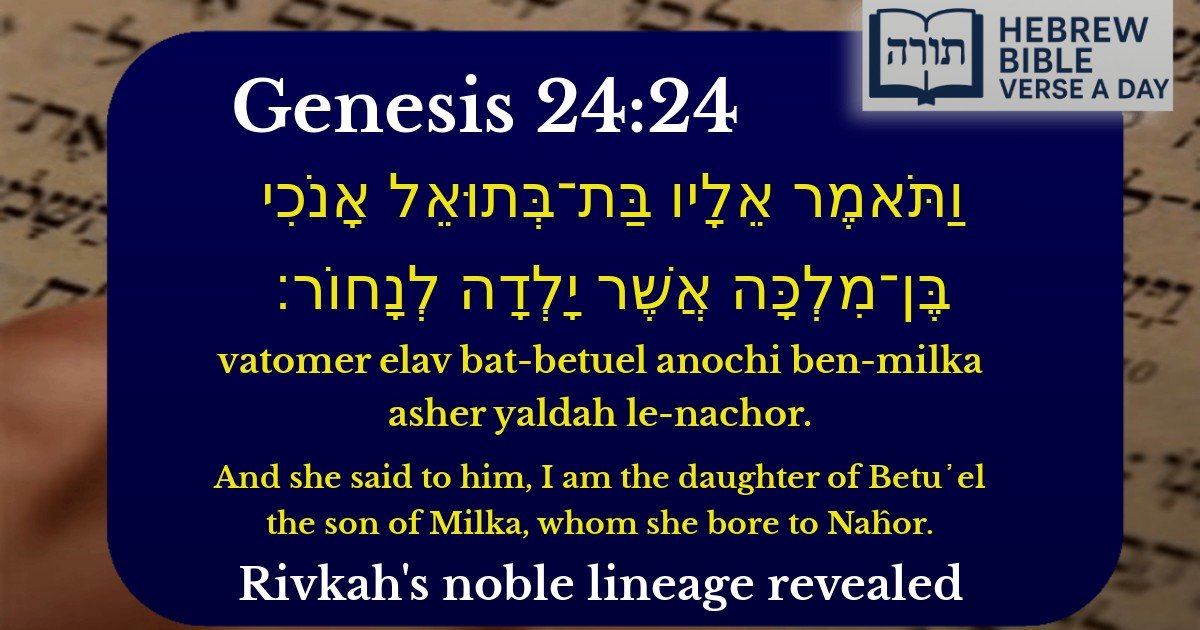

Context of the Verse
This verse (Genesis 24:24) is part of the narrative where Eliezer, Avraham's servant, encounters Rivka (Rebecca) at the well. Rivka identifies herself as the daughter of Betu'el and granddaughter of Milka and Nachor. This identification is significant in establishing her lineage as part of Avraham's extended family.
Rashi's Commentary
Rashi (Genesis 24:24) notes that Rivka emphasizes her lineage by mentioning both her father (Betu'el) and her grandmother (Milka). He explains that she does this to clarify that she is indeed from Avraham's family, as Nachor was Avraham's brother. Rashi also points out that Rivka mentions Milka specifically because she was the primary wife of Nachor, unlike Reumah, who was a concubine (see Genesis 22:24). This underscores Rivka's noble lineage.
Midrashic Insights
Halachic and Ethical Implications
The Rambam (Hilchos Ishus 3:19) derives from this interaction the importance of verifying the lineage of a potential spouse. Rivka's transparency aligns with the Torah's emphasis on yichus (lineage) as a factor in marriage, ensuring the continuity of Avraham's spiritual legacy.
Nachor's Significance
Nachor, Avraham's brother, represents a branch of the family that did not follow Avraham's path of monotheism. However, Rivka's emergence from this lineage demonstrates that righteousness can flourish even in less ideal circumstances, as later seen in her role as a matriarch of the Jewish people.