

Join Our Newsletter To Be Informed When New Videos Are Posted
Hebrew Text
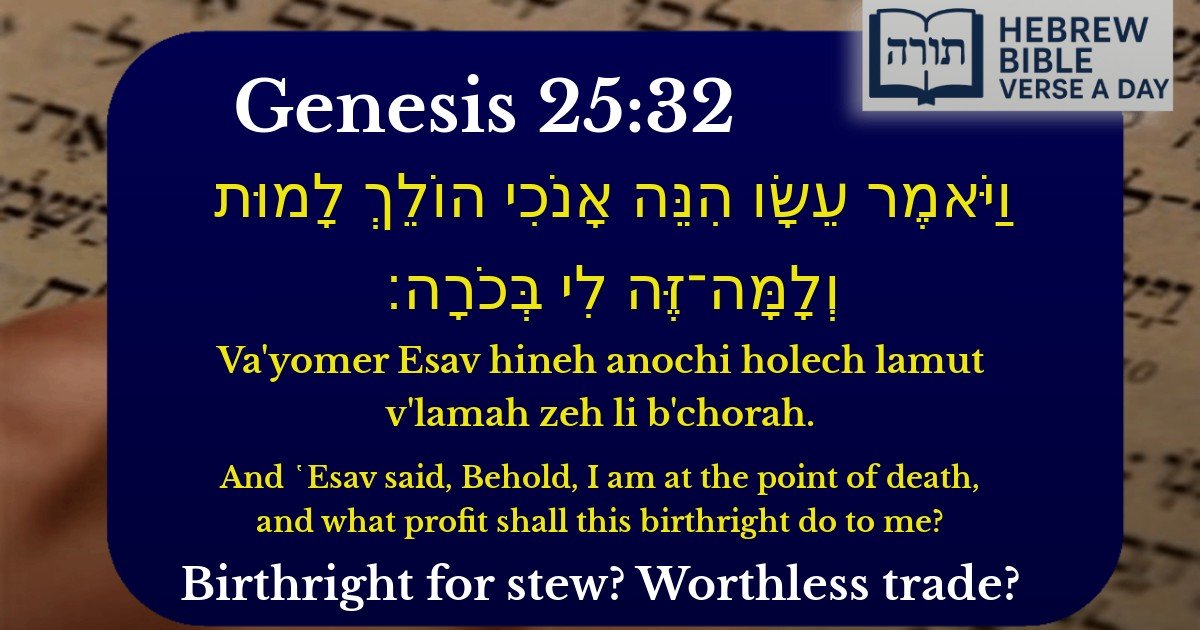
וַיֹּאמֶר עֵשָׂו הִנֵּה אָנֹכִי הוֹלֵךְ לָמוּת וְלָמָּה־זֶּה לִי בְּכֹרָה׃
English Translation
And ῾Esav said, Behold, I am at the point of death, and what profit shall this birthright do to me?
Transliteration
Va'yomer Esav hineh anochi holech lamut v'lamah zeh li b'chorah.
Hebrew Leining Text
וַיֹּ֣אמֶר עֵשָׂ֔ו הִנֵּ֛ה אָנֹכִ֥י הוֹלֵ֖ךְ לָמ֑וּת וְלָמָּה־זֶּ֥ה לִ֖י בְּכֹרָֽה׃
🎵 Listen to leining
Parasha Commentary
📚 Talmud Citations
This verse is quoted in the Talmud.
📖 Bava Batra 16b
The verse is discussed in the context of Esau's attitude towards the birthright and his lack of appreciation for spiritual matters, contrasting with Jacob's valuation of the birthright.
Understanding Esav's Statement
The verse (Bereshit 25:32) records Esav's declaration: "Behold, I am at the point of death, and what profit shall this birthright do to me?" This statement reflects Esav's attitude toward the spiritual significance of the bechorah (birthright). Traditional commentators offer several insights into Esav's mindset and the deeper meaning of his words.
Rashi's Explanation
Rashi explains that Esav exaggerated his condition, claiming he was near death when he was merely exhausted from hunting. His question, "Why do I need the birthright?" reveals his disdain for its spiritual responsibilities, such as the Temple service that would later be assigned to firstborns before the selection of the Kohanim. Esav prioritized immediate physical needs over eternal spiritual rewards.
Rambam's Perspective
Rambam (Hilchot Teshuva 6:3) uses this episode to illustrate how a person can be misled by temporary desires, abandoning eternal values for fleeting gratification. Esav's dismissal of the birthright demonstrates a failure to appreciate its divine significance, focusing instead on his immediate hunger.
Midrashic Interpretations
Ibn Ezra's Insight
Ibn Ezra notes that Esav's statement reveals his shortsightedness. He assumed the birthright had no value if he were to die soon, ignoring its eternal spiritual implications. His words "Why is this to me?" (לָמָּה־זֶּה לִי) express contempt, as if the birthright were worthless.
Chassidic Interpretation
The Sefat Emet teaches that Esav's rejection of the birthright symbolizes a rejection of divine purpose. By saying, "What do I gain from this?" he reduced sacred matters to transactional terms, unable to perceive their intrinsic holiness.
Halachic Implications
The Gemara (Bava Batra 123b) discusses how Yaakov's acquisition of the birthright was legally valid, as Esav willingly sold it. This underscores that Esav's disregard for spiritual inheritance allowed Yaakov to rightfully assume its privileges and duties.