Frequently Asked Questions
Q: What is happening in Genesis 27:18?
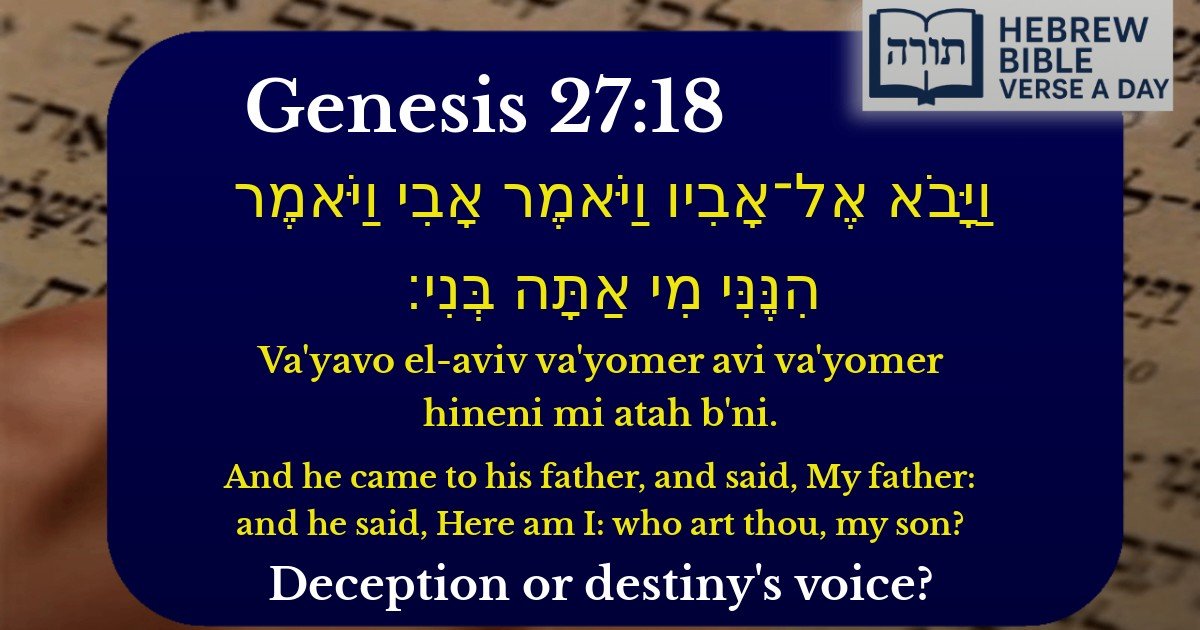
A: In Genesis 27:18, Jacob approaches his father Isaac while pretending to be his brother Esau in order to receive the blessing intended for the firstborn. Isaac, who is blind, asks, 'Who are you, my son?' This moment is part of the larger story where Jacob obtains the blessing through deception, as explained by Rashi and other commentators.
Q: Why did Isaac ask 'Who are you, my son?' in Genesis 27:18?
A: Isaac asked 'Who are you, my son?' because he was blind (Genesis 27:1) and could not see Jacob. Additionally, according to Rashi, Isaac suspected something was unusual because Jacob’s voice sounded like Jacob’s, but the person claimed to be Esau. This created confusion, leading to Isaac’s question.
Q: What lesson can we learn from Genesis 27:18?
A: From Genesis 27:18, we learn the importance of honesty and the consequences of deception. While Jacob ultimately received the blessings, the Midrash and Talmud discuss the hardships he later faced as a result of this act. The verse reminds us that even when things seem justified, misleading others can lead to complications.
Q: How does Genesis 27:18 relate to Jewish tradition?
A: Genesis 27:18 is part of the broader narrative about the transmission of blessings and covenantal promises in Jewish tradition. The Torah emphasizes the significance of blessings, as seen in Isaac’s role. Jewish commentators like Ramban discuss how this event shaped the future of the Jewish people, as Jacob’s descendants became the Twelve Tribes of Israel.
Q: Why is the dialogue in Genesis 27:18 important?
A: The dialogue in Genesis 27:18 is important because it marks a turning point in biblical history—the moment Jacob secures the birthright blessing. The exchange highlights themes of identity, parental blessings, and divine destiny, which are central to Jewish thought. The Talmud and Midrash explore the moral and theological implications of this event.


Context in the Torah
This verse (Bereshit 27:18) appears in the narrative of Yaakov (Jacob) receiving the blessings from his father Yitzchak (Isaac). The scene is pivotal, as Yitzchak intends to bless Esav (Esau), while Rivka (Rebecca) orchestrates Yaakov's reception of the blessings instead.
Rashi's Commentary
Rashi explains that Yaakov's initial address, "My father," was a respectful way to announce his presence. Yitzchak's response, "Here am I" (hineni), reflects his readiness to engage, despite his blindness. When Yitzchak asks, "Who art thou, my son?" Rashi notes that Yitzchak sensed something unusual—the voice sounded like Yaakov's, but the hands felt like Esav's (due to the goat skins Yaakov wore). This dissonance prompted his questioning.
Ibn Ezra's Insight
Ibn Ezra highlights the emotional tension in the exchange. Yitzchak, though physically weakened, remains spiritually attuned. His question arises not from mere confusion but from a deeper intuition that the situation was not as it seemed.
Midrashic Interpretation
The Midrash (Bereshit Rabbah 65:18) elaborates that Yaakov hesitated before speaking, fearing his father might curse him if discovered. Yitzchak's response, "Who art thou, my son?" carries a dual meaning: he was testing whether this was truly Esav, as the voice did not match the outward appearance.
Rambam's Perspective
Rambam (in his ethical writings) derives a lesson about truth and deception. While Yaakov's actions were justified under the circumstances (as the blessings rightfully belonged to him), the episode underscores the complexity of human interactions and divine providence—how Hashem's plan unfolds even through seemingly ambiguous means.
Key Lessons