Frequently Asked Questions
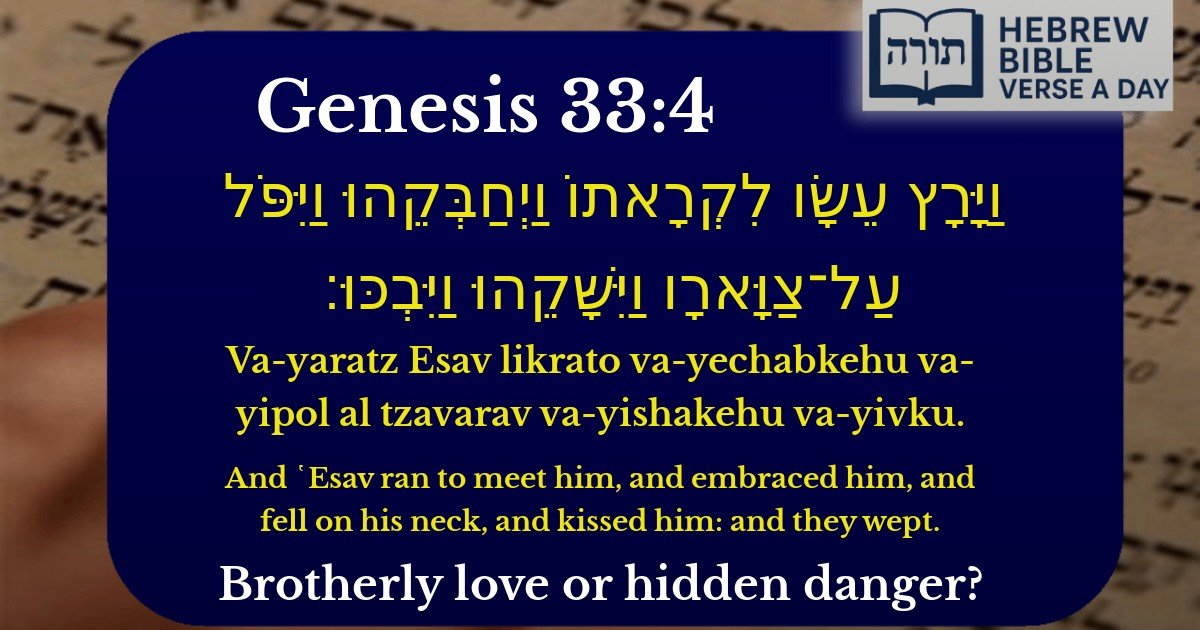
Q: What does the verse 'And Esav ran to meet him, and embraced him...' mean?
A: This verse describes the emotional reunion between Yaakov (Jacob) and his brother Esav after many years of separation. According to Rashi, the embrace and kiss show that Esav's anger had subsided, and he was genuinely happy to see Yaakov. The tears indicate that both brothers were moved by the moment, though some commentaries suggest Esav's kiss was not entirely sincere (see Rashi on Genesis 33:4).
Q: Why is the reunion between Yaakov and Esav important?
A: This reunion is significant because it marks the resolution of a long-standing conflict between the brothers. The Torah teaches us about the importance of reconciliation and making peace, even after deep disagreements. The Rambam (Hilchot De'ot 7:7) emphasizes the value of pursuing peace with others, as Yaakov did by preparing gifts and showing humility to Esav.
Q: What can we learn from Yaakov and Esav's reunion?
A: We learn several lessons: 1) The importance of preparing for reconciliation (Yaakov sent gifts ahead), 2) Showing humility can help mend relationships, and 3) Even difficult relationships can have moments of genuine connection. The Midrash (Bereishit Rabbah 78:8) notes that Yaakov's approach teaches us how to deal wisely with potential adversaries.
Q: Why does the Torah mention that they wept?
A: The Talmud (Sanhedrin 92a) explains that crying in this context shows deep emotion. Yaakov cried because he hadn't seen his brother in many years and was relieved the meeting went peacefully. Esav cried because he was moved by Yaakov's humility and generosity. The tears symbolize the complexity of their relationship - a mix of past conflict and present reconciliation.
Q: How does this verse apply to family relationships today?
A: This verse teaches us that even when family relationships are strained, reconciliation is possible with effort and sincerity. The Sages derive from this that one should always be willing to make peace (Pirkei Avot 1:12). Today, we learn to approach conflicts with preparation (like Yaakov's gifts), humility, and openness to emotional connection, while being wise about potential challenges.


Rashi's Interpretation of Esav's Kiss
Rashi (Bereshit 33:4) notes that the word וַיִּשָּׁקֵהוּ ("and he kissed him") appears with dots above it in the Torah scroll. This suggests a dual interpretation:
Ramban's Perspective on the Encounter
Ramban (Bereshit 33:4) argues that the plain meaning (peshat) supports the sincerity of Esav's actions, as the Torah states they both wept. He suggests that Esav's earlier anger (Bereshit 27:41) had subsided after 20 years, and seeing Yaakov's humility and gifts (Bereshit 33:3,8) softened his heart.
Midrashic Insights
Midrash Tanchuma (Vayishlach 8) offers a deeper dimension:
Or HaChaim's Mystical View
Or HaChaim (Bereshit 33:4) explains that this encounter reflects the eternal struggle between the spiritual (Yaakov) and physical (Esav) realms. The embrace represents their interconnected destinies, while the kiss symbolizes moments when the physical world appears to embrace holiness - though this harmony is often temporary.
Talmudic Connection
The Talmud (Sanhedrin 12a) links this verse to the concept of eisav soneh l'yaakov ("Esav hates Yaakov"), teaching that while there may be temporary reconciliations, the fundamental tension between these forces persists throughout history.