
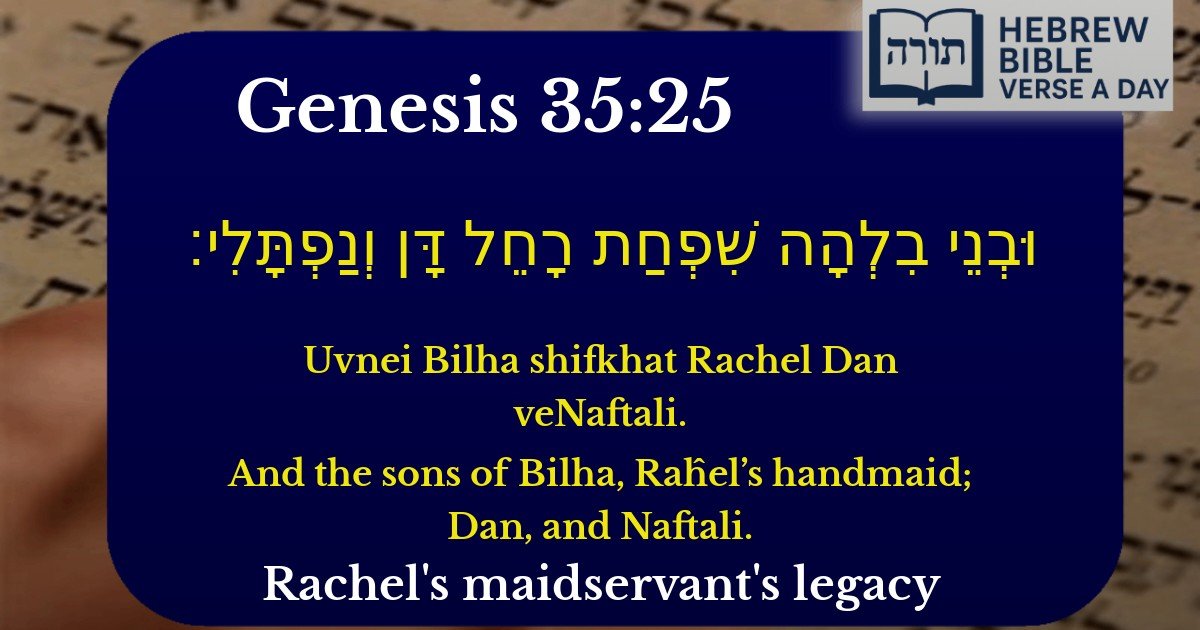

Genesis 35:25 - Rachel's maidservant's legacy

Genesis 35:25 - בראשית 35:25

Hebrew Text

וּבְנֵי בִלְהָה שִׁפְחַת רָחֵל דָּן וְנַפְתָּלִי׃

English Translation

And the sons of Bilha, Raĥel’s handmaid; Dan, and Naftali.

Transliteration

Uvnei Bilha shifkhat Rachel Dan veNaftali.

Hebrew Leining Text

וּבְנֵ֤י בִלְהָה֙ שִׁפְחַ֣ת רָחֵ֔ל דָּ֖ן וְנַפְתָּלִֽי׃

🎵 Listen to leining

Parasha Commentary

The Sons of Bilhah: Dan and Naftali

The verse states: "וּבְנֵי בִלְהָה שִׁפְחַת רָחֵל דָּן וְנַפְתָּלִי" ("And the sons of Bilhah, Rachel’s handmaid: Dan and Naftali"). This verse appears in Bereishit 35:25, listing the sons of Yaakov born to Bilhah, Rachel’s maidservant. Below are key insights from traditional Orthodox Jewish commentators:

Rashi’s Explanation

Rashi notes that Bilhah is referred to as "שִׁפְחַת רָחֵל" ("Rachel’s handmaid") to emphasize that these sons were considered Rachel’s children in a spiritual sense. Since Rachel gave Bilhah to Yaakov as a wife (Bereishit 30:3-4), the children born to Bilhah were legally attributed to Rachel, fulfilling her desire for offspring (Rashi on Bereishit 30:3).

Midrashic Insights

The Midrash (Bereishit Rabbah 71:4) highlights the unique qualities of Dan and Naftali:

  • Dan: His name means "judgment" (from דין), reflecting his role as a judge. The Midrash connects him to Shimshon (Samson), a descendant of Dan, who delivered justice to Israel (Sotah 10a).
  • Naftali: His name means "wrestling" (from נפתול), symbolizing his swiftness (Bereishit 30:8). The Midrash associates him with speed and agility, later reflected in the tribe’s role in battle (Chullin 91b).

Rambam’s Perspective

While Rambam does not comment directly on this verse, his principles in Hilchos Ishus (Laws of Marriage) clarify the status of children born to a maidservant given as a wife. Such children are legitimate heirs, reinforcing that Dan and Naftali held equal standing among Yaakov’s sons.

Symbolic Significance

The placement of Dan and Naftali among the tribes carries deeper meaning:

  • Dan’s tribe camped north of the Mishkan (Bamidbar 2:25), representing strength in adversity.
  • Naftali’s tribe was blessed with fertile land (Devarim 33:23), embodying abundance and divine favor.

Thus, this verse not only lists Yaakov’s sons but also foreshadows the unique destinies of their tribes in Klal Yisrael.

📚 Talmud Citations

This verse is quoted in the Talmud.

📖 Berakhot 16b
The verse is referenced in a discussion about the tribes of Israel and their blessings.
📖 Megillah 14a
Mentioned in the context of the lineage of the tribes and their roles.

Frequently Asked Questions

Q: Who were Dan and Naftali in the Torah?
A: Dan and Naftali were two of the twelve sons of Yaakov (Jacob). They were born to Bilha, who was Rachel's maidservant (Genesis 35:25). These two sons became the founders of two of the Twelve Tribes of Israel.
Q: Why does the Torah mention that Bilha was Rachel's maidservant?
A: The Torah emphasizes this relationship because Rachel originally gave Bilha to Yaakov as a wife when she was unable to conceive (Genesis 30:3-6). According to Rashi, this shows that the children born to Bilha were considered Rachel's in a spiritual sense, as was the custom with maidservants in those times.
Q: What is the significance of Dan and Naftali being born to a maidservant?
A: The Talmud (Berachos 16a) teaches that all of Yaakov's sons - whether born to wives or maidservants - were equally righteous and became the heads of the Twelve Tribes. Their lineage shows that greatness in Judaism isn't determined by birth circumstances, but by one's deeds and connection to Hashem.
Q: How were the tribes of Dan and Naftali different from each other?
A: Midrashim describe distinct characteristics for each tribe. Dan was known for justice (his name relates to 'din' - judgment) and produced the judge Samson. Naftali was associated with swiftness (his name relates to 'niftar' - to run) and his tribe was known for producing olive oil for the Temple (Rashi on Deuteronomy 33:23).
Q: Why does the Torah list Rachel's children before Leah's?
A: Rashi explains (on Genesis 35:23) that although Leah had children first, Rachel is given precedence because she was Yaakov's primary intended wife. This teaches the importance of original intentions in Jewish thought. The order also reflects that Rachel's son Yosef (and later Binyamin) would play central roles in Jewish history.