Frequently Asked Questions
Q: Who was Esav (Esau) and why is he called Edom?
A: Esav was the twin brother of Yaakov (Jacob) and the son of Yitzchak (Isaac). He is called Edom because of the red lentil stew ('adom' means red in Hebrew) he sold his birthright for (Genesis 25:30). The name also refers to his descendants, the Edomites, who lived in Mount Se'ir.
Q: Why did Esav settle in Mount Se'ir?
A: According to Rashi (Genesis 36:6), Esav moved to Mount Se'ir because the land of Canaan could not support both his and Yaakov's large flocks and possessions. This fulfilled the prophecy given to Rivka (Rebecca) that 'two nations are in your womb' (Genesis 25:23), leading to their separation.
Q: What is the significance of Mount Se'ir in the Torah?
A: Mount Se'ir became the homeland of Esav's descendants, the Edomites. The Torah later commands the Israelites not to hate the Edomites because they are their brothers (Devarim 23:8). This region plays a role in future biblical events, including Israel's travels during the Exodus.
Q: How does the Torah's mention of Esav settling in Mount Se'ir relate to Jewish history?
A: This verse marks the beginning of the Edomite nation, who would have a complex relationship with Israel throughout history. The separation of Yaakov and Esav's descendants shows how Hashem's plan unfolded, with Yaakov's line becoming the Israelites while Esav's line developed separately in Edom.
Q: What lesson can we learn from Esav settling in Mount Se'ir?
A: The Midrash teaches that Esav's move to Mount Se'ir shows how each person has their destined place in the world. While Yaakov was meant to continue the covenant in Canaan, Esav had his own role to play elsewhere. This teaches us about divine providence and how different nations have their appointed roles.

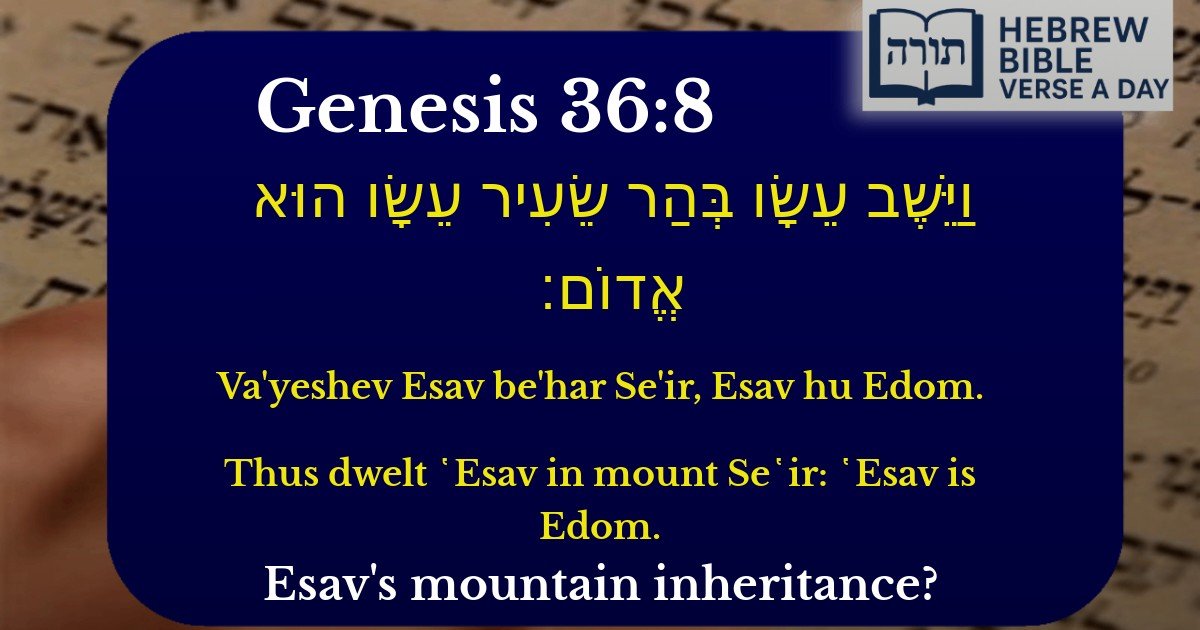

The Identification of Esav with Edom
The verse states, "Thus dwelt Esav in mount Se'ir: Esav is Edom" (Genesis 36:8). This identification of Esav with Edom is significant in Jewish tradition. Rashi explains that the name Edom derives from Esav's fondness for red (adom), as seen earlier when he sold his birthright for red lentil stew (Genesis 25:30). The Torah emphasizes this connection to highlight the enduring legacy of Esav's descendants, the Edomites, who became a persistent adversary of Israel.
Esav's Settlement in Mount Se'ir
The verse notes that Esav settled in Mount Se'ir, a region later associated with Edom. The Midrash (Bereishit Rabbah 82:13) comments that Esav's choice to dwell there was providential, ensuring that he would not remain in the Land of Canaan, which was designated for Yaakov and his descendants. Ramban (Nachmanides) adds that this separation fulfilled the divine prophecy that two nations would emerge from Rivkah's womb (Genesis 25:23), with Esav's lineage establishing its own territory outside the covenantal land.
Esav as a Symbol of Worldly Power
Traditional Jewish commentators often view Esav as representing materialism and temporal power. The Talmud (Avodah Zarah 11a) associates Edom with Rome and later oppressive empires, symbolizing forces that oppose the spiritual mission of Israel. The Sforno explains that Esav's settlement in Se'ir reflects his preference for worldly conquests, in contrast to Yaakov's devotion to spiritual inheritance.
Theological Implications