Frequently Asked Questions
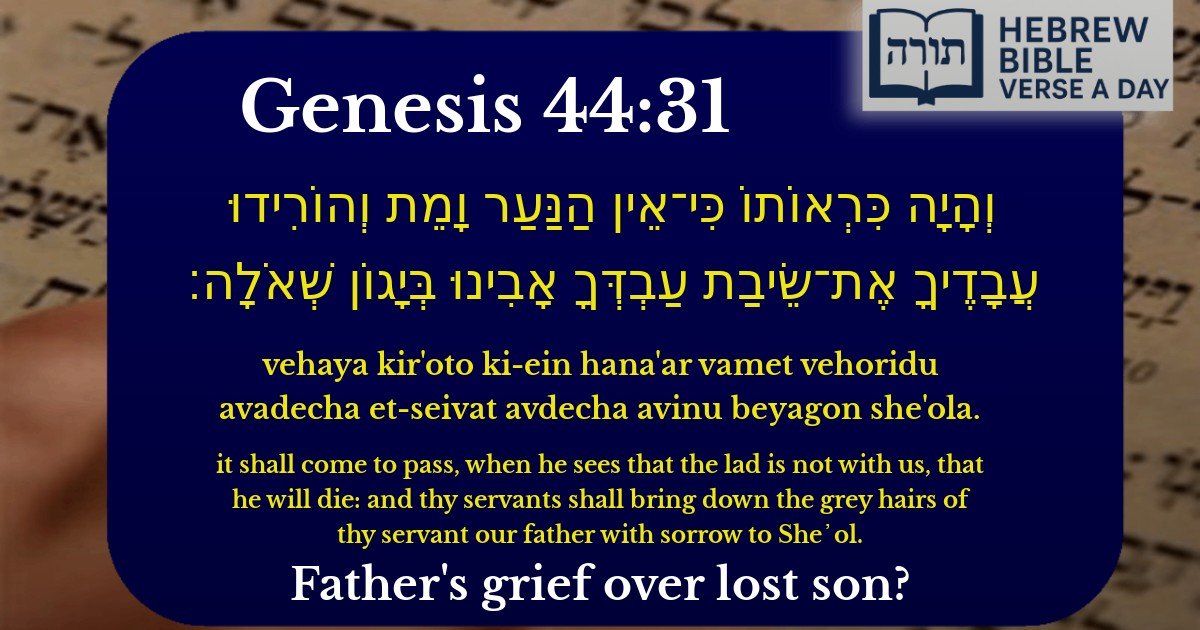
Q: What does Genesis 44:31 mean?
A: In Genesis 44:31, Judah is pleading with Joseph (whom he doesn't yet recognize) not to keep Benjamin as a slave. Judah explains that if their father Jacob sees Benjamin is missing, the shock and grief would kill him. The verse emphasizes Judah's deep concern for his father's wellbeing and the potential tragic consequences of Benjamin's absence.
Q: Why is Judah so worried about Jacob's reaction in this verse?
A: Judah is worried because Jacob already suffered terribly when Joseph (Benjamin's full brother) was lost. As Rashi explains, Jacob's soul was bound up with Benjamin's (Genesis 44:30), meaning he had a special emotional attachment. The Talmud (Shabbat 30b) teaches that excessive grief can indeed shorten one's life, so Judah's concern was valid according to Jewish tradition.
Q: What does 'bring down the grey hairs... with sorrow to Sheol' mean?
A: This poetic phrase means that the grief would cause Jacob's death. 'Grey hairs' symbolizes old age and wisdom, while 'Sheol' refers to the grave or afterlife. The Ramban explains that Judah is describing how their father would die from heartbreak, descending prematurely to the grave burdened by sorrow rather than passing naturally in old age.
Q: How does this verse show Judah's character development?
A: This verse demonstrates Judah's complete transformation from the brother who suggested selling Joseph (Genesis 37:26-27) to one who takes full responsibility for Benjamin. As the Midrash (Bereshit Rabbah 93:7) notes, Judah's willingness to sacrifice himself for Benjamin and his concern for his father's feelings marks his growth into a true leader of the tribes.
Q: What lesson can we learn from Judah's words in this verse?
A: We learn the importance of considering how our actions affect others, especially our parents. The Talmud (Kiddushin 31b) teaches honoring one's parents is a fundamental mitzvah. Judah's concern models how we should anticipate and prevent causing emotional pain to our parents. Additionally, it teaches the value of taking responsibility for protecting family members.


Context in the Torah
This verse (Bereshit 44:31) is part of Yehuda's impassioned plea to Yosef (still unrecognized as their brother) to release Binyamin, expressing concern for their father Yaakov's wellbeing if Binyamin does not return. The verse reflects Yehuda's deep sense of responsibility and fear of causing their father unbearable grief.
Rashi's Commentary
Rashi explains that Yehuda emphasizes the potential death of Yaakov not merely as a possibility, but as a certainty ("vamet" - "and he will die"). This strong language demonstrates how Yaakov's life was bound up with Binyamin's, as Binyamin was the remaining child of Rachel, Yaakov's most beloved wife. Rashi notes that Yaakov had already endured the loss of Yosef, and losing Binyamin would be catastrophic.
Ibn Ezra's Insight
Ibn Ezra focuses on the phrase "veyoredu avadecha" ("your servants shall bring down"), noting the gravity of being responsible for causing a parent's death through grief. He connects this to the severity of the mitzvah of honoring one's parents, implying that allowing such grief would be a profound violation of this commandment.
Midrashic Interpretation
The Midrash (Bereshit Rabbah 93:7) elaborates that Yehuda's words contained prophetic undertones. While speaking about Yaakov, he unknowingly alluded to the future when the ten tribes (represented by the brothers) would cause grief to Hashem (the "Father" of Israel) through their actions. The "grey hairs" symbolize the honor due to both earthly fathers and the Heavenly Father.
Halachic Implications
Chassidic Perspective
The Sefat Emet explains that the "grey hairs" represent wisdom and connection to the divine. Causing them to descend to Sheol (the grave) in sorrow means severing that spiritual connection. Yehuda's plea teaches that our actions must preserve and honor the spiritual legacy of our ancestors.