Frequently Asked Questions
Q: What does Genesis 47:19 mean in the context of the story?
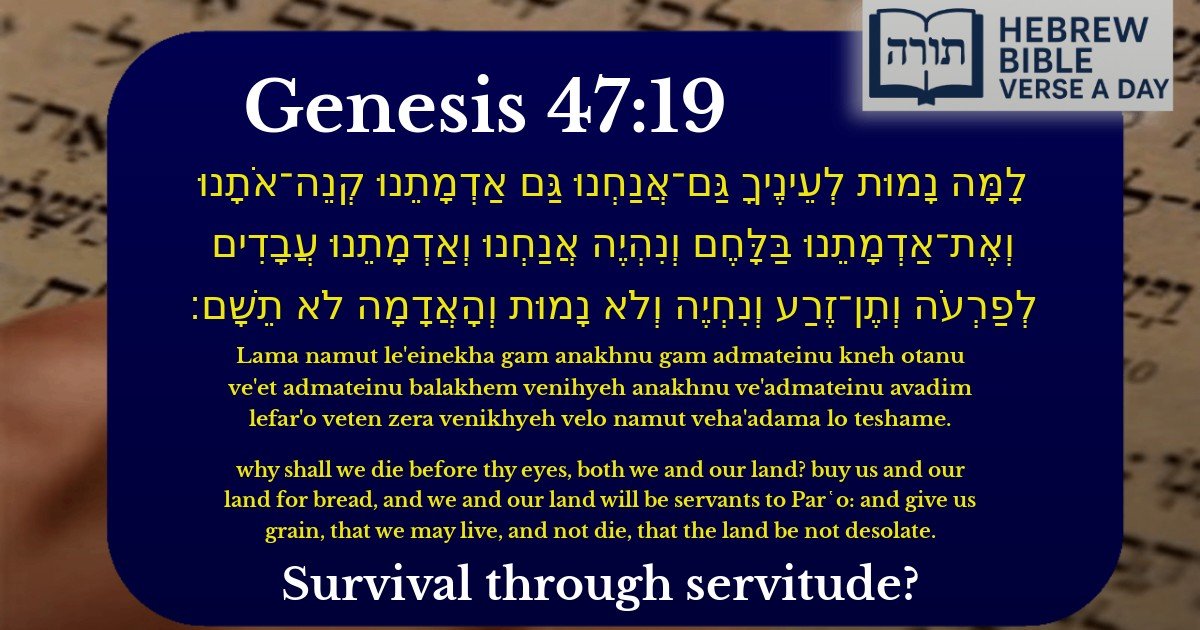
A: In Genesis 47:19, the people of Egypt are speaking to Yosef (Joseph) during a severe famine. They offer themselves and their land as servants to Pharaoh in exchange for food, as they are desperate to survive. According to Rashi, this shows their extreme distress and willingness to give up their freedom to avoid starvation. The verse highlights Yosef's wisdom in managing the crisis under Pharaoh's authority.
Q: Why did the people of Egypt offer themselves as servants to Pharaoh?
A: The people of Egypt were facing a devastating famine and had no other means to survive. As explained in the Talmud (Bava Metzia 39a), they saw no alternative but to surrender their land and freedom in exchange for food. This was a last resort to prevent death and the desolation of their land, showing the severity of the famine during Yosef’s time.
Q: What lesson can we learn from Genesis 47:19?
A: This verse teaches the importance of gratitude and recognizing Divine providence in difficult times. The Midrash (Bereishit Rabbah 90:5) explains that the famine was part of Hashem’s plan to bring Yaakov’s family to Egypt. It also reminds us of the value of resourcefulness and leadership, as Yosef’s wise governance saved lives during the crisis.
Q: How does Genesis 47:19 relate to Jewish teachings on slavery and servitude?
A: Jewish law (Halacha) distinguishes between voluntary servitude, like in this verse, and forced slavery. The Rambam (Hilchos Avadim 1:1) explains that the Torah permits a person to sell themselves into servitude under extreme circumstances, but with protections. Here, the Egyptians chose servitude to survive, but Jewish law ensures ethical treatment even in such cases.
Q: Why is the phrase 'that the land be not desolate' important in this verse?
A: The people were concerned not only for their own survival but also for the future of the land. Rashi notes that they feared the land would become barren if they died, leaving no one to cultivate it. This reflects a broader Jewish value of stewardship—caring for the land and ensuring its productivity for future generations, as emphasized in agricultural laws (e.g., Shemittah).


Context of the Verse
This verse (Genesis 47:19) is part of the narrative where the Egyptians, suffering from the severe famine during Yosef's (Joseph's) governance, plead with him to sell them and their land to Pharaoh in exchange for food. The desperation of the people is evident as they seek survival at any cost.
Rashi's Commentary
Rashi explains that the Egyptians were saying, "Why should we die before your eyes?"—meaning, why should we perish while you, Yosef, have the power to save us? They further emphasize their willingness to become slaves to Pharaoh in exchange for sustenance, demonstrating their complete surrender to Yosef's authority as Pharaoh's representative.
Rambam's Perspective
Rambam (Hilchot Matnot Aniyim 10:7) discusses the ethical dimensions of this situation. While Yosef acted within his role to sustain the people, Rambam highlights the importance of ensuring that those in dire straits are not exploited. The Egyptians' plea reflects their recognition of Yosef's just governance, as they trusted him to provide a fair solution.
Midrashic Interpretation
The Midrash (Bereishit Rabbah 90:5) elaborates on the Egyptians' statement, "that the land be not desolate." It suggests that their concern was not only for their own survival but also for the preservation of the land's productivity. This reflects a broader principle in Jewish thought about the stewardship of the earth and the responsibility to prevent its desolation.
Halachic Implications
Symbolic Meaning
The Malbim interprets this plea as a metaphor for human dependence on Hashem. Just as the Egyptians turned to Yosef in their desperation, we are reminded to turn to Hashem in times of need, acknowledging our reliance on Divine providence for sustenance and survival.