Frequently Asked Questions
Q: What does Genesis 47:26 mean?
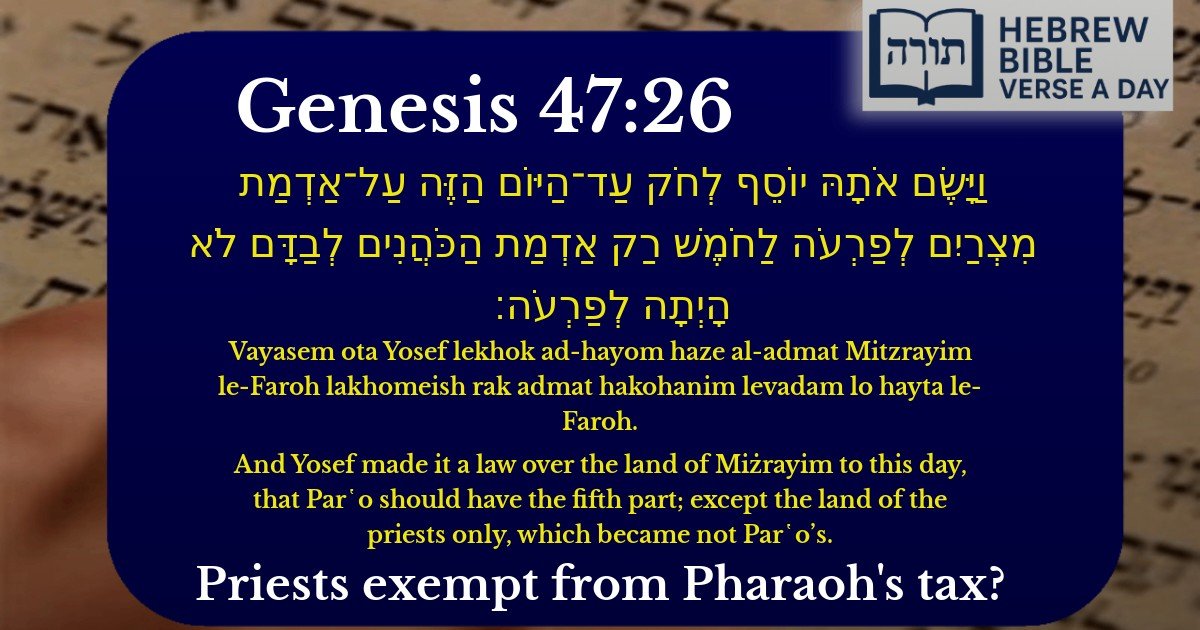
A: This verse explains that Yosef (Joseph) established a permanent tax law in Egypt where Pharaoh would receive one-fifth (20%) of the produce from the land. The only exception was the land belonging to the Egyptian priests, which remained exempt from this tax.
Q: Why did Yosef institute a 20% tax in Egypt?
A: According to Rashi and other commentaries, Yosef implemented this tax as a fair and sustainable solution after the years of famine. During the famine, Yosef had collected all the money, livestock, and land for Pharaoh in exchange for food. Afterward, he allowed the people to work the land and keep 80% of their produce while giving 20% to Pharaoh—a balanced arrangement that ensured stability.
Q: Why were the priests' lands exempt from Pharaoh's tax?
A: The Torah states that the priests' land did not become Pharaoh's property. Traditional Jewish sources (like Ramban) explain that Egyptian priests held a privileged status and were supported by Pharaoh, so their lands remained under their control. This detail highlights the cultural norms of ancient Egypt, where priestly classes often had special exemptions.
Q: What lesson can we learn from Yosef's tax policy?
A: Yosef's approach teaches fairness and wisdom in leadership. Instead of exploiting the people, he created a system where they could sustain themselves while contributing to the government. The Talmud (Avot 5:21) praises wise governance, and Yosef's policy reflects this principle—balancing the needs of the ruler and the people with justice.
Q: Does this verse have any relevance today?
A: Yes, this verse reminds us of the importance of just economic policies. Jewish tradition emphasizes fair taxation and caring for the needy (as seen in laws of tithing and tzedakah). Yosef's model shows that a stable society requires both responsibility from the people and fairness from the government.


Context of the Verse
This verse (Bereshit 47:26) describes the economic policy Yosef implemented in Mitzrayim during the years of famine. After acquiring all the land for Pharaoh in exchange for food, Yosef established a permanent tax of one-fifth (חומש) of the produce for Pharaoh, except for the land belonging to the priests (אדמת הכהנים), which remained exempt.
Yosef's Decree as a Permanent Law
Rashi explains that the phrase "עד היום הזה" ("to this day") indicates that this tax remained in effect even at the time the Torah was written, demonstrating the enduring nature of Yosef's decree. Ramban adds that this shows Yosef's wisdom in creating a sustainable system that benefited both the monarchy and the people, preventing future crises.
The Fifth (חומש) Tax
The חומש (one-fifth) tax is significant in Jewish law beyond this context. The Midrash (Bereshit Rabbah 91:5) connects this to the concept of giving a fifth in other areas, such as:
- Ma'aser (tithing) where one separates a tenth, but when accounting for terumah and ma'aser combined, it approximates a fifth.
- The requirement to add a fifth when redeeming consecrated property (Vayikra 27:27).
This demonstrates a thematic link between Yosef's economic policy and broader halachic principles.Exemption of the Priests' Land
The Torah emphasizes that the priests' land did not become Pharaoh's. Rashi explains that this was because the priests received a fixed portion from Pharaoh and thus did not need to sell their land. The Ramban suggests this shows respect for the priestly class and their spiritual role, even in a foreign land. The Kli Yakar adds that this exemption parallels the later Israelite system where the Levites and Kohanim did not receive agricultural land, being sustained by tithes instead.
Halachic and Historical Implications
The Sforno notes that this system established by Yosef created a balanced society where:
- The monarchy had stable income without oppressing the people.
- The people retained 80% of their produce, ensuring their livelihood.
- The priestly class maintained independence to focus on spiritual matters.
This became a model of just governance that influenced later Jewish thought on societal structure.