

Genesis 50:13 - Honoring fathers in sacred land

Genesis 50:13 - בראשית 50:13

Hebrew Text

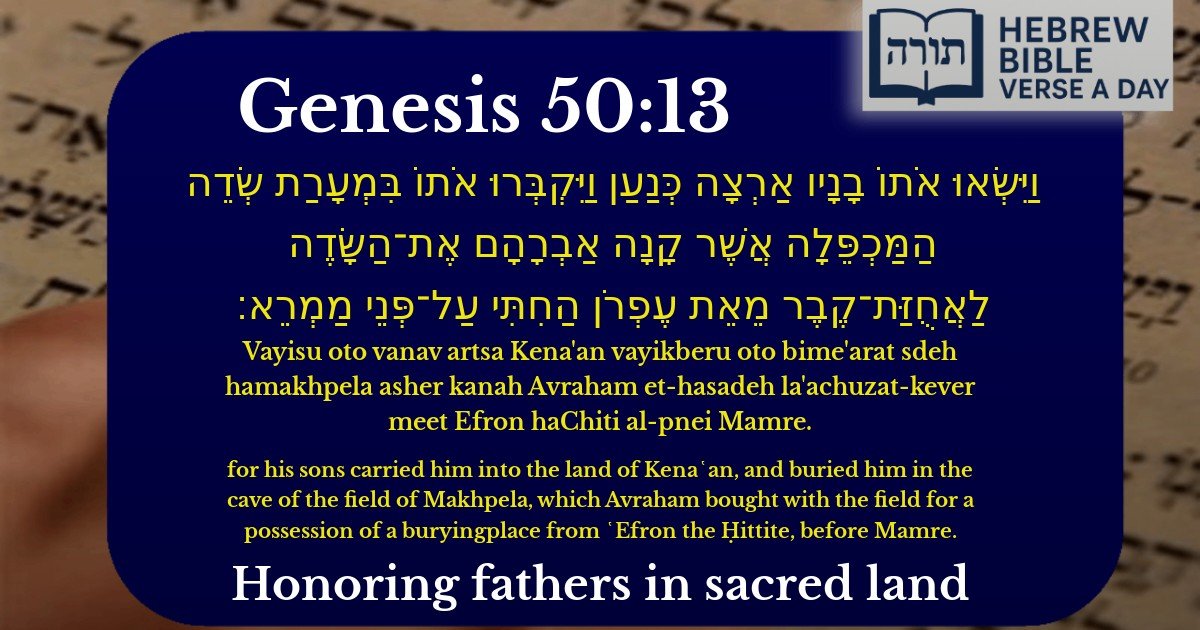
וַיִּשְׂאוּ אֹתוֹ בָנָיו אַרְצָה כְּנַעַן וַיִּקְבְּרוּ אֹתוֹ בִּמְעָרַת שְׂדֵה הַמַּכְפֵּלָה אֲשֶׁר קָנָה אַבְרָהָם אֶת־הַשָּׂדֶה לַאֲחֻזַּת־קֶבֶר מֵאֵת עֶפְרֹן הַחִתִּי עַל־פְּנֵי מַמְרֵא׃

English Translation

for his sons carried him into the land of Kena῾an, and buried him in the cave of the field of Makhpela, which Avraham bought with the field for a possession of a buryingplace from ῾Efron the Ḥittite, before Mamre.

Transliteration

Vayisu oto vanav artsa Kena'an vayikberu oto bime'arat sdeh hamakhpela asher kanah Avraham et-hasadeh la'achuzat-kever meet Efron haChiti al-pnei Mamre.

Hebrew Leining Text

וַיִּשְׂא֨וּ אֹת֤וֹ בָנָיו֙ אַ֣רְצָה כְּנַ֔עַן וַיִּקְבְּר֣וּ אֹת֔וֹ בִּמְעָרַ֖ת שְׂדֵ֣ה הַמַּכְפֵּלָ֑ה אֲשֶׁ֣ר קָנָה֩ אַבְרָהָ֨ם אֶת־הַשָּׂדֶ֜ה לַאֲחֻזַּת־קֶ֗בֶר מֵאֵ֛ת עֶפְרֹ֥ן הַחִתִּ֖י עַל־פְּנֵ֥י מַמְרֵֽא׃

🎵 Listen to leining

Parasha Commentary

Burial of Yaakov in the Cave of Machpelah

The verse describes how Yaakov's sons carried his body to the land of Canaan and buried him in the Cave of Machpelah, which Avraham had purchased as a burial site from Efron the Hittite. This act fulfills Yaakov's final request (Bereishit 47:29-30) to be buried with his forefathers, demonstrating the importance of honoring parental wishes and maintaining ancestral connections.

Significance of the Cave of Machpelah

Rashi (Bereishit 23:9) explains that the name "Machpelah" (מכפלה) implies a doubling, referring either to:

  • The cave's structure having two chambers (one atop the other)
  • Its containing couples (Adam and Chava, Avraham and Sarah, Yitzchak and Rivka, Yaakov and Leah)

The Midrash (Bereishit Rabbah 58:4) elaborates that this cave is the entrance to Gan Eden, making it especially sacred ground for burial.

Historical Context of the Purchase

The Torah emphasizes that this was the field Avraham purchased from Efron (Bereishit 23:16-20). Ramban notes this repetition serves to:

  • Establish clear Jewish ownership of the site
  • Demonstrate that burial in Eretz Yisrael is a fundamental value
  • Show that even temporary residence in Egypt didn't sever the connection to the ancestral homeland

Location "Before Mamre"

The mention of Mamre (ממרא) recalls Avraham's ally (Bereishit 14:13). The Kli Yakar suggests this reference:

  • Reminds us that Mamre advised Avraham regarding the mitzvah of brit milah
  • Connects the burial site to Avraham's spiritual achievements
  • Indicates the area's holiness as a place where Avraham served Hashem

Lessons from Yaakov's Burial

The Talmud (Sotah 13a) derives important principles from this event:

  • The importance of honoring burial requests (kibud av v'em even after death)
  • The special status of Eretz Yisrael as the proper resting place for tzaddikim
  • The unity of Yaakov's sons in fulfilling this mitzvah despite previous conflicts

📚 Talmud Citations

This verse is quoted in the Talmud.

📖 Sotah 13a
The verse is referenced in a discussion about the burial of Jacob, emphasizing the fulfillment of his request to be buried in the Cave of Machpelah.
📖 Bava Batra 100b
The verse is cited in the context of discussing the legal acquisition of the Cave of Machpelah by Abraham, highlighting the significance of the burial site.

Frequently Asked Questions

Q: Why was Yaakov (Jacob) buried in the Cave of Machpelah?
A: Yaakov was buried in the Cave of Machpelah because it was the family burial site purchased by his grandfather Avraham (Abraham) as a permanent burial place. This cave is where Avraham and Sarah, Yitzchak (Isaac) and Rivka (Rebecca), and later Leah were buried (Genesis 23, 25:9, 49:31). Burying Yaakov there fulfilled his final request (Genesis 49:29-32) and connected him to his ancestors.
Q: What is the significance of the Cave of Machpelah in Judaism?
A: The Cave of Machpelah is highly significant in Judaism as the burial place of our forefathers and foremothers: Avraham and Sarah, Yitzchak and Rivka, and Yaakov and Leah. According to Midrash (Pirkei DeRabbi Eliezer 36), it is also the entrance to the Garden of Eden. The purchase of this cave by Avraham (Genesis 23) established the first Jewish-owned land in Israel, making it spiritually and historically important.
Q: Why does the Torah mention that Avraham bought the field from Efron the Hittite?
A: The Torah emphasizes that Avraham legally purchased the field and cave from Efron to show that this holy site rightfully belongs to the Jewish people. As Rashi explains (on Genesis 23:17), Avraham insisted on paying full price rather than accepting it as a gift, ensuring undisputed ownership for future generations. This teaches the importance of honest business dealings, even when dealing with sacred matters.
Q: What lesson can we learn from Yaakov's sons carrying him to Israel for burial?
A: We learn the importance of honoring parents and keeping our promises. Despite the difficulty of traveling from Egypt to Canaan, Yaakov's sons faithfully fulfilled his burial request (Genesis 47:29-30). The Talmud (Kiddushin 31b) teaches that honoring parents continues even after their passing. This also teaches the significance of being buried in the Land of Israel, which our tradition considers especially holy.
Q: Where is the Cave of Machpelah located today?
A: The Cave of Machpelah is located in the city of Hebron (Chevron) in Israel. Today, a large structure built by King Herod stands over the cave, known as the Ma'arat HaMachpelah. It's a site of prayer and pilgrimage, especially on Shabbat Chayei Sarah when we read about Avraham purchasing the cave. The Zohar teaches that prayers at this site are especially potent due to the righteous souls buried there.