

Join Our Newsletter To Be Informed When New Videos Are Posted
Hebrew Text
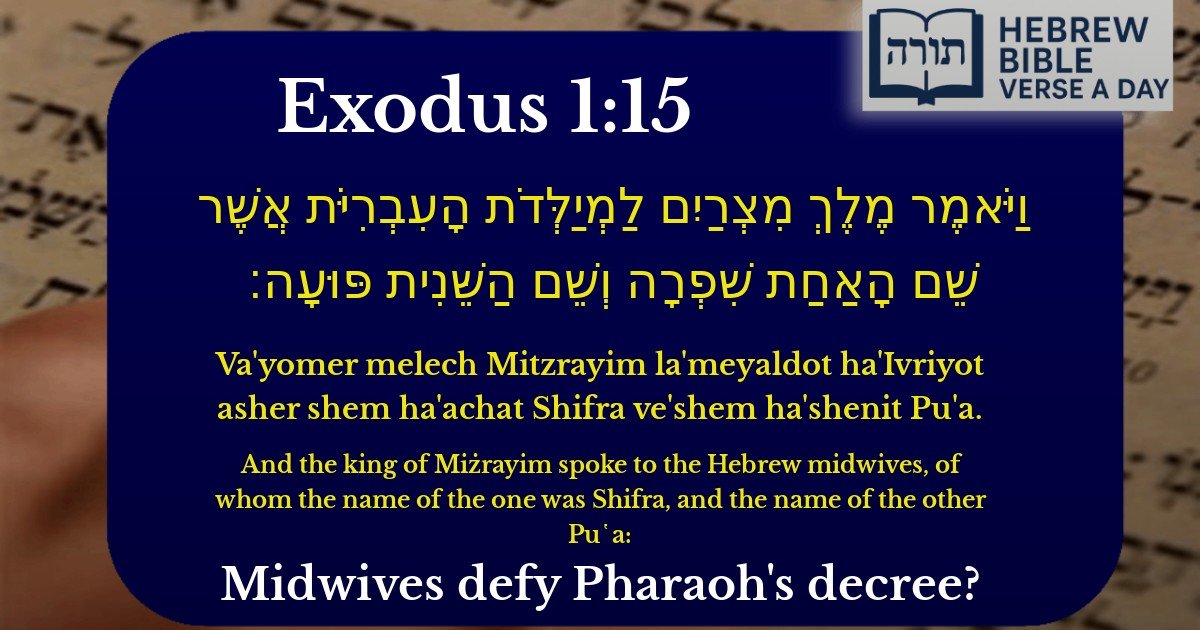
וַיֹּאמֶר מֶלֶךְ מִצְרַיִם לַמְיַלְּדֹת הָעִבְרִיֹּת אֲשֶׁר שֵׁם הָאַחַת שִׁפְרָה וְשֵׁם הַשֵּׁנִית פּוּעָה׃
English Translation
And the king of Miżrayim spoke to the Hebrew midwives, of whom the name of the one was Shifra, and the name of the other Pu῾a:
Transliteration
Va'yomer melech Mitzrayim la'meyaldot ha'Ivriyot asher shem ha'achat Shifra ve'shem ha'shenit Pu'a.
Hebrew Leining Text
וַיֹּ֙אמֶר֙ מֶ֣לֶךְ מִצְרַ֔יִם לַֽמְיַלְּדֹ֖ת הָֽעִבְרִיֹּ֑ת אֲשֶׁ֨ר שֵׁ֤ם הָֽאַחַת֙ שִׁפְרָ֔ה וְשֵׁ֥ם הַשֵּׁנִ֖ית פּוּעָֽה׃
🎵 Listen to leining
Parasha Commentary
📚 Talmud Citations
This verse is quoted in the Talmud.
📖 Sotah 11b
The verse is discussed in the context of the midwives' defiance of Pharaoh's decree, highlighting their righteousness and the divine reward they received.
The Midwives and Their Identities
The verse introduces two Hebrew midwives, Shifra and Pu'a, who were commanded by Pharaoh to kill newborn Israelite boys. Rashi (Shemot 1:15) explains that these midwives were none other than Yocheved (Moshe's mother) and Miriam (Moshe's sister). The name Shifra is derived from the root שפר, meaning "to beautify," because she would clean and care for the newborns. Pu'a comes from the root פעה, meaning "to coo" or "to soothe," as she would calm the infants with gentle sounds.
Pharaoh's Strategy
The Midrash (Shemot Rabbah 1:13) elaborates that Pharaoh first attempted to suppress the Israelites through forced labor, but when they continued to multiply, he resorted to targeting their children. By commanding the midwives, he sought to undermine the Israelite population growth covertly, avoiding open rebellion. The Talmud (Sotah 11b) notes that Pharaoh specifically chose Hebrew midwives, assuming they would comply out of fear, but they defied him due to their righteousness.
The Significance of Their Names
Moral Courage and Divine Reward
The Rambam (Hilchot Yesodei HaTorah 5:4) cites the midwives as exemplars of Kiddush Hashem (sanctifying G-d's name) by risking their lives to save Jewish children. As a reward, Hashem "made them houses" (Shemot 1:21)—interpreted by Chazal (Sotah 11b) to mean they merited dynasties of priesthood (from Yocheved) and kingship (from Miriam, ancestor of David).
Pharaoh's Misguided Approach
The Kli Yakar (Shemot 1:15) observes that Pharaoh's plan failed because he underestimated the midwives' loyalty to G-d and their people. By addressing them directly, he revealed his ignorance of their true identities (as Yocheved and Miriam) and their unwavering commitment to life, setting the stage for his eventual downfall.