Frequently Asked Questions
Q: Who is the 'maid' mentioned in Exodus 2:8?
A: The 'maid' (הָעַלְמָה, 'ha’almah') in Exodus 2:8 refers to Miriam, the sister of baby Moshe (Moses). According to Rashi and Midrashic sources (Shemot Rabbah 1:13), Miriam had been watching over her brother Moshe after he was placed in the Nile, and she bravely approached Pharaoh’s daughter to suggest finding a Hebrew wet-nurse for him.
Q: Why did Pharaoh’s daughter tell the maid to call the child’s mother?
A: Pharaoh’s daughter recognized that the baby was Hebrew and needed a Hebrew woman to nurse him. Miriam cleverly offered to find a suitable nurse, and Pharaoh’s daughter agreed. Unbeknownst to her, the woman Miriam brought was actually Moshe’s own mother, Yocheved (Rashi on Exodus 2:7). This was a hidden miracle, allowing Moshe to be raised by his biological mother during his early years.
Q: What lesson can we learn from this verse about Divine Providence?
A: This verse teaches us about Hashem’s hidden hand in guiding events (Hashgacha Pratit). Even in difficult times—like Pharaoh’s decree against Hebrew boys—Hashem orchestrated events so that Moshe would be saved, raised by his own mother, and eventually grow up in Pharaoh’s palace. The Midrash (Shemot Rabbah 1:24) highlights how every detail was arranged for the future redemption of the Jewish people.
Q: Why is Miriam’s role in this verse significant?
A: Miriam’s quick thinking and bravery set in motion Moshe’s salvation. The Talmud (Sotah 12b) praises her righteousness and explains that her actions demonstrated great faith in Hashem’s plan. Her role here foreshadows her later leadership alongside Moshe and Aharon during the Exodus, showing how even the young can play crucial roles in Jewish history.
Q: How does this verse connect to the theme of Jewish motherhood?
A: This verse highlights the dedication of Jewish mothers—both Yocheved, who risked everything to save her son, and Miriam, who acted with wisdom beyond her years. The Midrash (Shemot Rabbah 1:13) emphasizes how Jewish women played key roles in the redemption from Egypt by preserving Jewish identity and hope. Their actions serve as a model of courage and faith for all generations.

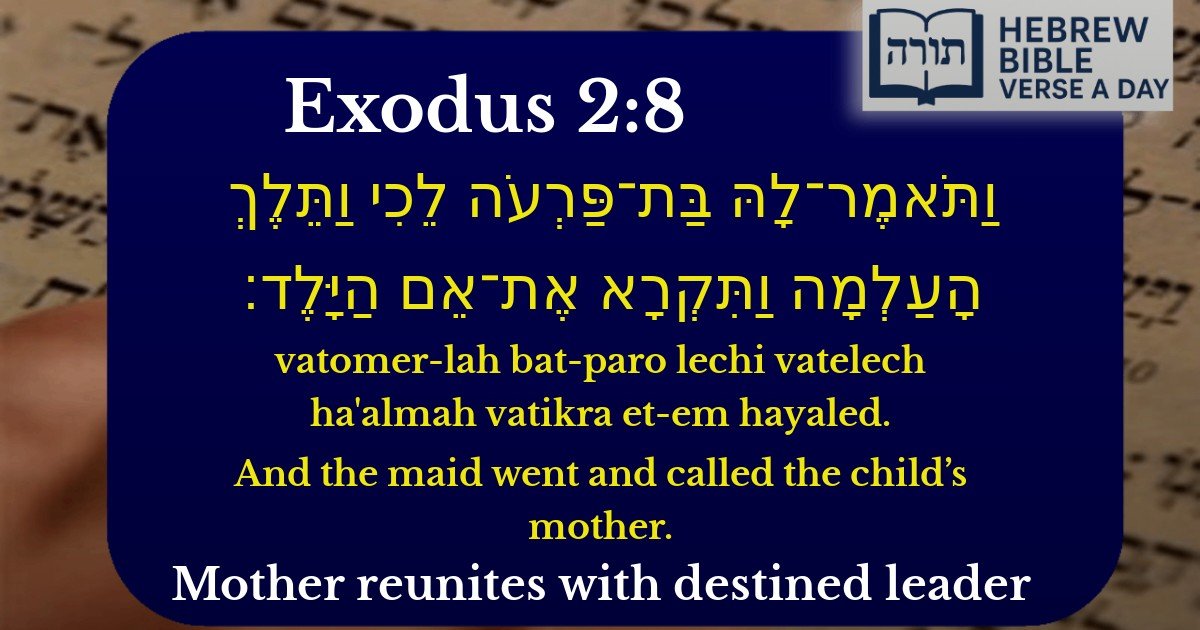

Context of the Verse
The verse (Shemot 2:8) describes the moment when Pharaoh's daughter instructs Miriam, who had been observing the baby Moshe in the Nile, to fetch the child's mother (Yocheved) to nurse him. This occurs after Pharaoh's daughter discovers the basket containing Moshe and recognizes him as a Hebrew child.
Rashi's Commentary
Rashi (Rabbi Shlomo Yitzchaki) explains that the term "הָעַלְמָה" (the maiden) refers to Miriam, who was young at the time. He notes that Miriam had been standing at a distance to see what would happen to her brother Moshe (as mentioned in the previous verse, Shemot 2:4). Rashi emphasizes that Miriam's quick action—going to call Yocheved—demonstrates her wisdom and readiness to assist in the fulfillment of Hashem's plan.
Midrashic Insights
The Midrash (Shemot Rabbah 1:23) elaborates on this episode, highlighting several key points:
Rambam's Perspective
While Rambam (Maimonides) does not comment directly on this verse, his principles of hashgacha pratit (Divine providence) can be applied here. The entire episode—from Moshe being placed in the Nile to his eventual return to his mother—demonstrates how Hashem orchestrates events to ensure the survival and destiny of the Jewish people.
Halachic Implications
The Talmud (Sotah 12b) discusses this verse in the context of the laws of yichud (seclusion). It notes that Pharaoh's daughter was accompanied by her maidservants when she went to bathe in the Nile, teaching the importance of avoiding situations that could lead to improper conduct.
Moral Lessons