Frequently Asked Questions
Q: Who was the 'priest of Midyan' mentioned in Exodus 2:16?
A: The 'priest of Midyan' refers to Yitro (Jethro), who later became Moshe's (Moses') father-in-law. According to Rashi and other commentaries, Yitro was a former advisor to Pharaoh who left Egypt due to his opposition to the oppression of the Israelites. The Torah calls him a 'priest' (kohen) because he served as a spiritual leader in Midyan, though not in the same way as the Kohanim of Israel.
Q: Why does the Torah mention that Yitro had seven daughters?
A: The mention of seven daughters highlights Yitro's righteousness, as the number seven often symbolizes completeness in Torah. The Midrash (Shemot Rabbah 1:32) explains that these daughters represented the seven nations who would later oppose Israel, hinting that even those nations could produce righteous individuals like Yitro and his family. Additionally, it emphasizes the contrast between their modest behavior (drawing water for their father's flock) and the immodesty often associated with idolatrous cultures.
Q: What lesson can we learn from the daughters of Yitro drawing water for their father's flock?
A: This teaches the importance of kindness (chesed) and diligence. Rashi notes that they drew water themselves rather than delegating the task, showing humility. The Talmud (Bava Metzia 87a) connects this to the idea that righteous people are careful with others' property (since they watered their father's flock properly). It also sets the stage for Moshe's encounter with them, where he defends them from shepherds, demonstrating that acts of kindness lead to divine providence.
Q: Why does the Torah specify that they filled the 'troughs' (רְהָטִים)?
A: The word 'רְהָטִים' (troughs) is interpreted by the Midrash (Shemot Rabbah 1:32) as hinting at the future. The same root letters (ר-ה-ט) can mean 'to run,' alluding to how these events would 'run' toward the redemption of Israel—through Moshe meeting Yitro's family. The Malbim adds that filling the troughs completely shows their thoroughness in doing mitzvot, a trait that attracted Moshe's attention.
Q: How does this verse connect to Moshe's later life?
A: This incident leads directly to Moshe meeting Yitro's daughters, marrying Tziporah (one of them), and living in Midyan—a period of preparation for his leadership. The Ramban explains that Moshe's kindness here mirrors his future role as Israel's compassionate leader. The Sforno adds that Yitro's household, where righteousness was valued, became a fitting place for Moshe to grow before returning to Egypt for the Exodus.


Context in the Torah
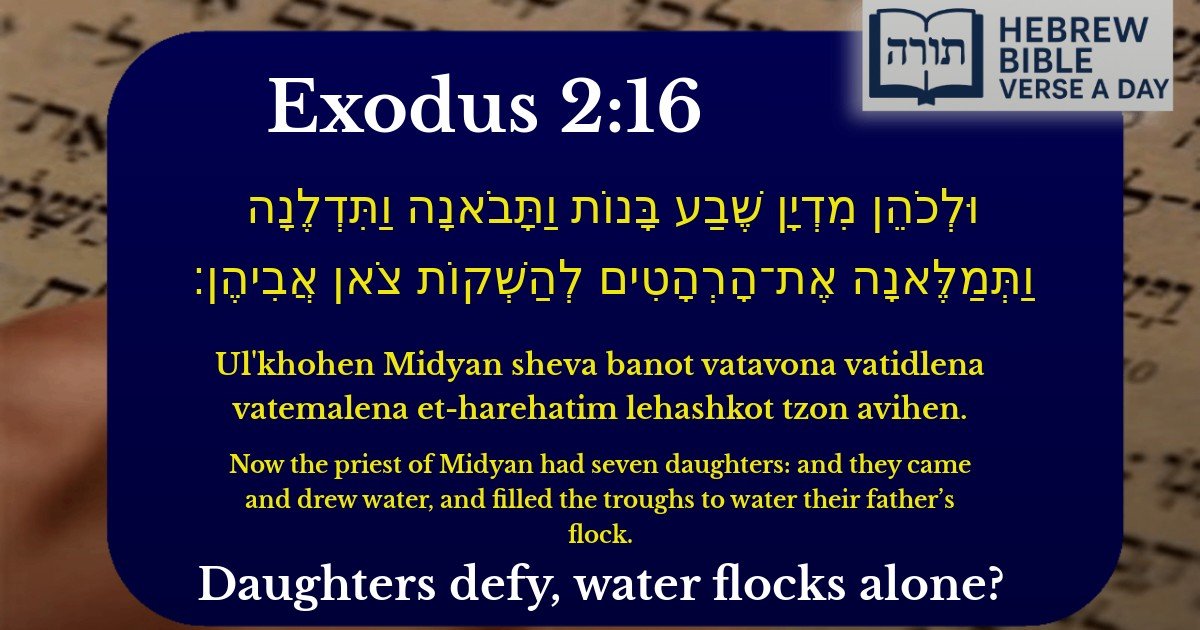
The verse (Shemot 2:16) describes the daughters of Yitro (Jethro), the priest of Midyan, who came to draw water for their father's flock. This occurs shortly before Moshe encounters them and assists them against the shepherds who drove them away. The narrative sets the stage for Moshe's eventual marriage to Tzipporah, one of Yitro's daughters.
Rashi's Commentary
Rashi explains that the phrase "וּלְכֹהֵן מִדְיָן" ("the priest of Midyan") refers to Yitro, who was previously an idolatrous priest but later abandoned his ways and converted to monotheism. The verse emphasizes his seven daughters, highlighting their righteousness and modesty, as they performed the labor of drawing water themselves rather than delegating it to servants.
Midrashic Insights
Symbolism of Seven Daughters
The Zohar associates the seven daughters with the seven sefirot (divine attributes) of Chesed (kindness) through Malchut (kingship), reflecting Yitro's spiritual stature. Their act of drawing water symbolizes drawing divine blessing into the world.
Halachic Perspective (Rambam)
Rambam (Hilchos Avodas Kochavim 1:3) references Yitro's past as a priest of idolatry to teach that even those deeply entrenched in avodah zarah can repent and embrace Torah. His daughters' righteousness further illustrates the transformative power of sincere teshuvah.