Frequently Asked Questions
Q: Who is the 'Egyptian man' mentioned in Exodus 2:19?
A: The 'Egyptian man' refers to Moses, who had fled Egypt after killing an Egyptian taskmaster (Exodus 2:11-15). Although Moses was a Hebrew, he was raised in Pharaoh's palace and likely appeared Egyptian in dress and manner. Rashi explains that the daughters of Yitro (Jethro) recognized him as an Egyptian based on his appearance.
Q: Why did Moses help Yitro's daughters water their flock?
A: Moses acted with kindness and righteousness, traits that made him suitable for leadership. The Midrash (Shemot Rabbah 1:32) highlights that Moses demonstrated his concern for justice by defending the weak (the daughters) against the shepherds who harassed them. This event foreshadowed his role as the future leader of Israel.
Q: What lesson can we learn from Moses' actions in Exodus 2:19?
A: This verse teaches the importance of helping others, even strangers, and standing up against injustice. The Rambam (Hilchot De'ot 1:6-7) emphasizes that we should emulate Moses' traits of kindness and courage. His willingness to assist Yitro's daughters, despite being a fugitive, shows selflessness and moral responsibility.
Q: Why does the verse mention that Moses 'drew water' for the flock?
A: Drawing water was a difficult task, and Moses went beyond merely rescuing the women—he helped them complete their work. Rashi notes that this act demonstrated his extraordinary strength (as drawing water for an entire flock was strenuous) and his humility in performing a servant's task. This further showed his suitability for leadership.
Q: How does this verse connect to Moses' later role as leader of Israel?
A: This incident reveals Moses' innate leadership qualities—compassion, bravery, and a sense of justice—which G-d later chose to redeem the Israelites. The Talmud (Sotah 13b) connects this event to his future mission, showing that leaders are tested through small acts of kindness before being entrusted with greater responsibilities.


Context in the Torah
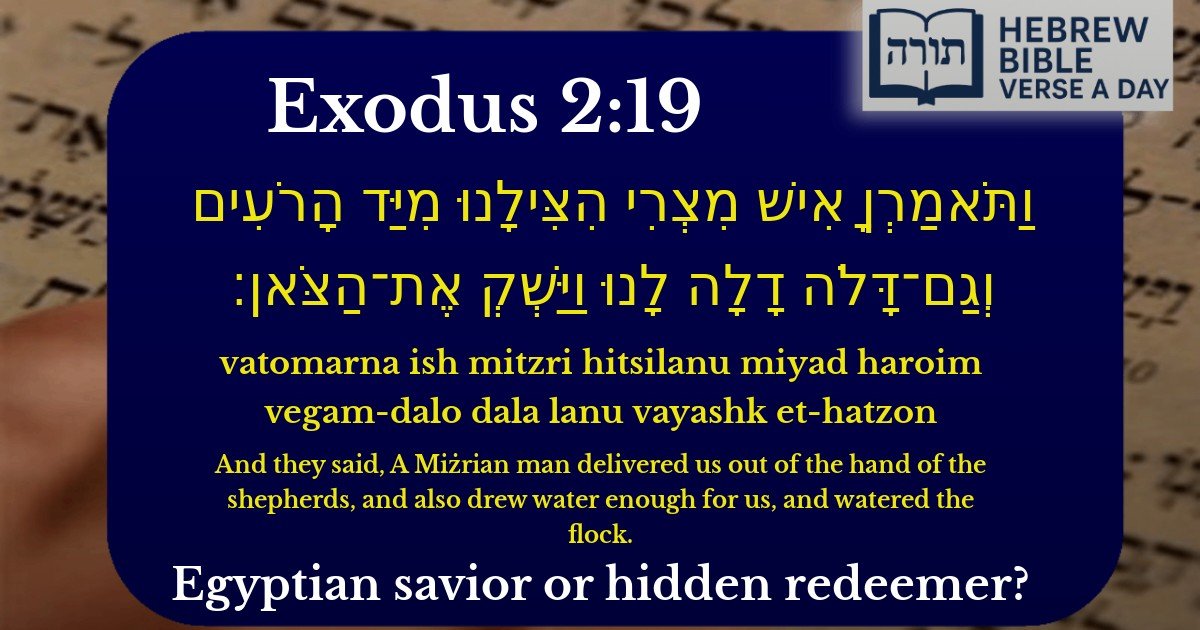
The verse (Shemot 2:19) recounts the words of Yitro's daughters after Moshe saved them from the shepherds who were harassing them at the well in Midyan. This event marks the beginning of Moshe's journey toward becoming the leader of Bnei Yisrael.
Rashi's Explanation
Rashi (on Shemot 2:19) explains that the daughters referred to Moshe as an "Egyptian man" (ish Mitzri) because he appeared Egyptian in dress and speech, having fled from Pharaoh's palace. Rashi also notes that Moshe drew water "enough for us" (dalo dala lanu)—emphasizing that he drew water not just for the daughters, but for their entire flock, demonstrating his extraordinary strength and kindness.
Midrashic Insights
The Midrash (Shemot Rabbah 1:32) elaborates that Moshe's act of drawing water was miraculous—the water rose on its own to meet him, a sign of his future role in performing miracles for Bnei Yisrael. Additionally, the Midrash highlights that the daughters' description of Moshe as an "Egyptian" was not derogatory but an observation of his outward appearance, unaware of his true Hebrew identity.
Rambam's Perspective
Rambam (Hilchos De'os 5:1) derives from this episode the importance of chessed (kindness) even toward strangers. Moshe, though a fugitive, intervened to help the daughters, embodying the principle that one should "love your neighbor as yourself" (Vayikra 19:18). This act of righteousness was a precursor to his leadership.
Lessons from the Verse