

Join Our Newsletter To Be Informed When New Videos Are Posted
Hebrew Text
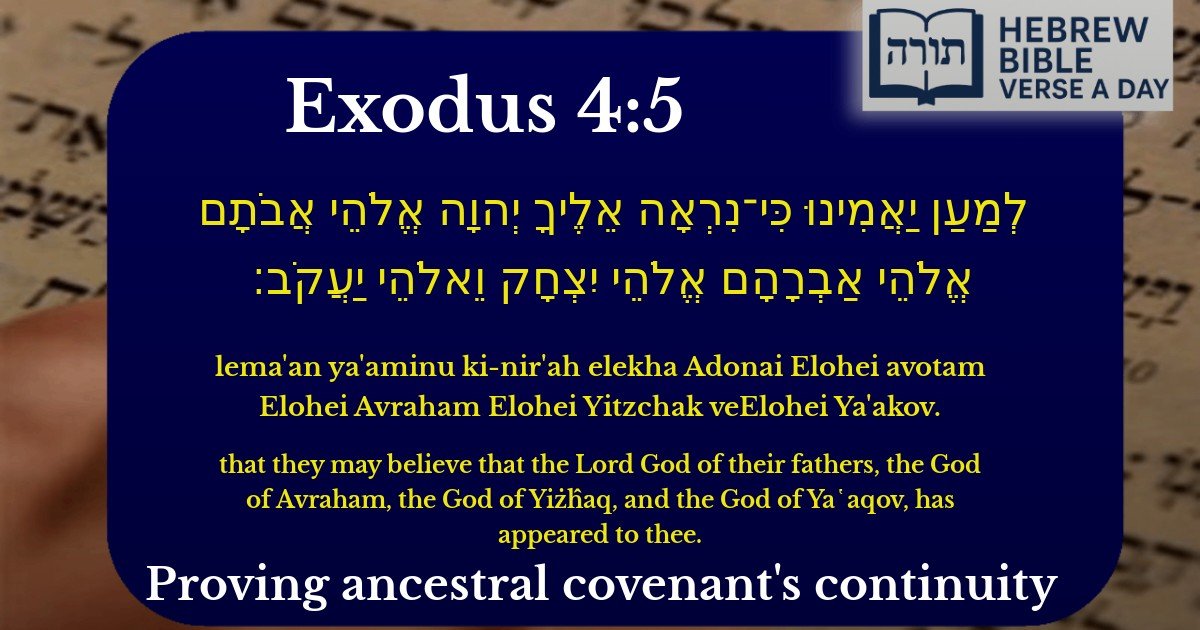
לְמַעַן יַאֲמִינוּ כִּי־נִרְאָה אֵלֶיךָ יְהוָה אֱלֹהֵי אֲבֹתָם אֱלֹהֵי אַבְרָהָם אֱלֹהֵי יִצְחָק וֵאלֹהֵי יַעֲקֹב׃
English Translation
that they may believe that the Lord God of their fathers, the God of Avraham, the God of Yiżĥaq, and the God of Ya῾aqov, has appeared to thee.
Transliteration
Lema'an ya'aminu ki-nir'ah elekha Adonai Elohei avotam Elohei Avraham Elohei Yitzchak veElohei Ya'akov.
Hebrew Leining Text
לְמַ֣עַן יַאֲמִ֔ינוּ כִּֽי־נִרְאָ֥ה אֵלֶ֛יךָ יְהֹוָ֖ה אֱלֹהֵ֣י אֲבֹתָ֑ם אֱלֹהֵ֧י אַבְרָהָ֛ם אֱלֹהֵ֥י יִצְחָ֖ק וֵאלֹהֵ֥י יַעֲקֹֽב׃
🎵 Listen to leining
Parasha Commentary
📚 Talmud Citations
This verse is quoted in the Talmud.
📖 Berakhot 7a
The verse is referenced in a discussion about the nature of divine revelation and the importance of faith in God's appearances to the patriarchs.
📖 Sanhedrin 111a
The verse is cited in a debate about the merits of the patriarchs and how their faith serves as a foundation for future generations.
Context of the Verse
This verse (Shemot 4:5) appears when Hashem commands Moshe to perform signs before Bnei Yisrael to validate his prophetic mission. The purpose of these signs is to instill belief that Hashem—the God of their forefathers—has truly appeared to Moshe.
Rashi's Explanation
Rashi emphasizes that the phrase "אֱלֹהֵי אֲבֹתָם" (God of their fathers) is specified to reassure Bnei Yisrael that the same God who made covenants with Avraham, Yitzchak, and Yaakov is now redeeming them. This continuity reinforces their faith in Moshe's divine mission.
Rambam on Prophetic Verification
In Moreh Nevuchim (2:40), Rambam explains that signs and miracles serve as temporary proofs to establish a prophet's credibility. Here, the mention of the Avot connects Moshe's mission to the eternal covenant, ensuring the people recognize this as part of Hashem's ongoing relationship with Klal Yisrael.
Midrashic Insight
The Midrash (Shemot Rabbah 3:4) highlights that Hashem did not say "God of your fathers" but "God of their fathers" to include all future generations. This teaches that emunah (faith) is not limited to Moshe's generation but extends to all Jews, who must affirm the same divine legacy.
Theological Significance
Practical Lesson
The Ohr HaChaim notes that belief rooted in miracles alone is incomplete; the verse ties faith to the legacy of the Avot. True emunah requires both witnessing Hashem's power and understanding His eternal covenant with our ancestors.