

Join Our Newsletter To Be Informed When New Videos Are Posted
Hebrew Text
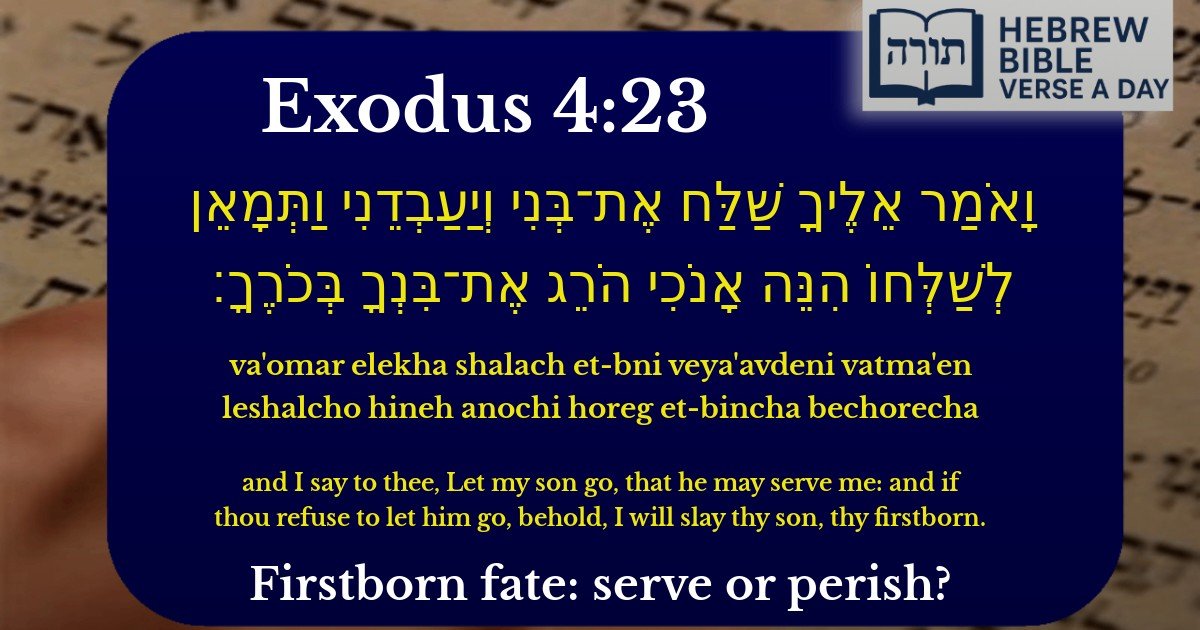
וָאֹמַר אֵלֶיךָ שַׁלַּח אֶת־בְּנִי וְיַעַבְדֵנִי וַתְּמָאֵן לְשַׁלְּחוֹ הִנֵּה אָנֹכִי הֹרֵג אֶת־בִּנְךָ בְּכֹרֶךָ׃
English Translation
and I say to thee, Let my son go, that he may serve me: and if thou refuse to let him go, behold, I will slay thy son, thy firstborn.
Transliteration
Va'omar elekha shalach et-bni veya'avdeni vatma'en leshalcho hineh anochi horeg et-bincha bechorecha
Hebrew Leining Text
וָאֹמַ֣ר אֵלֶ֗יךָ שַׁלַּ֤ח אֶת־בְּנִי֙ וְיַֽעַבְדֵ֔נִי וַתְּמָאֵ֖ן לְשַׁלְּח֑וֹ הִנֵּה֙ אָנֹכִ֣י הֹרֵ֔ג אֶת־בִּנְךָ֖ בְּכֹרֶֽךָ׃
🎵 Listen to leining
Parasha Commentary
📚 Talmud Citations
This verse is quoted in the Talmud.
📖 Sanhedrin 101a
The verse is referenced in the context of discussing the plagues in Egypt and Pharaoh's refusal to let the Israelites go.
📖 Exodus Rabbah 11:4
The verse is cited in a midrashic discussion about the hardening of Pharaoh's heart and the consequences of his refusal to release the Israelites.
Context in Exodus
This verse (Exodus 4:23) is part of Hashem's command to Moshe to deliver a final warning to Pharaoh before the plague of the firstborn. It encapsulates the central demand of Yetziat Mitzrayim (the Exodus from Egypt): the liberation of Bnei Yisrael to serve Hashem.
Rashi's Explanation
Rashi emphasizes that "בְּנִי" ("My son") refers to Klal Yisrael, whom Hashem calls His firstborn (Exodus 4:22). The demand for Pharaoh to release them is framed as returning a father's rightful possession. Rashi notes that Pharaoh's refusal constitutes a rejection of Hashem's sovereignty, making the subsequent plague of the firstborn a measure-for-measure punishment (מידה כנגד מידה).
Rambam on Divine Justice
In Moreh Nevuchim (3:17), Rambam explains that the plagues demonstrated Hashem's absolute control over nature and human affairs. The targeting of firstborns specifically addressed Egyptian society's hierarchical structure, striking at the future leadership (firstborns being heirs) to break Pharaoh's resistance.
Midrashic Insights
Halachic Dimension
The Sefer HaChinuch (Mitzvah 31) derives from this verse the obligation to remember Yetziat Mitzrayim daily, as it embodies the foundational truth of Hashem's intervention in history to establish His covenant with Israel.
Chassidic Perspective
The Sefat Emet teaches that "וְיַעַבְדֵנִי" ("that he may serve Me") refers not only to physical liberation but to the spiritual purpose of receiving the Torah at Har Sinai. Pharaoh's refusal symbolized the yetzer hara's resistance to this higher service.