
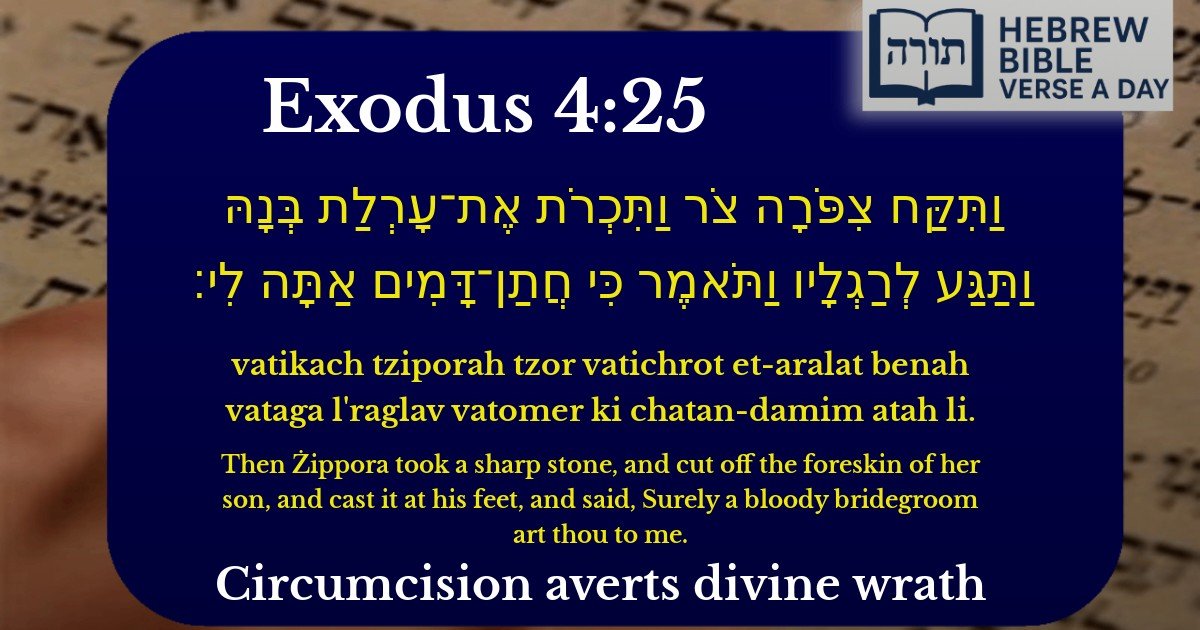

Exodus 4:25 - Circumcision averts divine wrath

Exodus 4:25 - שמות 4:25

Hebrew Text

וַתִּקַּח צִפֹּרָה צֹר וַתִּכְרֹת אֶת־עָרְלַת בְּנָהּ וַתַּגַּע לְרַגְלָיו וַתֹּאמֶר כִּי חֲתַן־דָּמִים אַתָּה לִי׃

English Translation

Then Żippora took a sharp stone, and cut off the foreskin of her son, and cast it at his feet, and said, Surely a bloody bridegroom art thou to me.

Transliteration

Vatikach tziporah tzor vatichrot et-aralat benah vataga l'raglav vatomer ki chatan-damim atah li.

Hebrew Leining Text

וַתִּקַּ֨ח צִפֹּרָ֜ה צֹ֗ר וַתִּכְרֹת֙ אֶת־עׇרְלַ֣ת בְּנָ֔הּ וַתַּגַּ֖ע לְרַגְלָ֑יו וַתֹּ֕אמֶר כִּ֧י חֲתַן־דָּמִ֛ים אַתָּ֖ה לִֽי׃

🎵 Listen to leining

Parasha Commentary

Context of the Verse

This verse (Shemot 4:25) describes an incident where Tzipporah, the wife of Moshe, performs the brit milah (circumcision) on their son after Moshe had neglected to do so. The event occurs during Moshe's journey back to Egypt to fulfill his divine mission to liberate the Jewish people. According to Rashi and the Midrash, Moshe had delayed the circumcision due to the urgency of his mission, but an angel threatened his life as a consequence, prompting Tzipporah to act swiftly.

Explanation of the Actions

  • Tzipporah's Initiative: Tzipporah takes a sharp stone (tzor) to perform the circumcision, demonstrating her understanding of the mitzvah's urgency. The Midrash (Shemot Rabbah 5:8) praises her quick thinking and devotion to fulfilling the covenant.
  • "Cast it at his feet": Rashi explains that Tzipporah touched the foreskin to Moshe's feet, symbolizing that the neglect of this mitzvah had endangered him. Some commentators suggest this was an act of protest or a reminder of the covenant's importance.

Meaning of "Bloody Bridegroom"

The phrase "חֲתַן־דָּמִים" ("bloody bridegroom") has been interpreted in several ways:

  • Rashi's Interpretation: Rashi explains that Tzipporah referred to Moshe as a "bridegroom of blood" because the blood of the circumcision saved him from death. The mitzvah of brit milah was so critical that its neglect nearly cost Moshe his life.
  • Symbolic Meaning: The Zohar (2:95b) suggests that the phrase highlights the covenantal bond between Moshe and the Jewish people, sealed through blood, much like a bridegroom is bound to his bride.
  • Midrashic Perspective: The Midrash Tanchuma (Shemot 18) states that Tzipporah’s words were a declaration that Moshe was now fully committed to the covenant, just as a bridegroom is bound in marriage.

Halachic and Moral Lessons

This episode teaches several key lessons in Jewish thought:

  • The paramount importance of brit milah, which cannot be delayed even for a divine mission (Rambam, Hilchot Milah 1:1-2).
  • The role of women in upholding Jewish tradition, as seen in Tzipporah’s decisive action (Talmud, Avodah Zarah 27a).
  • The idea that neglecting a mitzvah, even for noble reasons, can have severe consequences (Talmud, Nedarim 32a).

📚 Talmud Citations

This verse is quoted in the Talmud.

📖 Nedarim 31b
The verse is discussed in the context of the mitzvah of circumcision and the role of Zipporah in performing it.
📖 Yevamot 72a
The verse is referenced in a discussion about the laws of circumcision and the significance of Zipporah's actions.

Frequently Asked Questions

Q: Why did Tzipora perform the circumcision on her son?
A: According to Rashi (Exodus 4:24-26), Moshe was delayed in circumcising his son, and an angel sought to punish him for this neglect. Tzipora acted quickly to perform the mitzvah of brit milah (circumcision) to save Moshe's life, showing the importance of fulfilling this commandment promptly.
Q: What does 'a bloody bridegroom' mean in this verse?
A: The phrase 'a bloody bridegroom' (חֲתַן־דָּמִים) refers to the act of circumcision, where blood is shed as part of the covenant between Hashem and the Jewish people. Tzipora acknowledged that Moshe was now 'redeemed' through this mitzvah, as the blood of circumcision protected him from harm (Rashi, Exodus 4:25).
Q: Why was Moshe punished for not circumcising his son?
A: The Midrash (Shemot Rabbah 5:8) explains that Moshe was on his way to Egypt to lead the Jewish people to freedom, yet he neglected the mitzvah of brit milah for his own son. This teaches that even great leaders must prioritize personal mitzvah observance, as no one is exempt from fulfilling Hashem's commandments.
Q: What lesson can we learn from Tzipora's actions?
A: Tzipora teaches the importance of taking initiative in performing mitzvot, even when others hesitate. Her quick action saved Moshe and fulfilled the covenant of Avraham. The Talmud (Nedarim 31b) also notes that women play a crucial role in upholding brit milah, as seen here.
Q: Why did Tzipora use a sharp stone instead of a metal knife?
A: Rashi (Exodus 4:25) explains that Tzipora used a צֹר (flint stone) because metal knives were associated with war and bloodshed, while a stone was a purer instrument for this sacred act. This also connects to Yehoshua's later use of flint knives for circumcision (Joshua 5:2-3), showing continuity in the mitzvah's observance.