Frequently Asked Questions
Q: What does 'I am the Lord' mean in Exodus 6:2?
A: When Hashem says 'I am the Lord' (אֲנִי יְהוָה) in this verse, He is reaffirming His eternal, unchanging nature and His covenant with the Jewish people. Rashi explains that this emphasizes Hashem's faithfulness in keeping His promises, particularly the redemption from Egypt. It is a declaration of His mastery over history and His relationship with us.
Q: Why did Hashem speak directly to Moshe in Exodus 6:2?
A: Hashem spoke directly to Moshe because Moshe was the chosen leader to take Bnei Yisrael out of Egypt. The Rambam (Maimonides) teaches in Yesodei HaTorah that Moshe reached the highest level of prophecy, allowing him to communicate directly with Hashem. This verse highlights the unique relationship between Hashem and Moshe as the redeemer of Israel.
Q: What is the significance of Hashem introducing Himself as 'the Lord' in this verse?
A: The name יְהוָה (Hashem) used here represents Divine mercy and connection to the Jewish people. The Midrash (Shemot Rabbah) explains that this name signifies Hashem's compassion, especially during difficult times like the slavery in Egypt. By saying 'I am the Lord,' Hashem reassures Moshe and Bnei Yisrael that He is with them and will fulfill His promises.
Q: How does Exodus 6:2 relate to the rest of the Exodus story?
A: This verse is part of Hashem's reassurance to Moshe before the plagues and the Exodus. The Talmud (Sanhedrin 111a) teaches that this declaration sets the stage for the miracles that follow, showing Hashem's power and commitment to freeing Bnei Yisrael. It reminds us that even when redemption seems delayed, Hashem's promises are certain.
Q: What lesson can we learn today from Exodus 6:2?
A: This verse teaches us bitachon (trust) in Hashem. Just as He assured Moshe of His presence and plan during difficult times, we must remember that Hashem guides Jewish history with wisdom and compassion. The Sforno explains that recognizing 'I am the Lord' means acknowledging Hashem's control over all events, inspiring us to strengthen our faith even in challenging times.

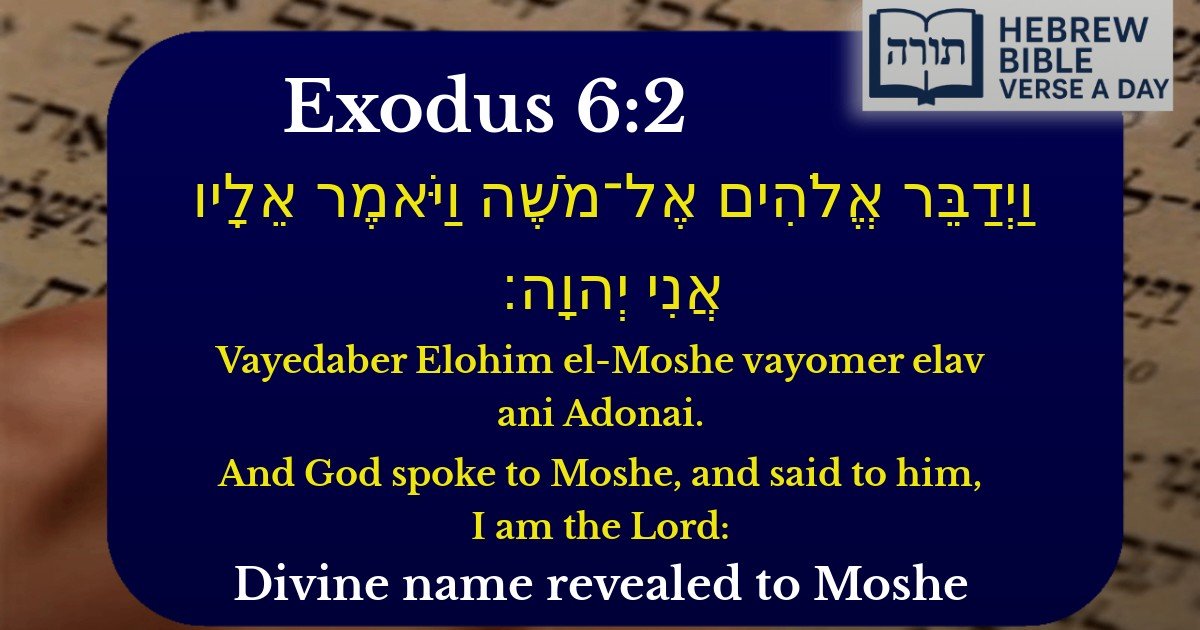

The Divine Revelation to Moshe
The verse states: "וַיְדַבֵּר אֱלֹהִים אֶל־מֹשֶׁה וַיֹּאמֶר אֵלָיו אֲנִי יְהוָה" ("And God spoke to Moshe, and said to him, I am the Lord"). This marks a pivotal moment in the Torah, where Hashem reveals Himself to Moshe with the Divine Name (הוי"ה). Rashi (Shemot 6:2) explains that this Name signifies Hashem's attribute of rachamim (mercy) and His eternal, unchanging nature—fulfilling His promises to the Avot (Patriarchs).
The Significance of the Divine Name
The Rambam (Moreh Nevuchim 1:61) teaches that the Name הוי"ה represents Hashem's absolute existence—the One who was, is, and will be. The Midrash (Shemot Rabbah 6:4) elaborates that this Name was used here to reassure Moshe that just as Hashem was with the Avot, He would now redeem Bnei Yisrael.
Moshe's Role as Intermediary
The Talmud (Sanhedrin 111a) highlights that this communication establishes Moshe's unique prophetic stature—unlike other prophets, who received visions, Moshe heard Hashem's words directly ("פה אל פה"). The Ohr HaChaim adds that the double language ("וידבר... ויאמר") signifies both the transmission of the message and its clarity, free of ambiguity.