Frequently Asked Questions
Q: What does it mean that Moshe was made 'a god to Pharaoh'?
A: Rashi explains that this means Moshe would act as a judge and authority over Pharaoh, delivering divine messages and warnings. The term 'god' here is used metaphorically to signify authority, not divinity, as Moshe was clearly a human prophet chosen by Hashem.
Q: Why did Aharon have to be Moshe's prophet to Pharaoh?
A: According to the Midrash (Shemos Rabbah), Moshe initially hesitated to speak to Pharaoh due to his humility and speech difficulties (Exodus 4:10). Aharon served as his spokesman, conveying Moshe's divinely inspired words clearly and powerfully, demonstrating how leaders sometimes need support to fulfill their missions.
Q: How does this verse show the relationship between Moshe and Aharon?
A: This verse highlights their teamwork—Moshe received prophecy directly from Hashem, while Aharon faithfully transmitted it. The Rambam (Yesodei HaTorah 7:7) notes that this mirrors the ideal prophet-helper relationship, where both roles are essential in serving Hashem's will.
Q: What lesson can we learn from Moshe being called 'a god' to Pharaoh?
A: The Talmud (Nedarim 38a) teaches that true leadership is about representing Hashem's justice, not personal power. Moshe's authority was solely for executing divine judgment on Pharaoh, reminding us that influence should be used for righteousness, not ego.
Q: Why is this verse important in the story of the Exodus?
A: It establishes Moshe and Aharon's divinely appointed roles before the plagues begin (Exodus 7:14 onwards). As the Midrash (Tanchuma Va'eira 8) explains, this clarified to Pharaoh that their demands to free Israel came from Hashem, not human ambition, setting the stage for the miracles that followed.

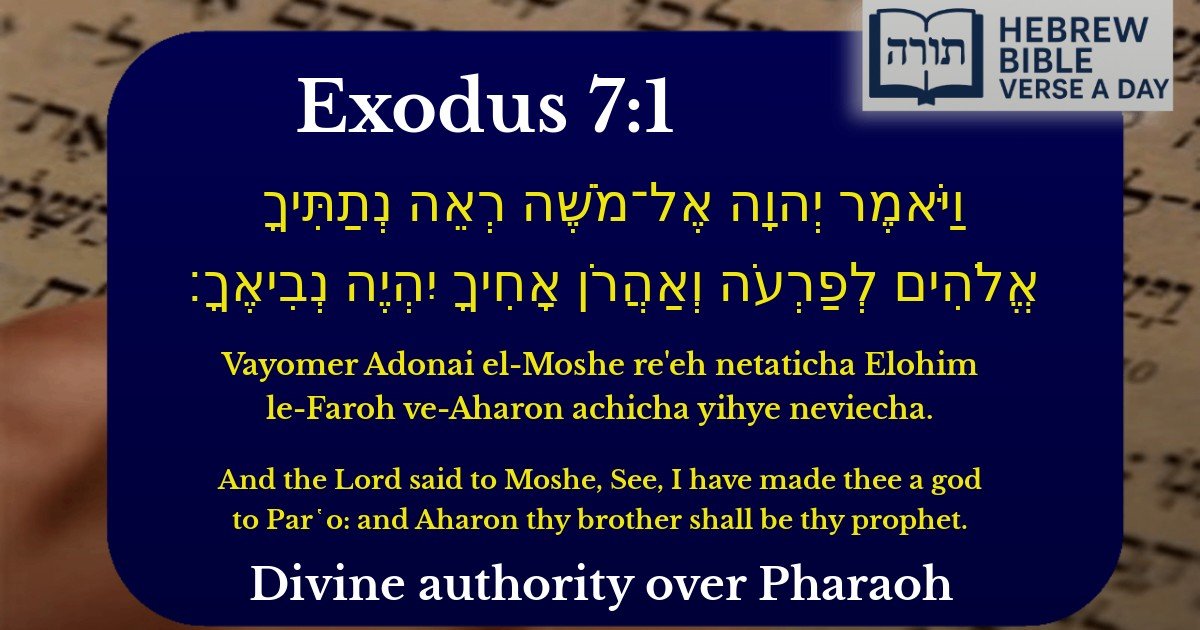

Understanding the Role of Moshe as "Elohim" to Pharaoh
Rashi explains that the term "Elohim" in this context does not imply divinity, but rather denotes authority and power. Moshe was appointed as a judge and ruler over Pharaoh, with the ability to execute divine judgments upon him. This aligns with the usage of "Elohim" in other Tanachic passages (e.g., Shemot 22:8) where it refers to human judges.
Aharon as Moshe's Prophet
The phrase "Aharon your brother shall be your prophet" (נְבִיאֶךָ) requires careful analysis. Ramban suggests that Aharon served as Moshe's spokesperson, conveying Moshe's words to Pharaoh, since Moshe expressed difficulty with speech (Shemot 4:10). This establishes a prophetic hierarchy where Moshe, as the primary recipient of divine communication, delegates the verbal transmission to Aharon.
Midrashic Insights
Halachic Implications
The Rambam (Hilchos Yesodei HaTorah 7:6) derives from this verse that a prophet must be recognized through consistent, verifiable signs - as Moshe was before Pharaoh. This establishes the Torah's standard for authentic prophecy.
Symbolic Representation
Kli Yakar suggests that Moshe as "Elohim" and Aharon as "prophet" represent the dual channels of divine interaction with the world: strict judgment (Moshe) and merciful communication (Aharon). This reflects the balance of middos in Hashem's relationship with creation.