Frequently Asked Questions
Q: What does it mean that Pharaoh's heart was hardened?
A: The phrase 'hardened heart' means that Pharaoh stubbornly refused to let the Israelites go despite seeing Hashem's signs and wonders. According to Rashi, Pharaoh initially hardened his own heart (Exodus 7:13), and later Hashem strengthened this stubbornness (Exodus 7:14) as a form of divine punishment for his wickedness.
Q: Why did Hashem harden Pharaoh's heart?
A: The Rambam (Hilchos Teshuvah 6:3) explains that when a person repeatedly sins and refuses to repent, Hashem may remove their free will to repent as a punishment. Pharaoh had many opportunities to let the Israelites go but chose evil, so Hashem confirmed his stubbornness to demonstrate His power through the Ten Plagues.
Q: What lesson can we learn from Pharaoh's hardened heart?
A: The Midrash teaches that Pharaoh's stubbornness warns us about the danger of ignoring truth and refusing to change. When a person continuously rejects doing what is right, their heart can become spiritually 'hardened,' making repentance difficult. This teaches the importance of humility and listening to moral guidance.
Q: How does this verse relate to free will in Judaism?
A: The Talmud (Berachos 33b) and Rambam emphasize that humans generally have free will, but extreme wickedness can lead to losing that ability as a consequence. Pharaoh's case was unique—his free will was restricted only after he repeatedly chose evil, serving as a lesson about the consequences of persistent wrongdoing.
Q: Why is this verse important in the story of the Exodus?
A: This verse marks the beginning of the Ten Plagues, showing that Pharaoh's refusal set the stage for Hashem to reveal His might. As the Midrash (Shemos Rabbah 13:3) explains, each plague targeted Egypt's false beliefs, proving Hashem's absolute power and fulfilling His promise to redeem the Jewish people.

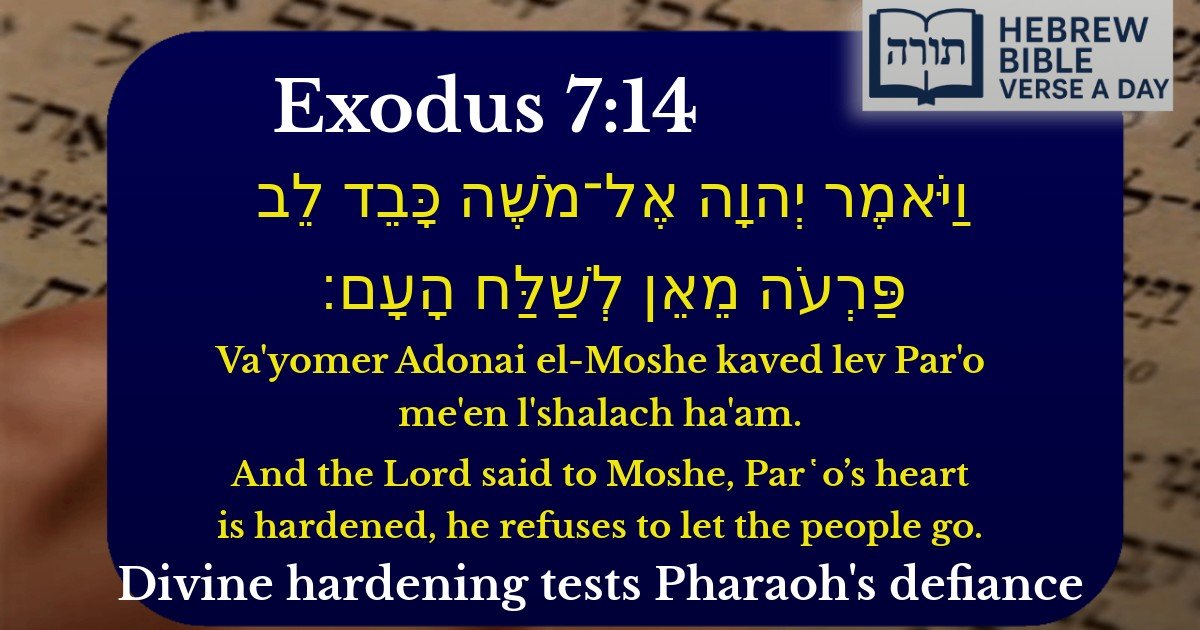

The Hardening of Pharaoh's Heart
The verse states, "וַיֹּאמֶר יְהוָה אֶל־מֹשֶׁה כָּבֵד לֵב פַּרְעֹה מֵאֵן לְשַׁלַּח הָעָם" ("And the Lord said to Moshe, Pharaoh’s heart is hardened, he refuses to let the people go"). This concept of Pharaoh's heart being hardened appears multiple times in the Exodus narrative, raising theological and moral questions about free will and divine intervention.
Rashi's Explanation
Rashi (Shemot 7:3) explains that Hashem hardened Pharaoh's heart after Pharaoh had already demonstrated his own wickedness and stubbornness by refusing to let Bnei Yisrael go despite the initial plagues. This teaches that when a person repeatedly sins despite warnings, Hashem may remove their ability to repent, as a form of divine justice. Thus, Pharaoh's free will was not initially violated—he first chose evil, and only afterward was his heart hardened.
Rambam's Perspective
Rambam (Hilchot Teshuvah 6:3) discusses this concept in the context of השגחה פרטית (divine providence). He explains that severe and repeated sins can lead to a state where repentance becomes exceedingly difficult, as a consequence of one's own actions. Pharaoh's hardening of heart was a punishment measure for his earlier refusals to heed Hashem's signs.
Midrashic Insights
Moral and Theological Implications
The hardening of Pharaoh's heart serves as a warning about the dangers of persistent wickedness. The Sforno (Shemot 7:3) notes that this was not merely punitive but also served a greater purpose: to demonstrate Hashem's absolute power over creation and to fulfill the promise made to Avraham (Bereishit 15:14) that the nation would leave with great wealth after enduring oppression.