Frequently Asked Questions
Q: What does Exodus 7:17 mean when it says the Nile will turn to blood?
A: This verse describes the first of the Ten Plagues in Egypt, where Hashem (God) turns the Nile River into blood as a sign of His power. According to Rashi, this was a direct punishment against the Egyptians who worshipped the Nile as a god, showing that Hashem controls all of nature. The transformation of water to blood symbolized judgment and the severity of Pharaoh's refusal to free the Jewish people.
Q: Why did Hashem choose to strike the Nile first?
A: The Nile was the lifeblood of Egypt, providing water, agriculture, and sustenance. By striking it first, Hashem demonstrated His dominance over what the Egyptians considered sacred (Ramban). Additionally, the Midrash teaches that since Pharaoh had decreed the drowning of Jewish babies in the Nile, measure for measure, the Nile was punished by turning to blood.
Q: What lesson can we learn from Exodus 7:17 today?
A: This verse teaches that Hashem controls nature and history, and no false gods or human power can oppose His will. The Rambam explains that miracles like the plagues were meant to establish belief in Hashem's sovereignty. Today, we recognize that just as He redeemed the Jewish people from Egypt, He continues to guide and protect us.
Q: How did the plague of blood affect the Egyptians?
A: The Talmud (Sanhedrin 90a) explains that the plague made the Nile undrinkable and killed fish, causing economic and health crises. Rashi adds that even stored water turned to blood, showing that the miracle was total—only the Jewish people had access to clean water, demonstrating Hashem's protection of His nation.
Q: What does 'the rod in My hand' symbolize in this verse?
A: The rod represents Hashem's power and authority to execute judgment. The Midrash (Shemot Rabbah) explains that just as a shepherd uses a staff to guide his flock, Hashem uses His 'rod' to direct events—here, to bring justice upon Egypt and redeem the Jewish people.

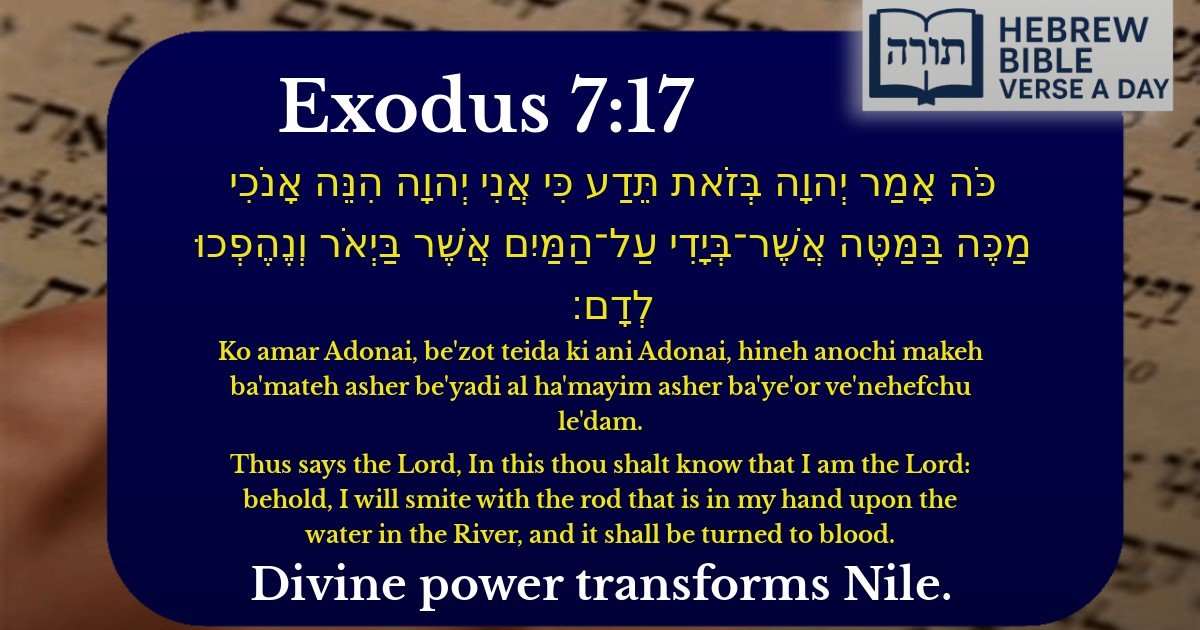

Context in Shemot (Exodus)
This verse (Shemot 7:17) is part of Hashem's instruction to Moshe before the first plague (Dam, blood) in Mitzrayim. It serves as a declaration of divine power to Pharaoh, demonstrating that Hashem is the ultimate authority over nature and human affairs.
Rashi's Explanation
Rashi emphasizes the phrase "בַּמַּטֶּה אֲשֶׁר־בְּיָדִי" ("the rod that is in My hand"), noting that this refers to Moshe's staff, which had previously been used for signs (e.g., turning into a snake). Rashi explains that the staff symbolizes divine authority and serves as a tool for executing Hashem's will in the physical world.
Symbolism of the Nile Turning to Blood
Purpose of the Plagues
The phrase "בְּזֹאת תֵּדַע כִּי אֲנִי יְהוָה" ("In this you shall know that I am the Lord") underscores that the plagues were not merely punishments but revelations of Hashem's sovereignty. As the Ramban explains, each plague progressively dismantled Pharaoh's arrogance and forced recognition of divine power.
The Rod as a Symbol
The Malbim highlights that the rod represents justice and authority. By using it to strike the Nile, Hashem showed that He controls both nature and human rulers, reinforcing the lesson that Pharaoh's defiance was futile.