Frequently Asked Questions
Q: Why did the fish in the Nile River die during the plague?
A: According to Rashi (Exodus 7:18), the fish died because the Nile turned to blood, depriving them of their natural habitat. The Midrash (Shemot Rabbah 9:9) explains that this was a punishment for the Egyptians, who worshipped the Nile as a god. By striking the Nile, Hashem showed His supremacy over their false deities.
Q: What is the significance of the Nile River stinking during this plague?
A: The foul smell (Exodus 7:18) made the water undrinkable and the river unusable, demonstrating the severity of the plague. Rambam (Moreh Nevuchim 3:29) teaches that this was part of Hashem's plan to show His power over nature and to humble the Egyptians, who relied on the Nile for survival.
Q: Why couldn't the Egyptians drink water from the Nile after this plague?
A: The Torah states (Exodus 7:18) that the Egyptians 'were unable to drink' the water because it had turned to blood and became foul. The Talmud (Sanhedrin 67b) notes that even when Egyptians tried to purchase water from the Israelites, it would turn to blood in their hands, showing that the plague was a divine punishment specifically targeting them.
Q: How does this plague teach us about Hashem's justice?
A: The plague of blood (Exodus 7:18) specifically targeted the Nile, which the Egyptians worshipped, teaching that Hashem punishes according to one's sins (Midrash Tanchuma, Va'eira 14). It also showed measure-for-measure justice, as the Egyptians drowned Israelite babies in the Nile (Shemot Rabbah 9:9).
Q: What practical lesson can we learn from the plague of blood today?
A: The Sages (Avot 5:4) teach that the plagues remind us of Hashem's control over nature and history. This plague specifically warns against idolizing natural resources (like the Egyptians did with the Nile) instead of recognizing the true Source of sustenance. The Chofetz Chaim adds that it teaches gratitude for clean water, a basic necessity we often take for granted.

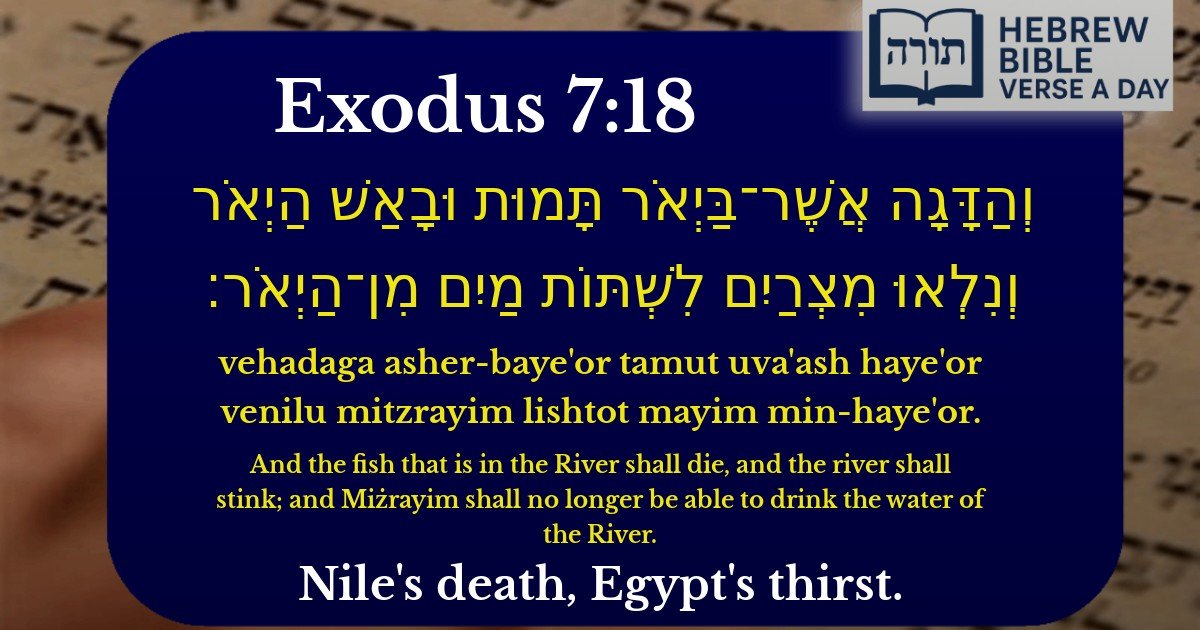

Context in the Plagues of Egypt
This verse (Shemot 7:18) describes the first plague—the turning of the Nile into blood—as foretold by Moshe to Pharaoh. The death of the fish and the resulting foul odor signify a complete disruption of Egypt's primary water source, which was central to their economy, agriculture, and daily life.
Rashi's Commentary
Rashi (Rabbi Shlomo Yitzchaki) explains that the fish would die because the water turned to blood, making it uninhabitable for aquatic life. He emphasizes that the Nile was not merely polluted but transformed into actual blood, as the verse states (וְנֶהֶפְכוּ כֻלָּם לְדָם, Shemot 7:17). The phrase וּבָאַשׁ הַיְאֹר ("the river shall stink") underscores the severity of the miracle, as decomposition would follow the death of the fish.
Symbolism of the Nile
The Midrash (Shemot Rabbah 9:9) highlights that the Nile was worshipped as a deity by the Egyptians. By striking it first, Hashem demonstrated His supremacy over their false gods. The Rambam (Maimonides, Moreh Nevuchim 3:29) notes that plagues often targeted Egypt's idolatrous beliefs to dismantle their illusions of power.
Impact on Egypt
Halachic Insight
The Talmud (Sanhedrin 67b) derives from this verse that a true miracle must produce irreversible effects—unlike sorcery, which is temporary. Here, the fish died permanently, proving the divine nature of the plague.