

Join Our Newsletter To Be Informed When New Videos Are Posted
Hebrew Text
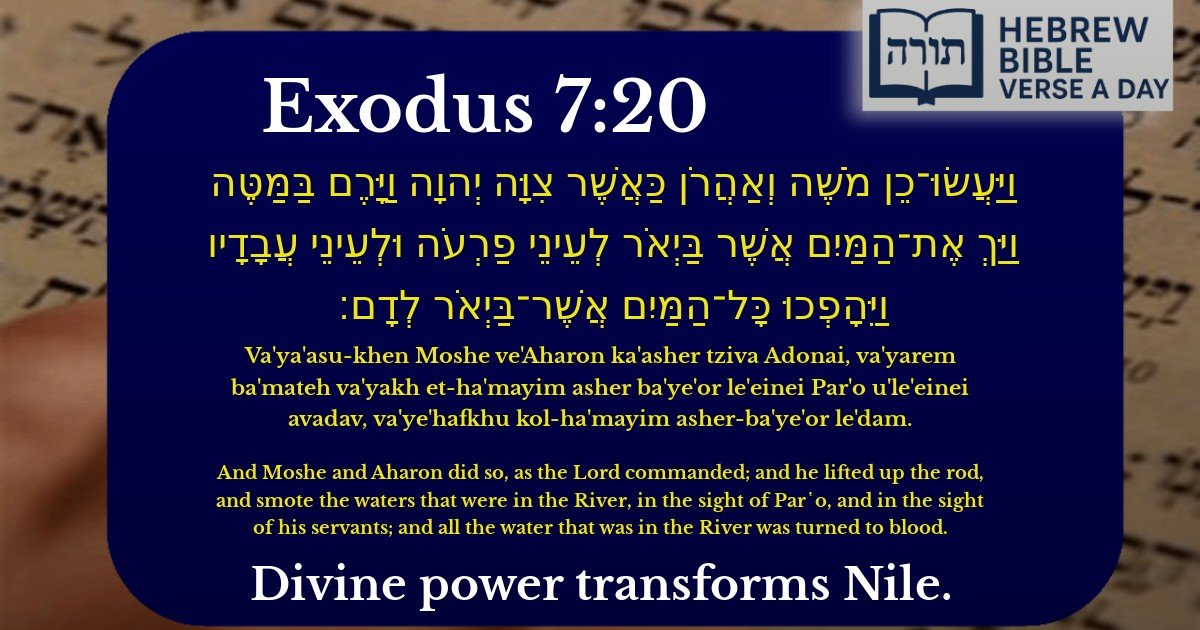
וַיַּעֲשׂוּ־כֵן מֹשֶׁה וְאַהֲרֹן כַּאֲשֶׁר צִוָּה יְהוָה וַיָּרֶם בַּמַּטֶּה וַיַּךְ אֶת־הַמַּיִם אֲשֶׁר בַּיְאֹר לְעֵינֵי פַרְעֹה וּלְעֵינֵי עֲבָדָיו וַיֵּהָפְכוּ כָּל־הַמַּיִם אֲשֶׁר־בַּיְאֹר לְדָם׃
English Translation
And Moshe and Aharon did so, as the Lord commanded; and he lifted up the rod, and smote the waters that were in the River, in the sight of Par῾o, and in the sight of his servants; and all the water that was in the River was turned to blood.
Transliteration
Va'ya'asu-khen Moshe ve'Aharon ka'asher tziva Adonai, va'yarem ba'mateh va'yakh et-ha'mayim asher ba'ye'or le'einei Par'o u'le'einei avadav, va'ye'hafkhu kol-ha'mayim asher-ba'ye'or le'dam.
Hebrew Leining Text
וַיַּֽעֲשׂוּ־כֵן֩ מֹשֶׁ֨ה וְאַהֲרֹ֜ן כַּאֲשֶׁ֣ר&thinsp
🎵 Listen to leining
Parasha Commentary
📚 Talmud Citations
This verse is quoted in the Talmud.
📖 Sanhedrin 67b
The verse is referenced in a discussion about the miracles performed by Moses and Aaron in Egypt, particularly focusing on the transformation of the Nile's waters into blood as a sign of divine power.
📖 Pesachim 118a
Mentioned in the context of recounting the plagues of Egypt, emphasizing the role of Moses and Aaron in executing God's commands.
Context of the Verse
The verse (Shemot 7:20) describes the first of the ten plagues—the transformation of the Nile's waters into blood—as Moshe and Aharon carry out Hashem's command before Pharaoh and his servants. This plague was a direct challenge to Egypt's reliance on the Nile, which they worshipped as a deity, demonstrating Hashem's supremacy over their false gods.
Rashi's Commentary
Rashi (Shemot 7:20) explains that Moshe was the one who struck the Nile, not Aharon, because the Nile had protected Moshe when he was cast into it as an infant (Shemot 2:3). It would have been inappropriate for Moshe to strike the very entity that had safeguarded him. However, Aharon was the one who struck the dust to bring forth lice (the third plague) because Moshe could not strike the earth, which had also protected him when he buried the Egyptian taskmaster (Shemot 2:12). This teaches the principle of hakarat hatov (recognizing and repaying kindness), even to inanimate objects.
Symbolism of the Plague
The Midrash (Shemot Rabbah 9:9) elaborates that the plague of blood was a measure-for-measure punishment (middah k'neged middah). The Egyptians had drowned Jewish infants in the Nile (Shemot 1:22), so Hashem turned their life-sustaining waters into blood, symbolizing the spilled blood of the innocent. Additionally, the Nile was central to Egypt's economy and agriculture; by striking it, Hashem demonstrated His control over their false deities and their very survival.
The Role of Pharaoh's Servants
The verse emphasizes that the miracle occurred "in the sight of Pharaoh and his servants." The Ramban (Shemot 7:20) notes that Pharaoh's magicians attempted to replicate this plague (Shemot 7:22), but their efforts only reinforced the severity of the miracle, as they could not reverse it. This public display was meant to break Pharaoh's arrogance and prove that Hashem's power was absolute.
The Rod as a Divine Instrument
The Talmud (Sanhedrin 67b) discusses the significance of Moshe's rod, which was used to perform miracles. Unlike the magicians' tricks, Moshe's actions were purely at Hashem's command, emphasizing that true miracles come from divine will, not human manipulation. The rod symbolized divine authority, showing that Moshe and Aharon acted solely as Hashem's emissaries.
Lessons for Jewish Thought