Frequently Asked Questions
Q: What does it mean that Pharaoh's heart was hardened?
A: The hardening of Pharaoh's heart means that he became stubborn and refused to listen to the signs and warnings from Hashem. According to Rashi, this was a punishment for Pharaoh's initial refusal to let the Israelites go, leading to his heart being further hardened as a consequence.
Q: Why did the Egyptian magicians try to replicate Moshe's miracles?
A: The Egyptian magicians tried to replicate Moshe's miracles using their 'secret arts' (לָטֵיהֶם) to show that they also had power, making Pharaoh doubt the divine nature of the plagues. The Midrash explains that they used demonic forces or illusions, but their abilities were limited compared to Hashem's true miracles.
Q: What lesson can we learn from Pharaoh not listening to the warnings?
A: The lesson is that stubbornness and refusal to recognize truth—especially when it comes from Hashem—leads to greater consequences. The Rambam teaches that a person should always be open to repentance and not harden their heart, as Pharaoh did, which only brought more suffering upon himself and Egypt.
Q: How does this verse connect to the concept of free will in Judaism?
A: This verse shows that Pharaoh initially had free will to let the Israelites go, but after repeatedly choosing evil, Hashem allowed his heart to harden as a form of punishment. The Talmud (Makkot 10b) discusses how a person who sins repeatedly may lose opportunities for repentance, emphasizing the importance of using free will correctly.
Q: Why is this verse important in the story of the Exodus?
A: This verse is important because it marks the beginning of Pharaoh's increasing stubbornness, leading to the escalation of the plagues. According to the Sages, it demonstrates that Hashem's word is absolute—Pharaoh’s refusal fulfilled what Hashem had foretold, showing divine control over history.

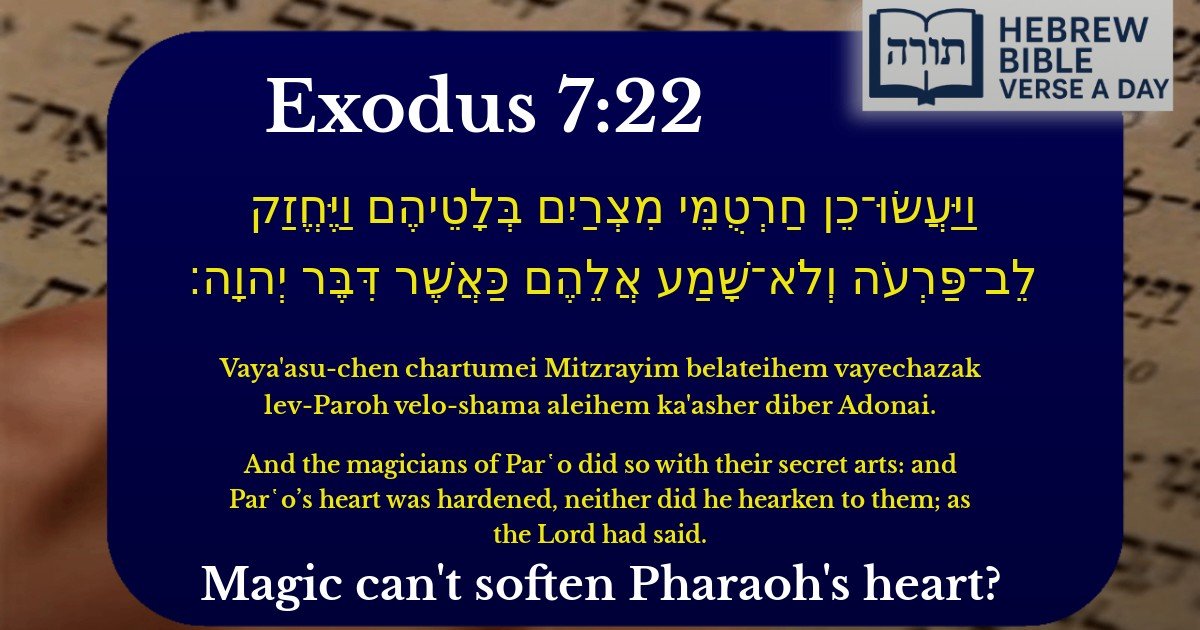

Understanding the Verse in Context
The verse describes how Pharaoh's magicians replicated some of the plagues through their "secret arts" (בְּלָטֵיהֶם), leading Pharaoh's heart to harden further. This occurs after Moshe and Aharon performed miracles before Pharaoh, demonstrating Hashem's power. The hardening of Pharaoh's heart is a recurring theme in the Exodus narrative, emphasizing divine intervention in human free will for a greater purpose.
Rashi's Explanation
Rashi (Shemot 7:22) comments that the magicians' ability to replicate the plague of blood (and later frogs) was limited—they could only perform these acts with their "secret arts" (בְּלָטֵיהֶם), implying sorcery or demonic forces. However, they could not undo the plague, showing that their power was inferior to Hashem's. Rashi also notes that Pharaoh's heart was hardened because of their actions—their mimicry gave him false confidence to resist Moshe's demands.
The Nature of Pharaoh's Hardened Heart
The Rambam (Hilchot Teshuvah 6:3) discusses the concept of divine hardening of the heart as a punishment for persistent sin. When a person repeatedly ignores warnings, Hashem may remove their ability to repent, allowing their stubbornness to lead to their downfall. Pharaoh's case exemplifies this principle—his initial refusal to heed Moshe's warnings led to a point where his heart was divinely hardened.
The Magicians' Role in Pharaoh's Stubbornness
The Midrash (Shemot Rabbah 9:11) explains that the magicians' ability to replicate the plagues was a test for Bnei Yisrael—to distinguish between true divine miracles and mere sorcery. Their actions emboldened Pharaoh, making him believe that Moshe's signs were not uniquely divine. However, as the plagues progressed, even the magicians acknowledged, "This is the finger of G-d" (Shemot 8:15), revealing the limits of their power.
Key Lessons from the Verse