Frequently Asked Questions
Q: Why couldn't the Egyptians drink water from the Nile during the plague of blood?
A: According to Rashi (Exodus 7:24), the Nile's water turned to actual blood during this plague, making it undrinkable. The Egyptians had to dig around the Nile to find groundwater that wasn't affected by the plague.
Q: What lesson can we learn from the Egyptians digging for water during the plague?
A: The Midrash teaches that this shows how far people will go to avoid changing their ways. Instead of repenting when seeing Hashem's power, the Egyptians worked harder to avoid the consequences. This teaches us the importance of proper response to divine messages.
Q: How long did the plague of blood last that made the Egyptians dig for water?
A: The plague lasted seven days (Exodus 7:25). According to traditional Jewish sources, this gave Pharaoh and the Egyptians ample time to recognize Hashem's power and repent, but they chose instead to seek alternative water sources.
Q: Why did the plague specifically target the Nile River?
A: The Rambam explains that since the Egyptians worshipped the Nile as a god, this plague demonstrated Hashem's supremacy over their false deities. Turning their 'god' into undrinkable blood showed the Nile's powerlessness before the Almighty.
Q: Did the plague of blood affect the Israelites' water too?
A: No, according to Rashi and other commentators, this was the first demonstration of the principle that the plagues distinguished between Egyptians and Israelites. While Egyptian water turned to blood, Jewish water remained unaffected, showing Hashem's protection of His people.


Context of the Verse
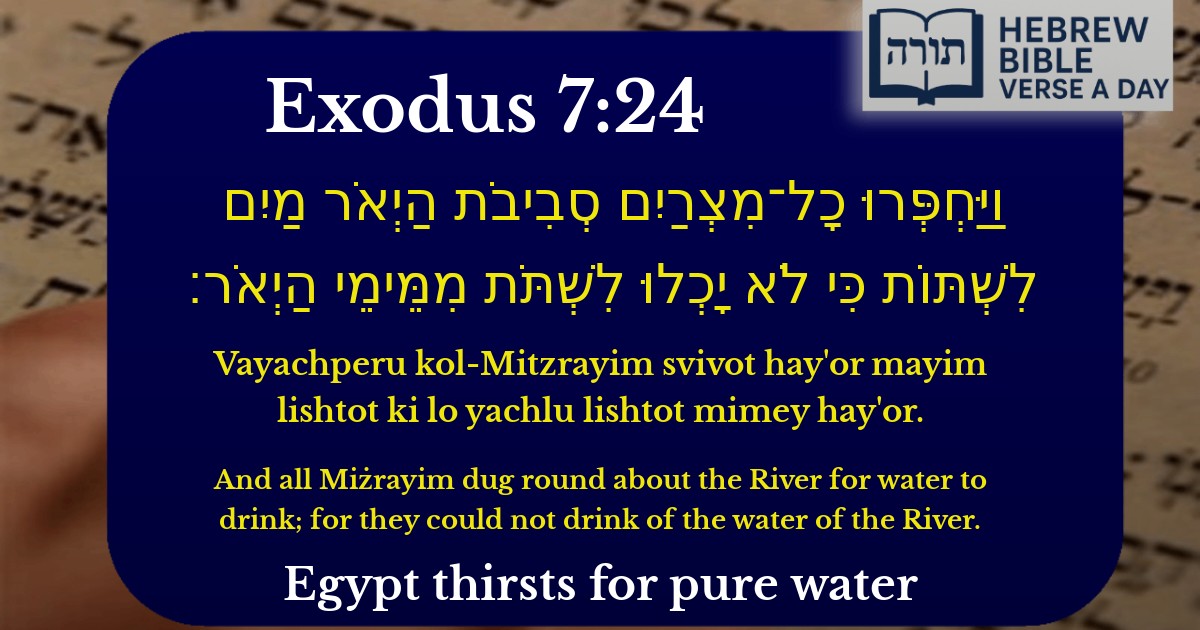
The verse (Shemot 7:24) describes the aftermath of the first plague, where the waters of the Nile turned to blood. The Egyptians, unable to drink from the Nile, were forced to dig around the river in search of drinkable water.
Rashi's Commentary
Rashi explains that the Egyptians dug around the Nile because the plague affected only the water that was in the river itself, not the groundwater beneath it. By digging, they accessed water that had not been transformed into blood. This highlights the precision of Hashem's judgment—the plague targeted the Nile, a symbol of Egyptian idolatry, while leaving other water sources unaffected for those who sought them.
Midrashic Insights
Rambam's Perspective
In Moreh Nevuchim (3:48), Rambam discusses how the plagues demonstrated Hashem's dominion over nature. The Nile, worshipped as a god, was rendered useless, proving its impotence and the folly of Egyptian idolatry. The Egyptians' digging underscores their reliance on human effort when divine retribution strikes.
Halachic Implications
The Gemara (Chullin 10b) derives from this verse that water drawn from the ground is considered distinct from river water. This principle is applied in halachah regarding the laws of mayim she'uvim (drawn water) and their suitability for ritual use, such as in a mikveh.