Frequently Asked Questions
Q: What does Exodus 8:9 mean when it says 'the Lord did according to the word of Moshe'?
A: This verse shows that Hashem listened to Moshe's prayer to remove the plague of frogs from Egypt. According to Rashi, it demonstrates Moshe's close relationship with Hashem and how his prayers were answered immediately. The phrase teaches us about the power of a tzaddik's (righteous person's) prayer.
Q: Why did the frogs die in the houses, courtyards and fields (Exodus 8:9)?
A: The Midrash explains that the frogs died in all these locations to show that the plague was completely removed from every part of Egyptian life. Unlike some plagues that just stopped, this one required the frogs to die to prove they were truly gone. The Sforno adds that this complete removal demonstrated Hashem's precise control over nature.
Q: What lesson can we learn from Exodus 8:9 about prayer?
A: From this verse we learn several important lessons about prayer: 1) Hashem listens to our prayers (as He listened to Moshe), 2) We should pray with confidence like Moshe did, and 3) When we see our prayers answered, we should recognize it as Hashem's kindness. The Rambam teaches that this story establishes the fundamental Jewish belief in the power of prayer.
Q: How is the removal of the frogs in Exodus 8:9 different from other plagues?
A: Unlike other plagues that simply ended, the frogs actually died (as stated in this verse). The Talmud (Pesachim 53b) explains this was a special kindness from Hashem - the Egyptians didn't have to clean up rotting frogs in their homes because they died outside. This shows that even in punishment, Hashem considers people's comfort.
Q: Why does the Torah specify where the frogs died (houses, courtyards, fields)?
A: Rashi explains that the Torah specifies these locations to show that the miracle was complete - no frogs remained anywhere. The houses represent private spaces, courtyards were semi-public areas, and fields were work spaces. This teaches that Hashem's miracles affect every aspect of life. The Ibn Ezra adds that this detail proves it was a supernatural event, not natural frog migration.

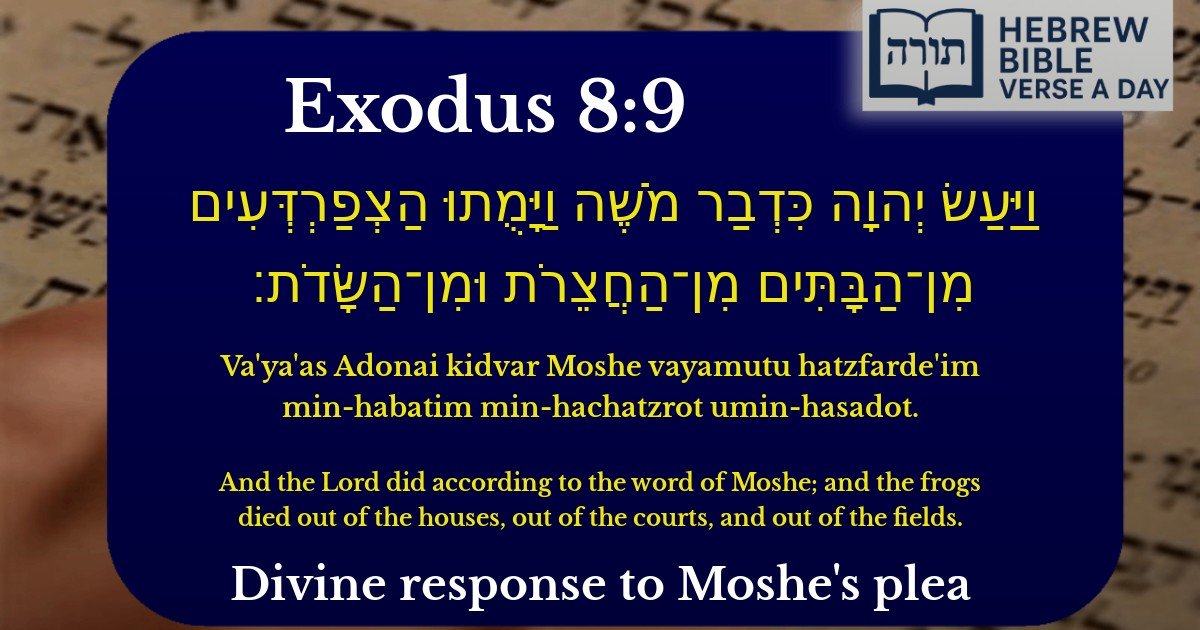

Rashi's Explanation
Rashi (Shemot 8:9) explains that the phrase "וַיַּעַשׂ יְהוָה כִּדְבַר מֹשֶׁה" ("And the Lord did according to the word of Moshe") demonstrates that Hashem fulfilled Moshe's request precisely. Moshe had asked that the frogs die immediately (Shemot 8:5-6), and Hashem honored this request, showing that Moshe's prayers were effective. Rashi further notes that the frogs died in an orderly manner—first in the houses, then the courtyards, and finally the fields—to prevent any foul odor from decaying frogs in living areas.
Midrashic Insights
The Midrash (Shemot Rabbah 10:7) elaborates that the frogs did not merely die but were "gathered in heaps," emphasizing the miraculous nature of their removal. This detail highlights that the plague's cessation was as much a divine act as its onset. Additionally, the Midrash teaches that the frogs' willingness to sacrifice themselves by entering ovens (during the plague) demonstrated greater kiddush Hashem (sanctification of G-d's name) than even the righteous, underscoring the lesson of total devotion to Hashem's will.
Rambam's Perspective
In Moreh Nevuchim (Guide for the Perplexed 2:48), Rambam discusses how the plagues, including the frogs, served as clear signs of divine intervention to both the Egyptians and Bnei Yisrael. The specificity of the frogs' death—only where Moshe designated—reinforced that these were not natural events but deliberate acts of Hashem to punish the Egyptians and liberate His people.
Halachic Implications