

Join Our Newsletter To Be Informed When New Videos Are Posted
Hebrew Text
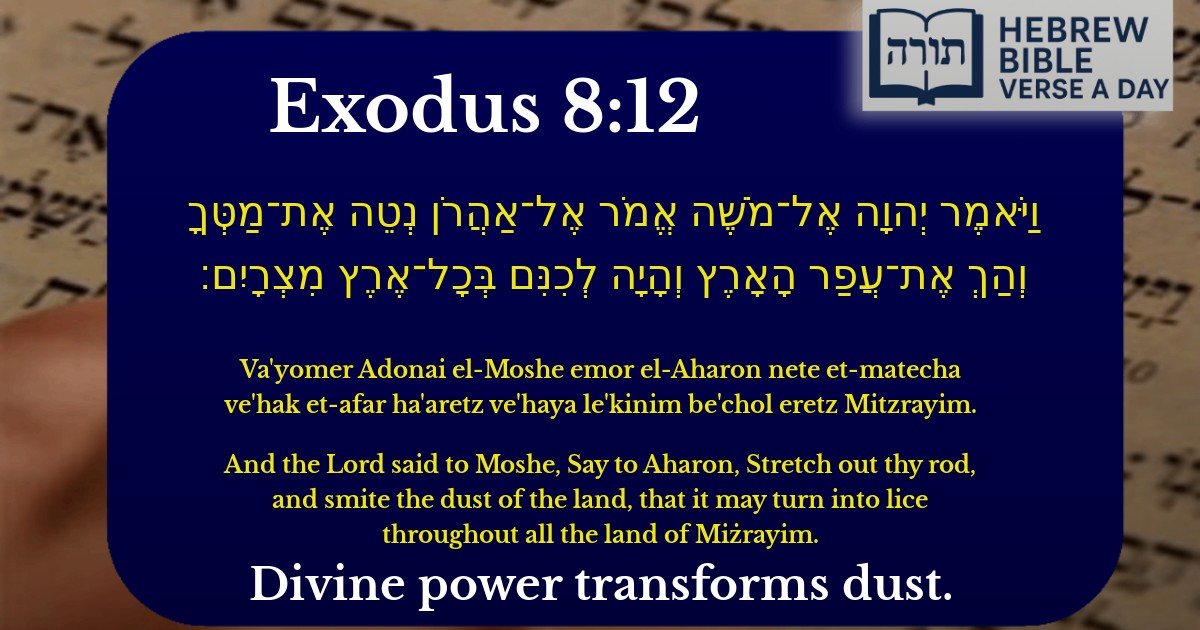
וַיֹּאמֶר יְהוָה אֶל־מֹשֶׁה אֱמֹר אֶל־אַהֲרֹן נְטֵה אֶת־מַטְּךָ וְהַךְ אֶת־עֲפַר הָאָרֶץ וְהָיָה לְכִנִּם בְּכָל־אֶרֶץ מִצְרָיִם׃
English Translation
And the Lord said to Moshe, Say to Aharon, Stretch out thy rod, and smite the dust of the land, that it may turn into lice throughout all the land of Miżrayim.
Transliteration
Va'yomer Adonai el-Moshe emor el-Aharon nete et-matecha ve'hak et-afar ha'aretz ve'haya le'kinim be'chol eretz Mitzrayim.
Hebrew Leining Text
וַיֹּ֣אמֶר יְהֹוָה֮ אֶל־מֹשֶׁה֒ אֱמֹר֙ אֶֽל־אַהֲרֹ֔ן נְטֵ֣ה אֶֽת־מַטְּךָ֔ וְהַ֖ךְ אֶת־עֲפַ֣ר הָאָ֑רֶץ וְהָיָ֥ה לְכִנִּ֖ם בְּכׇל־אֶ֥רֶץ מִצְרָֽיִם׃
🎵 Listen to leining
Parasha Commentary
📚 Talmud Citations
This verse is quoted in the Talmud.
📖 Sotah 8b
The verse is referenced in a discussion about the plagues in Egypt, particularly focusing on the role of Aaron in executing the plague of lice.
📖 Sanhedrin 67b
The verse is mentioned in the context of discussing miracles and the nature of the plagues, emphasizing the transformation of dust into lice as a divine act.
The Command to Aharon
The verse states that Hashem instructed Moshe to tell Aharon to strike the dust, rather than performing the act himself. Rashi (Shemot 8:12) explains that Moshe was not permitted to strike the dust because the earth had protected him when he killed the Egyptian (Shemot 2:12) and buried the body in the sand. Since the dust had done him a kindness, it would be improper for him to afflict it. This teaches the principle of hakarat hatov (recognizing and repaying kindness), even to inanimate objects.
The Significance of the Lice Plague
The plague of lice (kinim) was the third of the ten plagues. The Midrash (Shemot Rabbah 10:7) notes that the Egyptian magicians could not replicate this miracle, admitting, "This is the finger of G-d" (Shemot 8:15). Unlike the previous plagues, which involved water or frogs (elements that could be manipulated through sorcery), lice emerged from the earth—something beyond the magicians' control. This demonstrated Hashem's absolute dominion over all creation.
Aharon's Role in the Plagues
Rambam (Moreh Nevuchim 3:46) suggests that Aharon was chosen to initiate this plague to emphasize that the miracles were performed by Hashem's will, not Moshe's personal power. Additionally, the Talmud (Sanhedrin 67b) teaches that the first two plagues (blood and frogs) were brought about through water, an element associated with Moshe (who was saved from the Nile). The shift to Aharon for the third plague underscores that the plagues were a divine, not human, endeavor.
Symbolism of the Dust
The dust turning into lice carries deeper meaning. The Midrash (Pirkei DeRabbi Eliezer 48) states that the lice afflicted the Egyptians in their most private spaces—their beds and clothing—symbolizing that impurity (represented by lice) had permeated every aspect of their lives. Furthermore, the dust (afar) recalls Hashem's curse to Adam (Bereishit 3:19), "For dust you are, and to dust you shall return," hinting at the mortality and futility of Egypt's resistance to Hashem's will.