

Join Our Newsletter To Be Informed When New Videos Are Posted
Hebrew Text
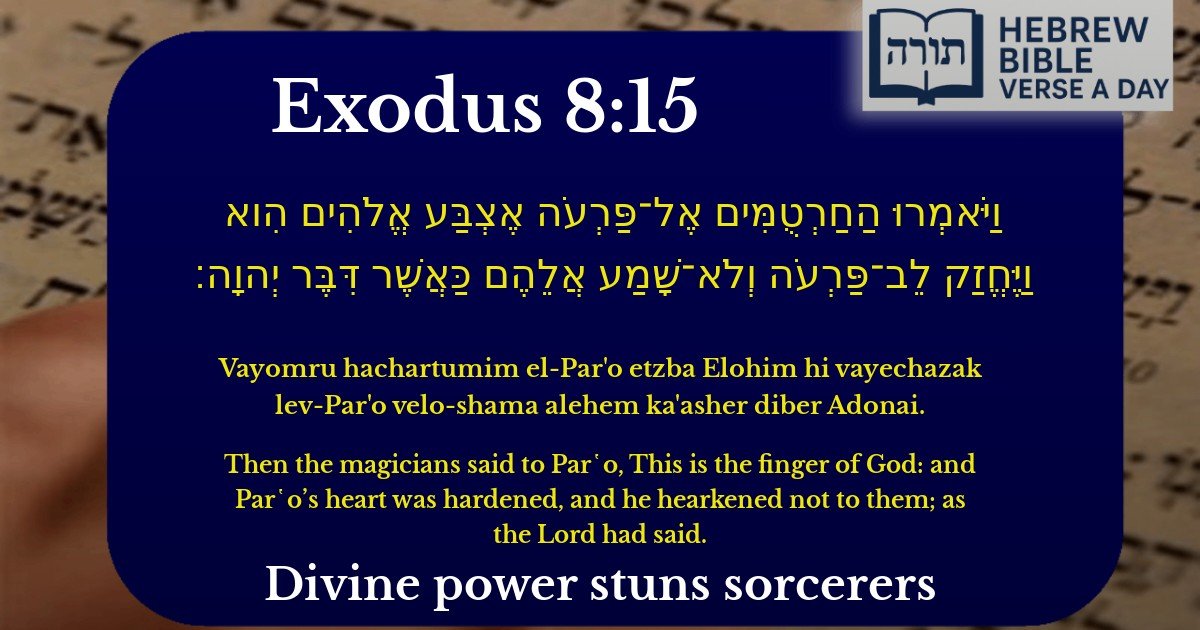
וַיֹּאמְרוּ הַחַרְטֻמִּים אֶל־פַּרְעֹה אֶצְבַּע אֱלֹהִים הִוא וַיֶּחֱזַק לֵב־פַּרְעֹה וְלֹא־שָׁמַע אֲלֵהֶם כַּאֲשֶׁר דִּבֶּר יְהוָה׃
English Translation
Then the magicians said to Par῾o, This is the finger of God: and Par῾o’s heart was hardened, and he hearkened not to them; as the Lord had said.
Transliteration
Vayomru hachartumim el-Par'o etzba Elohim hi vayechazak lev-Par'o velo-shama alehem ka'asher diber Adonai.
Hebrew Leining Text
וַיֹּאמְר֤וּ הַֽחַרְטֻמִּם֙ אֶל־פַּרְעֹ֔ה אֶצְבַּ֥ע אֱלֹהִ֖ים הִ֑וא וַיֶּחֱזַ֤ק לֵב־פַּרְעֹה֙ וְלֹֽא־שָׁמַ֣ע אֲלֵהֶ֔ם כַּאֲשֶׁ֖ר דִּבֶּ֥ר יְהֹוָֽה׃ {ס}
🎵 Listen to leining
Parasha Commentary
📚 Talmud Citations
This verse is quoted in the Talmud.
📖 Sotah 11a
The verse is referenced in the context of discussing Pharaoh's stubbornness and the hardening of his heart, illustrating how even the magicians recognized the divine nature of the plagues.
📖 Sanhedrin 67b
The verse is mentioned in a discussion about the nature of magic and the recognition by Pharaoh's magicians that the plagues were acts of God.
The Magicians' Admission: "This is the Finger of God"
In Shemot (Exodus) 8:15, the Egyptian magicians (chartumim) acknowledge that the plague of lice (kinim) is beyond their powers, declaring, "This is the finger of God" (etzba Elokim hi). Rashi explains that the term etzba (finger) here signifies a divine act of precision, as the lice emerged from dust—something the magicians could not replicate through their sorcery. The Midrash (Shemot Rabbah 10:7) elaborates that their admission highlights the limits of human power in contrast to Hashem's sovereignty.
Paroh's Hardened Heart
The verse states that despite the magicians' testimony, "Paroh’s heart was hardened" (vayechazek lev Paroh). Rambam (Hilchot Teshuvah 6:3) discusses the concept of divine hardening of Paroh's heart as a consequence of his persistent wickedness, wherein Hashem removed his ability to repent. The Malbim adds that Paroh’s obstinacy stemmed from his arrogance—even when his own advisors recognized divine intervention, he refused to submit.
Fulfillment of Divine Decree
The concluding phrase, "as the Lord had said" (ka'asher diber Hashem), underscores that Paroh’s defiance aligned with Hashem’s earlier prophecy (e.g., Shemot 7:3-4). The Ibn Ezra notes that this reaffirms the divine plan to demonstrate Hashem’s supremacy through the plagues. The Sforno emphasizes that each plague served as a measured revelation of divine justice, escalating until Paroh’s eventual recognition (see Shemot 9:27).
Key Lessons from the Verse