Frequently Asked Questions
Q: What does 'I will put a division between my people and thy people' mean in Exodus 8:19?
A: This verse refers to the fourth plague (wild animals or insects, depending on interpretation) during the Exodus from Egypt. Hashem declares that He will distinguish between the Egyptians and the Israelites by sparing the latter from the plague. Rashi explains that this 'division' (פְדֻת) means a clear distinction, showing that the plagues were directed by divine will and not random events.
Q: Why is the phrase 'tomorrow shall this sign be' important in Exodus 8:19?
A: The phrase emphasizes that the distinction between the Egyptians and Israelites would be visibly evident the next day. Ramban (Nachmanides) notes that this was a public demonstration of Hashem's control over nature and His protection of the Jewish people, reinforcing faith in divine providence.
Q: What lesson can we learn from Exodus 8:19 about divine protection?
A: The verse teaches that Hashem watches over His people and intervenes on their behalf. The Midrash (Shemot Rabbah) highlights that this distinction was a precursor to the eventual redemption from Egypt, showing that divine justice separates between the righteous and the wicked. This principle applies in all generations—Hashem protects those who follow His ways.
Q: How does the concept of 'division' in Exodus 8:19 apply to Jewish life today?
A: The division symbolizes the unique relationship between the Jewish people and Hashem. The Talmud (Chullin 5a) teaches that holiness requires separation from negative influences. Today, this reminds us to maintain spiritual distinctions—such as keeping kosher, Shabbat, and ethical conduct—to uphold our covenant with Hashem.
Q: What does Rashi say about the word 'פְדֻת' (division) in Exodus 8:19?
A: Rashi explains that 'פְדֻת' means a clear separation or distinction, derived from the root meaning 'to redeem.' This indicates that the Israelites were set apart as a redeemed people, untouched by the plagues affecting Egypt. The term underscores that their protection was an act of divine favor and redemption.

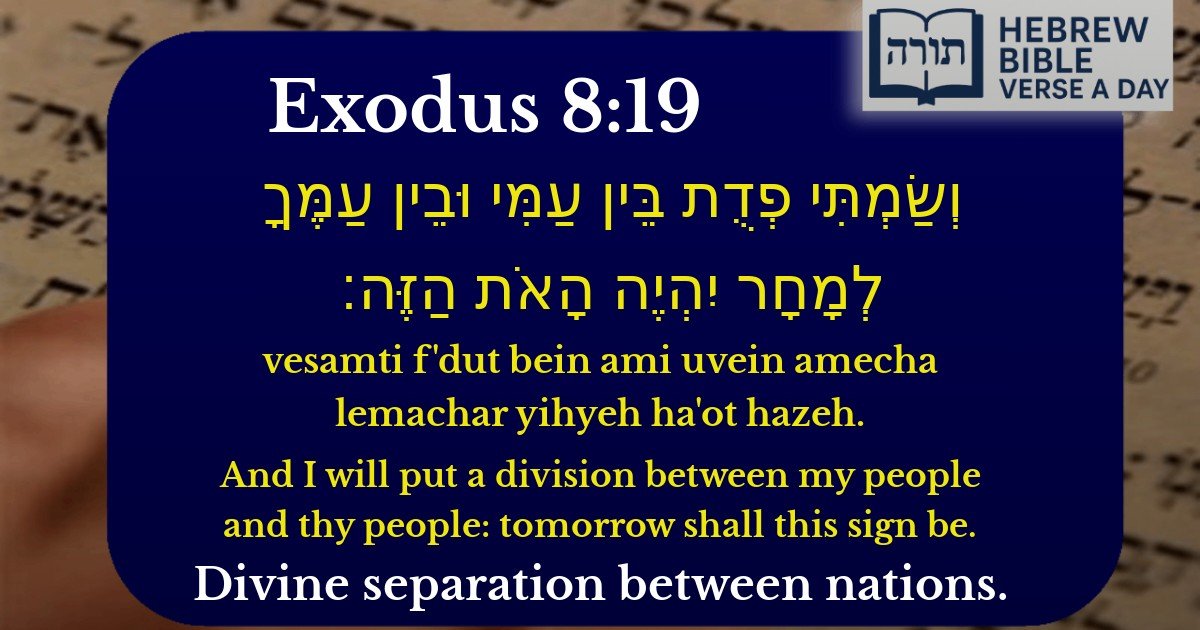

Context in the Exodus Narrative
This verse (Shemot 8:19) appears during the fourth plague of arov (wild beasts), where Hashem declares His intention to distinguish between the Israelites and Egyptians. Rashi explains that this "division" (pedut) refers to a clear separation in how the plagues affect each nation—demonstrating that the plagues are deliberate divine acts, not random natural events.
The Meaning of "Pedut" (Division)
Ramban (Nachmanides) elaborates that pedut implies not just separation but redemption—hinting at the future Exodus. The term suggests that Hashem actively protects Bnei Yisrael while executing judgment on Mitzrayim. The Midrash Tanchuma (Bo 4) emphasizes that this distinction began here and culminated in the final plague, where the Israelites were entirely spared.
"Tomorrow Shall This Sign Be"
The phrase "l'machar yihyeh ha'ot hazeh" is interpreted by the Sforno as a promise that the distinction will be visible and undeniable. The Ibn Ezra notes that "tomorrow" may refer to the immediate future, reinforcing the certainty of Hashem's intervention. The Talmud (Berachot 9a) links this to the broader theme of divine timing—miracles unfold according to Hashem's precise schedule.
Theological Implications