

Join Our Newsletter To Be Informed When New Videos Are Posted
Hebrew Text
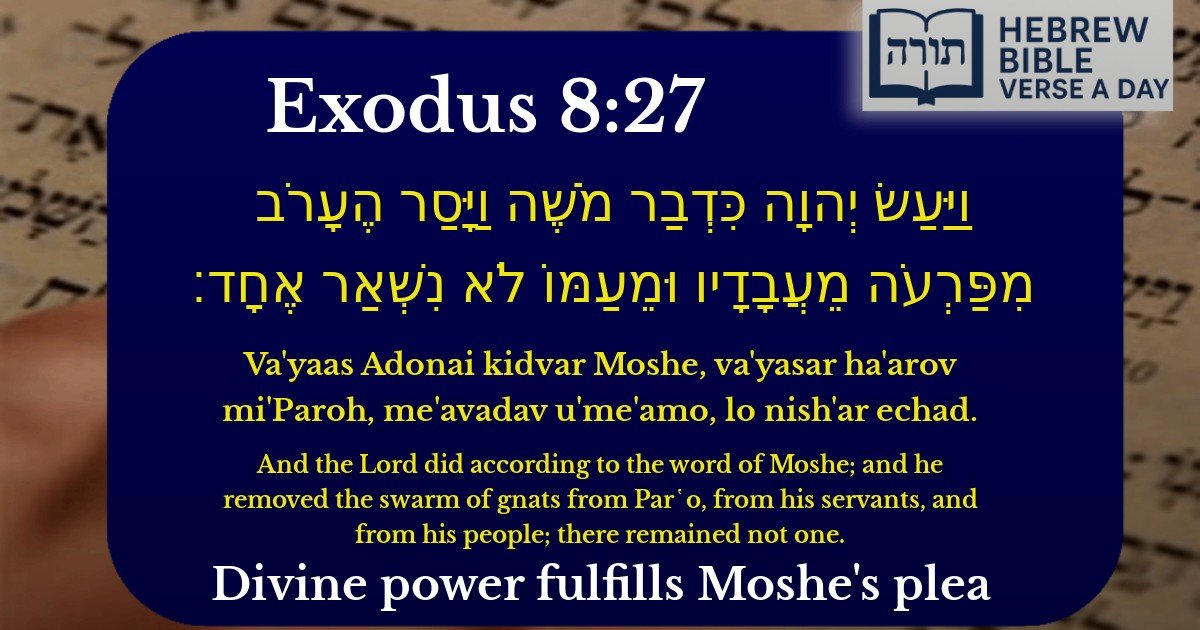
וַיַּעַשׂ יְהוָה כִּדְבַר מֹשֶׁה וַיָּסַר הֶעָרֹב מִפַּרְעֹה מֵעֲבָדָיו וּמֵעַמּוֹ לֹא נִשְׁאַר אֶחָד׃
English Translation
And the Lord did according to the word of Moshe; and he removed the swarm of gnats from Par῾o, from his servants, and from his people; there remained not one.
Transliteration
Va'yaas Adonai kidvar Moshe, va'yasar ha'arov mi'Paroh, me'avadav u'me'amo, lo nish'ar echad.
Hebrew Leining Text
וַיַּ֤עַשׂ יְהֹוָה֙ כִּדְבַ֣ר מֹשֶׁ֔ה וַיָּ֙סַר֙ הֶעָרֹ֔ב מִפַּרְעֹ֖ה מֵעֲבָדָ֣יו וּמֵעַמּ֑וֹ לֹ֥א נִשְׁאַ֖ר אֶחָֽד׃
🎵 Listen to leining
Parasha Commentary
📚 Talmud Citations
This verse is not quoted in the Talmud.
Rashi's Explanation of the Removal of the עָרֹב (Arov)
Rashi (Shemot 8:27) explains that the term עָרֹב refers to a mixture of wild animals, as derived from the root meaning "mixture." This aligns with the earlier description in Shemot 8:17, where the plague is described as a swarm of diverse creatures. The removal of the עָרֹב was complete—לֹא נִשְׁאַר אֶחָד ("not one remained")—demonstrating Hashem's precise control over the plagues, as they came and went exactly as Moshe declared.
Divine Precision in Fulfilling Moshe's Word
The phrase וַיַּעַשׂ יְהוָה כִּדְבַר מֹשֶׁה ("And the Lord did according to the word of Moshe") highlights Moshe's unique prophetic authority. The Rambam (Hilchos Yesodei HaTorah 7:6) teaches that Moshe's prophecy was unparalleled in its clarity and directness. Here, Hashem affirms Moshe's role by executing his request exactly as spoken, reinforcing his status as the definitive leader of Bnei Yisrael.
The Midrashic Perspective on Pharaoh's Stubbornness
The Midrash Tanchuma (Va'eira 14) notes that despite the severity of the plagues, Pharaoh's heart remained hardened. The complete removal of the עָרֹב could have been an opportunity for repentance, yet Pharaoh persisted in his refusal to release Bnei Yisrael. This illustrates the principle that Hashem sometimes allows the wicked to persist in their ways to bring about a greater revelation of His justice (see Rambam, Hilchos Teshuvah 6:3).
The Symbolism of the עָרֹב's Departure
The Ibn Ezra (Shemot 8:27) suggests that the total eradication of the עָרֹב—לֹא נִשְׁאַר אֶחָד—symbolizes the removal of impurity from Mitzrayim. Unlike previous plagues, where remnants may have lingered, this plague's abrupt disappearance underscores that Hashem’s miracles are not bound by natural processes. The Malbim adds that this demonstrated to Pharaoh that the plagues were not natural phenomena but direct acts of divine intervention.