

Join Our Newsletter To Be Informed When New Videos Are Posted
Hebrew Text
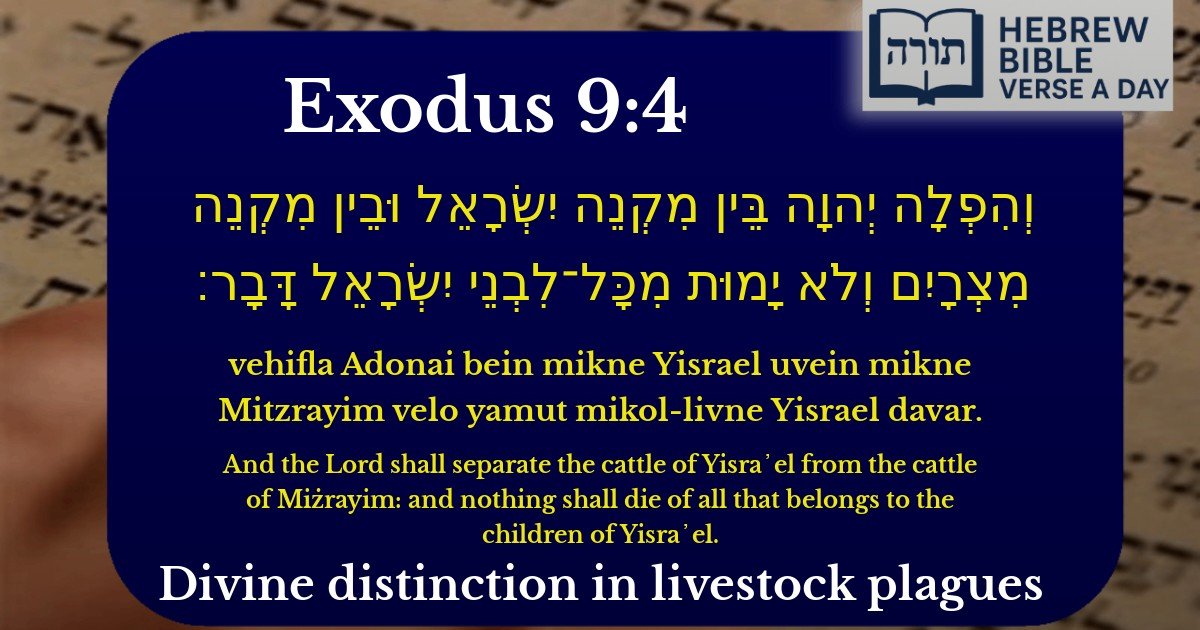
וְהִפְלָה יְהוָה בֵּין מִקְנֵה יִשְׂרָאֵל וּבֵין מִקְנֵה מִצְרָיִם וְלֹא יָמוּת מִכָּל־לִבְנֵי יִשְׂרָאֵל דָּבָר׃
English Translation
And the Lord shall separate the cattle of Yisra᾽el from the cattle of Miżrayim: and nothing shall die of all that belongs to the children of Yisra᾽el.
Transliteration
Vehifla Adonai bein mikne Yisrael uvein mikne Mitzrayim velo yamut mikol-livne Yisrael davar.
Hebrew Leining Text
וְהִפְלָ֣ה יְהֹוָ֔ה בֵּ֚ין מִקְנֵ֣ה יִשְׂרָאֵ֔ל וּבֵ֖ין מִקְנֵ֣ה מִצְרָ֑יִם וְלֹ֥א יָמ֛וּת מִכׇּל־לִבְנֵ֥י יִשְׂרָאֵ֖ל דָּבָֽר׃
🎵 Listen to leining
Parasha Commentary
📚 Talmud Citations
This verse is quoted in the Talmud.
📖 Berakhot 9b
The verse is referenced in a discussion about the distinction between Israel and other nations, particularly in the context of divine protection and separation.
📖 Sotah 11b
The verse is cited in a discussion about the plagues in Egypt and how God distinguished between the Israelites and the Egyptians.
Context in the Plagues
This verse (Shemot 9:4) appears during the fifth plague, Dever (pestilence), which struck the livestock of Egypt. The Torah emphasizes that Hashem would make a clear distinction (vehiflah) between the animals of Israel and those of Egypt, sparing the former entirely. This theme of divine separation recurs throughout the Exodus narrative, highlighting Hashem's providential care for Bnei Yisrael.
Rashi's Explanation
Rashi comments that the term vehiflah ("shall separate") implies a miraculous distinction, as the livestock of Bnei Yisrael and Mitzrayim were intermingled in the fields. Despite this, the plague selectively targeted only the Egyptian animals. Rashi further notes that this demonstrated Hashem's precision in judgment, as Pharaoh had previously doubted Moshe's warnings (Shemot 9:3), saying, "Who among them is Hashem?" The plague affirmed that Hashem governs even over the livestock of nations.
Rambam on Divine Providence
Rambam (Moreh Nevuchim 3:17) discusses how this plague illustrates hashgachah pratit (divine providence) over Bnei Yisrael. Unlike natural disasters, which affect all indiscriminately, the plague was a targeted act of justice, sparing the righteous. This aligns with the principle that Hashem's relationship with Israel is unique, as stated in Devarim 32:8: "He established the borders of nations according to the number of Bnei Yisrael."
Midrashic Insights
Halachic Implications
The Talmud (Bava Kama 60b) derives from this verse that during a plague, one should minimize exposure to danger, as Hashem's protection does not negate the obligation to exercise caution (hishtadlut). The selective nature of the plague also underscores the idea that tzaddikim are shielded from harm through merit, as echoed in Mishlei 12:21: "No harm befalls the righteous."