Frequently Asked Questions
Q: What does Exodus 9:32 mean when it says the wheat and spelt were not struck?
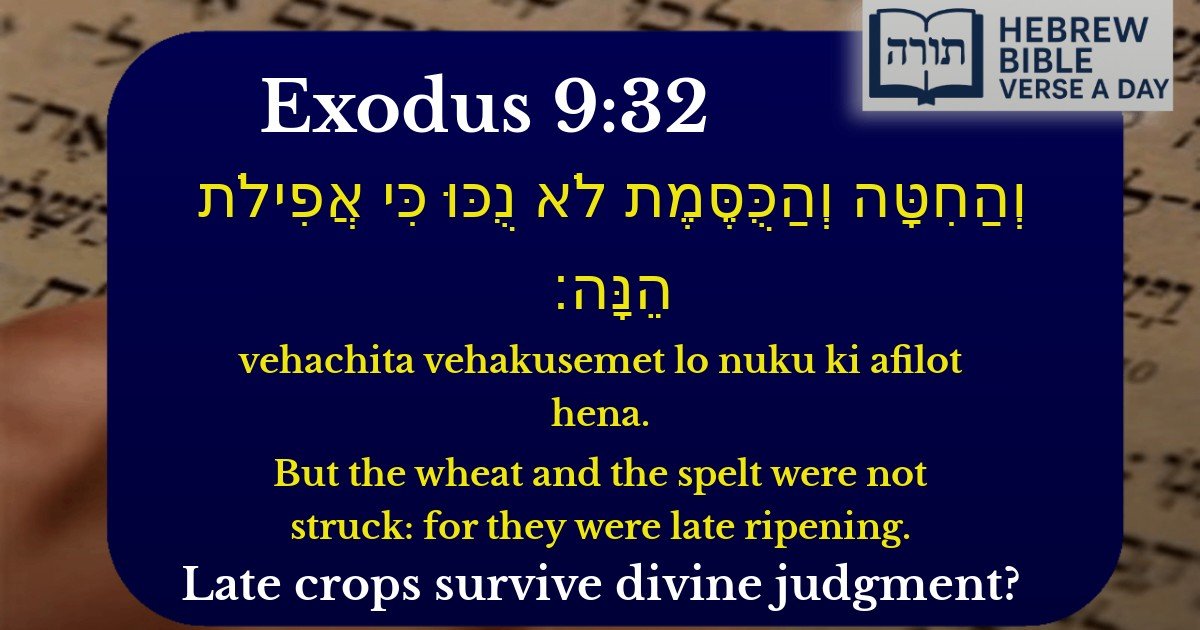
A: This verse refers to the plague of hail in Egypt (Exodus 9:22-26). Rashi explains that the wheat and spelt (kussemet) were not destroyed by the hail because they were 'late-ripening' (afilot) crops that hadn't fully grown yet. This shows Hashem's precision in judgment - only affecting what needed to be struck at that time.
Q: Why is it important that some crops weren't destroyed by the hail?
A: The Torah teaches us two important lessons here: 1) Hashem's judgments are exact and measured (Midrash Tanchuma), only punishing what needs punishment. 2) This preserved some food sources so the Egyptians would have sustenance after the plagues, showing that even in punishment, Hashem maintains some mercy (Rambam, Hilchot Teshuvah).
Q: What's the difference between wheat (chittah) and spelt (kussemet) mentioned here?
A: According to Talmudic sources (Pesachim 35a), spelt (kussemet) is a coarser, inferior type of wheat. The Torah mentions both to teach that all varieties of wheat were spared - showing that Hashem's protection extends to all levels of a species. The Malbim explains this demonstrates divine providence over all creation.
Q: How does this verse about ancient Egyptian crops apply to us today?
A: This teaches us that: 1) Hashem's providence is exact - He knows exactly when and how to act (Rambam, Yesodei HaTorah). 2) We should recognize that difficulties we face may be precisely timed for our growth, just as the hail came at the right time to not destroy all crops. 3) Like the late-ripening wheat, sometimes being 'delayed' is actually divine protection.
Q: Why does the Torah specify which crops were destroyed and which weren't?
A: The Ibn Ezra explains that these details: 1) Prove this was a supernatural event - natural hail would have destroyed everything randomly. 2) Show Pharaoh that Hashem controls nature precisely. 3) Teach future generations about divine justice - that punishment is never arbitrary but carefully measured (Mishlei 16:11). The Sforno adds this demonstrated Hashem's power to the Egyptians and Israelites alike.


Context of the Verse
This verse appears in Shemot (Exodus) 9:32, describing the aftermath of the plague of hail during the Ten Plagues in Egypt. The hail destroyed much of Egypt's crops, but the wheat and spelt were spared because they had not yet fully ripened.
Explanation of the Crops
Rashi explains that "חיטה" (wheat) and "כוסמת" (spelt) were late-ripening grains ("אפילות", meaning "hidden" or "not yet mature"). Unlike barley and flax, which were already in their vulnerable growth stages, wheat and spelt were still in early development, making them resilient to the hail.
Divine Precision in the Plagues
The Midrash (Shemot Rabbah 12:6) highlights that the plagues were meticulously calculated to demonstrate Hashem's control over nature. The hail struck only what was ready to be destroyed, sparing the wheat and spelt to show that the punishment was exact—neither excessive nor insufficient.
Agricultural Insight
Rambam (Moreh Nevuchim 3:48) notes that this detail underscores the Torah's accuracy in describing natural phenomena. Wheat and spelt, being winter crops, were still in their early growth during the month of Shevat (when the plague occurred), aligning with agricultural knowledge of the region.
Spiritual Lesson
The Kli Yakar teaches that this verse also carries a moral lesson: just as the wheat and spelt were spared due to their delayed growth, there are times when delay can be providential. What seems like a setback may actually be divine protection.