Frequently Asked Questions
Q: What does Exodus 14:7 mean when it says Pharaoh took 'six hundred chosen chariots'?
A: This verse describes Pharaoh's powerful military response to the Israelites leaving Egypt. The 'chosen chariots' refer to elite, well-trained forces (Rashi explains they were 'selected from among all others'). Chariots were the most advanced military technology of that time, showing Pharaoh's determination to pursue the Israelites.
Q: Why is it significant that Pharaoh took 'all the chariots of Egypt' in Exodus 14:7?
A: The Torah emphasizes that Pharaoh mobilized Egypt's entire chariot force to show the extreme measures he took against the Israelites. The Midrash (Mechilta) notes this demonstrates how Pharaoh and Egypt stubbornly refused to accept Hashem's will despite the Ten Plagues, leading to their ultimate downfall at the Red Sea.
Q: What does 'shalishim' (captains/officers) mean in Exodus 14:7?
A: The term 'shalishim' refers to high-ranking military officers. Rashi explains they were called this because each chariot had three warriors: a driver, a fighter, and an officer. The Ramban adds that these were Egypt's most experienced commanders, showing Pharaoh sent his best forces to recapture the Israelites.
Q: How does Exodus 14:7 relate to the miracle at the Red Sea?
A: This verse sets the stage for the miracle by showing the overwhelming military might Pharaoh sent against the defenseless Israelites. The Talmud (Sotah 36b) teaches that the greater the earthly threat, the more magnificent Hashem's salvation appeared when He split the sea and drowned these mighty forces.
Q: What lesson can we learn today from Exodus 14:7 about facing challenges?
A: This verse teaches that when facing seemingly insurmountable obstacles (like the Israelites facing Egypt's army), we must remember that Hashem can overcome any human power. As the Midrash Tanchuma explains, the same God who defeated Pharaoh's chariots continues to protect His people throughout history.

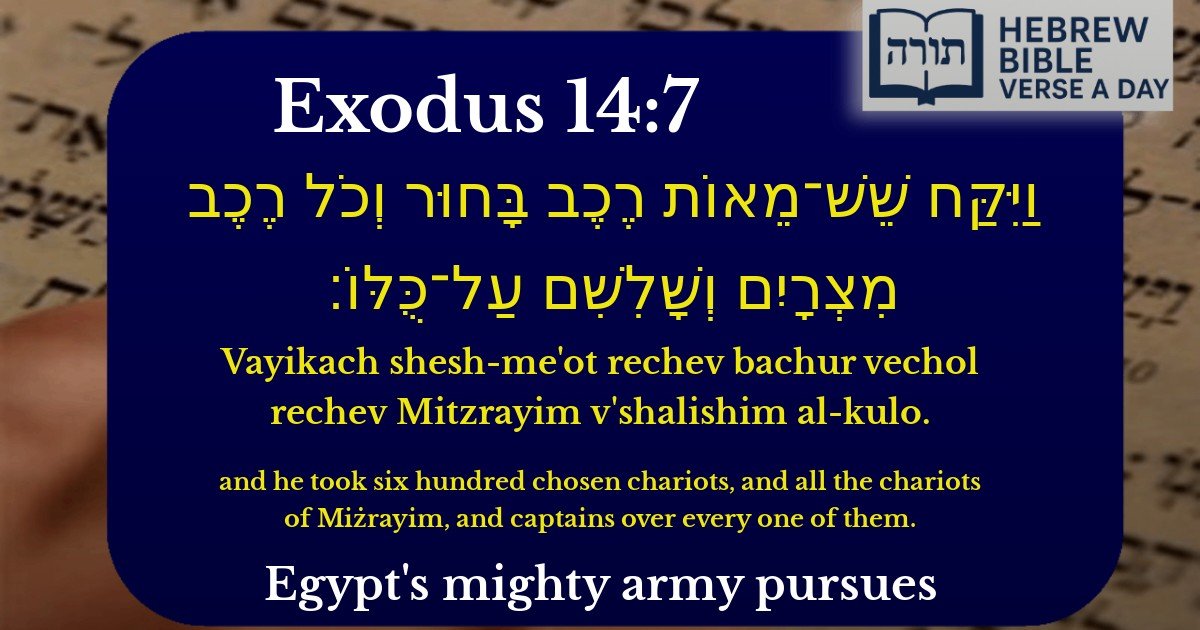

Context in the Exodus Narrative
This verse (Shemot 14:7) describes Pharaoh's military mobilization to pursue Bnei Yisrael after their departure from Mitzrayim. The "six hundred chosen chariots" represent the elite forces of Pharaoh's army, reinforced by additional chariots and officers ("shalishim"). Rashi explains that "shalishim" refers to high-ranking officers, as the term denotes a third-in-command or a distinguished warrior (based on Melachim II 7:2).
Symbolism of the Chariots
The Midrash (Shemot Rabbah 20:5) emphasizes that Pharaoh's reliance on chariots—a symbol of human power and technology—contrasts with Hashem's dominion over nature. The "chosen chariots" (רֶכֶב בָּחוּר) suggest they were specially selected for speed and strength, yet this worldly might would prove futile against divine intervention at the Yam Suf.
The Number Six Hundred
The Role of the "Shalishim"
Ibn Ezra interprets "shalishim" as officers overseeing each chariot crew, reflecting Mitzrayim's highly organized military hierarchy. The Kli Yakar adds that their presence underscores Pharaoh's desperation—deploying his entire command structure to reclaim slaves, which ultimately exposed his arrogance and folly.
Contrast with Divine Providence
The Mechilta (Beshalach 2) highlights the irony: Pharaoh's vast forces, meant to intimidate, became instruments of his downfall. The verse sets the stage for the miracle at the Yam Suf, where human strength is humbled by Hashem's intervention, as later stated: "Hashem will fight for you" (Shemot 14:14).