Frequently Asked Questions
Q: Why did the Israelites complain about water in Exodus 15:24?
A: The Israelites had just witnessed the miracle of the splitting of the Red Sea, yet they quickly complained when they lacked drinkable water at Marah. Rashi explains that this shows their lack of trust in Hashem, despite having seen great miracles. The water was bitter (marah), which is why they protested to Moshe.
Q: What lesson can we learn from Exodus 15:24?
A: This verse teaches the importance of faith and patience. Even after experiencing Hashem's miracles, the Israelites struggled with trust when facing difficulties. The Rambam (Hilchot De'ot) emphasizes that true faith means relying on Hashem even in challenging situations, rather than complaining.
Q: How did Moshe respond to the people's complaint about water?
A: Moshe turned to Hashem in prayer (as seen in the next verse, Exodus 15:25), and Hashem showed him a piece of wood to sweeten the bitter waters. The Midrash (Mechilta) explains that this teaches the power of prayer and that Hashem provides solutions to hardships when we seek His guidance.
Q: Why is this incident at Marah significant in Jewish tradition?
A: The Sages teach that at Marah, Hashem gave the Israelites some basic mitzvot (commandments) to prepare them for receiving the Torah at Sinai (Sanhedrin 56b). This episode highlights that challenges are opportunities for spiritual growth and deeper connection to Hashem's commandments.
Q: How does this verse apply to our lives today?
A: Just as the Israelites faced difficulties after their redemption, we too encounter challenges in life. The Chofetz Chaim teaches that instead of complaining, we should strengthen our emunah (faith) and turn to Hashem with trust, knowing that He guides us through every hardship.

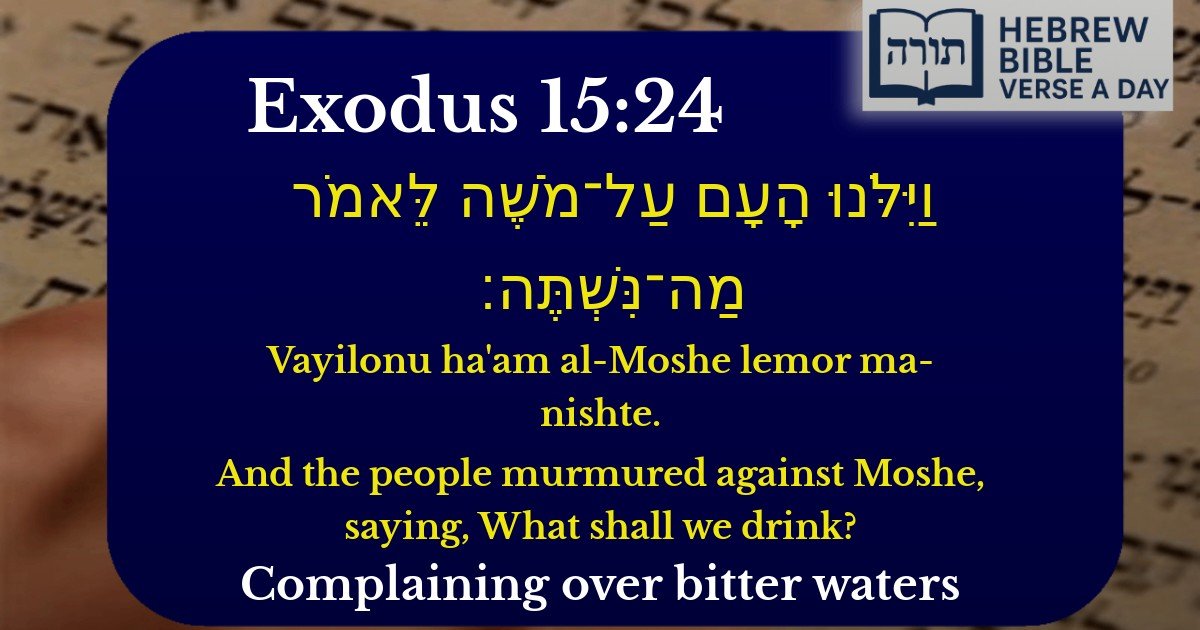

Context of the Verse
The verse (Shemot 15:24) describes the Israelites' complaint about the bitter waters at Marah, shortly after their miraculous crossing of the Red Sea. This event occurs just three days after witnessing Hashem's great miracles, highlighting the people's struggle with faith in challenging circumstances.
Rashi's Commentary
Rashi explains that the phrase "וַיִּלֹּנוּ" (and they murmured) indicates the people complained in a contentious manner. He notes that this was the first of several complaints during their journey, setting a troubling pattern. Rashi also points out that their murmuring was directed specifically at Moshe, despite Hashem being the ultimate provider, showing a lack of proper perspective.
Ibn Ezra's Insight
Ibn Ezra observes that the people's question "מַה־נִּשְׁתֶּה" (what shall we drink?) reflects genuine distress, as water is an immediate physical need. However, he notes that their approach - complaining rather than praying - demonstrated spiritual immaturity after having just witnessed Hashem's miracles.
Midrashic Interpretation
The Midrash (Mechilta) elaborates that this incident tested the Israelites' faith. It compares their reaction to a child who rebels against a parent after receiving many gifts. The Midrash emphasizes that true faith requires trusting in Hashem even when facing difficulties.
Rambam's Perspective
In his philosophical works, Rambam (Maimonides) would later explain that such tests help develop human free will and spiritual growth. The bitter waters served as an opportunity for the people to choose faith over complaint, preparing them for receiving the Torah.
Lessons from the Verse