

Join Our Newsletter To Be Informed When New Videos Are Posted
Hebrew Text
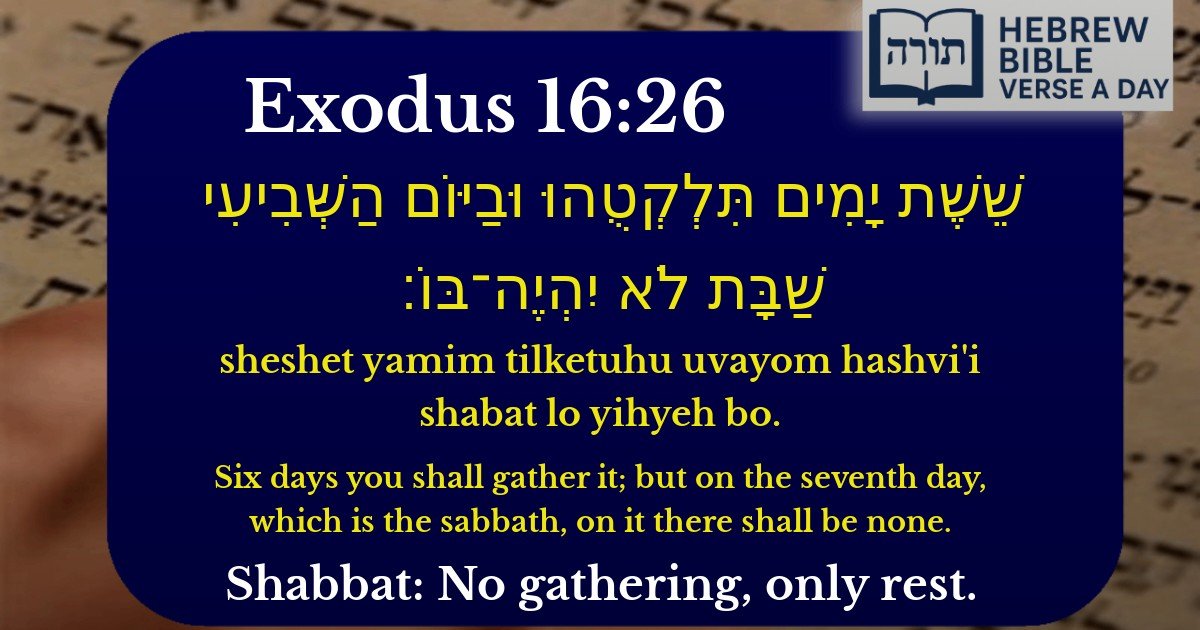
שֵׁשֶׁת יָמִים תִּלְקְטֻהוּ וּבַיּוֹם הַשְּׁבִיעִי שַׁבָּת לֹא יִהְיֶה־בּוֹ׃
English Translation
Six days you shall gather it; but on the seventh day, which is the sabbath, on it there shall be none.
Transliteration
Sheshet yamim tilketuhu uvayom hashvi'i shabat lo yihyeh bo.
Hebrew Leining Text
שֵׁ֥שֶׁת יָמִ֖ים תִּלְקְטֻ֑הוּ וּבַיּ֧וֹם הַשְּׁבִיעִ֛י שַׁבָּ֖ת לֹ֥א יִֽהְיֶה־בּֽוֹ׃
🎵 Listen to leining
Parasha Commentary
📚 Talmud Citations
This verse is quoted in the Talmud.
📖 Shabbat 87b
The verse is referenced in the discussion about the laws of Shabbat and the gathering of manna, illustrating the prohibition of gathering on the Sabbath.
📖 Yoma 75b
The verse is cited in the context of discussing the miracle of the manna and the observance of Shabbat during the Israelites' time in the wilderness.
Context in the Torah
This verse (Exodus 16:26) appears in the narrative of the manna, the miraculous food provided to the Israelites in the wilderness. The verse establishes the prohibition against gathering manna on Shabbat, reinforcing the sanctity of the seventh day.
Rashi's Commentary
Rashi explains that the phrase "שֵׁשֶׁת יָמִים תִּלְקְטֻהוּ" ("Six days you shall gather it") teaches that gathering manna was permitted only on the six weekdays, while "וּבַיּוֹם הַשְּׁבִיעִי שַׁבָּת לֹא יִהְיֶה־בּוֹ" ("but on the seventh day, the Sabbath, there shall be none") emphasizes that no manna would descend on Shabbat. This served as a test and lesson for Bnei Yisrael to observe Shabbat fully, trusting in Hashem's providence.
Rambam's Perspective
In Hilchot Shabbat (Laws of Shabbat), Rambam (Maimonides) derives from this verse that the prohibition of gathering manna on Shabbat is a prototype for the broader melachah (forbidden labor) of kotzer (reaping). This establishes a Torah-level prohibition against harvesting on Shabbat, which extends to other forms of gathering or collecting.
Midrashic Insights
Halachic Implications
The verse underscores the principle of menucha (rest) on Shabbat, not only refraining from labor but also trusting in Hashem's provision. The Talmud (Shabbat 117b) links this to the prohibition of preparing food on Shabbat, as the Israelites were forbidden even to "gather" what was already available.