

Join Our Newsletter To Be Informed When New Videos Are Posted
Hebrew Text
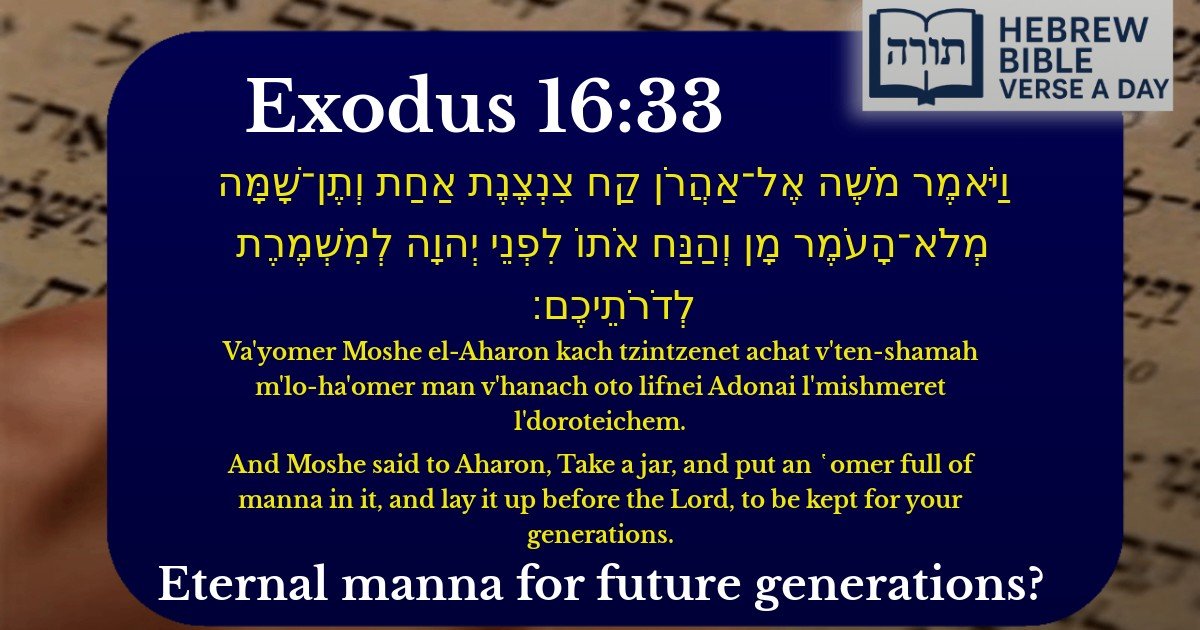
וַיֹּאמֶר מֹשֶׁה אֶל־אַהֲרֹן קַח צִנְצֶנֶת אַחַת וְתֶן־שָׁמָּה מְלֹא־הָעֹמֶר מָן וְהַנַּח אֹתוֹ לִפְנֵי יְהוָה לְמִשְׁמֶרֶת לְדֹרֹתֵיכֶם׃
English Translation
And Moshe said to Aharon, Take a jar, and put an ῾omer full of manna in it, and lay it up before the Lord, to be kept for your generations.
Transliteration
Va'yomer Moshe el-Aharon kach tzintzenet achat v'ten-shamah m'lo-ha'omer man v'hanach oto lifnei Adonai l'mishmeret l'doroteichem.
Hebrew Leining Text
וַיֹּ֨אמֶר מֹשֶׁ֜ה אֶֽל־אַהֲרֹ֗ן קַ֚ח צִנְצֶ֣נֶת אַחַ֔ת וְתֶן־שָׁ֥מָּה מְלֹֽא־הָעֹ֖מֶר מָ֑ן וְהַנַּ֤ח אֹתוֹ֙ לִפְנֵ֣י יְהֹוָ֔ה לְמִשְׁמֶ֖רֶת לְדֹרֹתֵיכֶֽם׃
🎵 Listen to leining
Parasha Commentary
📚 Talmud Citations
This verse is quoted in the Talmud.
📖 Yoma 52a
The verse is referenced in a discussion about the preservation of the manna as a testimony for future generations, connecting it to the hidden jar of manna mentioned in the verse.
📖 Menachot 99b
The verse is cited in a discussion about the measurements and the significance of the omer of manna that was kept as a memorial.
The Command to Preserve the Manna
The verse (Shemot 16:33) describes Moshe instructing Aharon to take a jar (tzintzenet) and place an omer of manna inside it, to be preserved before Hashem for future generations. This act serves as a testimony to the miracle of the manna that sustained Bnei Yisrael in the wilderness.
Rashi's Explanation
Rashi (on Shemot 16:33) explains that the jar was made of gold, as indicated by the term tzintzenet, which implies a vessel of importance. He further notes that the manna was placed before the Ark of the Covenant, as stated later in the Torah (Shemot 16:34). This placement ensured that future generations would witness the miracle and remember Hashem's providence.
Rambam's Perspective
In Moreh Nevuchim (3:50), Rambam discusses the significance of preserving the manna as a means of reinforcing faith in Divine sustenance. The manna, which appeared daily in exact measure according to each person's needs, demonstrated Hashem's direct involvement in the lives of Bnei Yisrael. By preserving it, the Torah ensures that this lesson endures for all generations.
Midrashic Insights
Halachic Significance
The Ramban (on Shemot 16:33) connects this mitzvah to the broader concept of zechirah (remembrance) in Judaism. Just as we remember the Exodus through matzah on Pesach, the jar of manna served as a physical reminder of Hashem's kindness during the wilderness journey. This aligns with the principle that tangible symbols help reinforce spiritual lessons.
The Symbolism of the Omer Measure
The omer measure (approximately 2.3 liters) represents the daily portion allotted to each person. By preserving this exact amount, the Torah emphasizes that sustenance comes from Hashem in precise measure—neither too little nor too much—teaching trust in Divine providence (bitachon).