Frequently Asked Questions
Q: What does it mean that Israel prevailed when Moshe raised his hands?
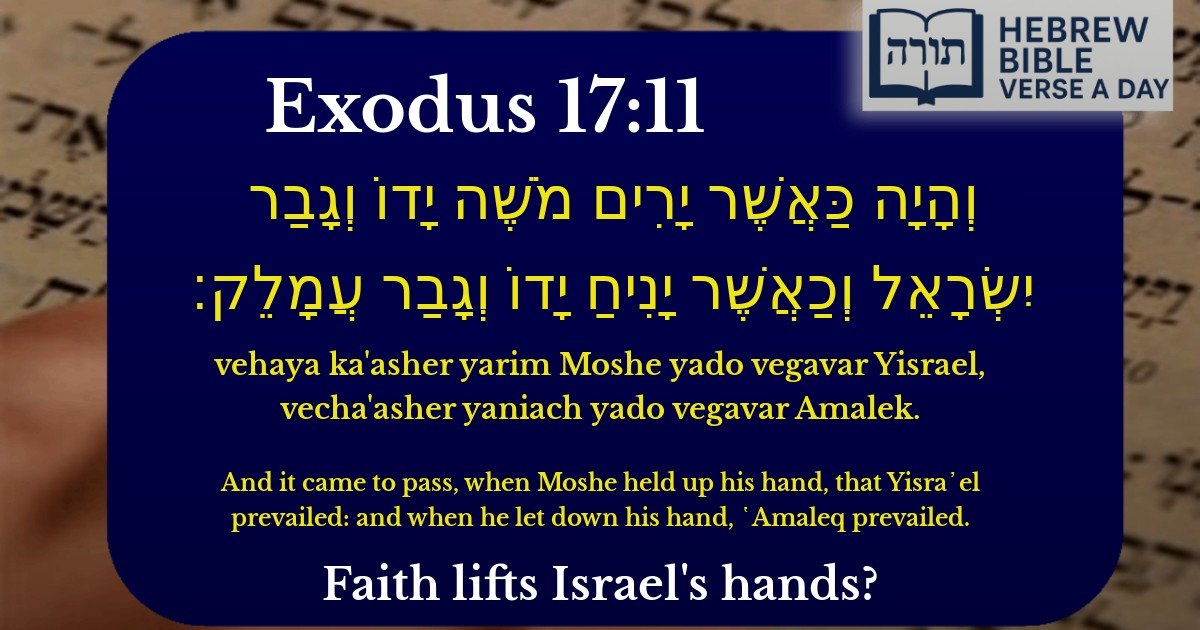
A: According to Rashi and the Talmud (Rosh Hashanah 29a), Moshe raising his hands symbolized the Jewish people looking upward and submitting their hearts to Hashem. It wasn't the physical act of raising hands that brought victory, but rather the spiritual awakening and prayer it represented. When the people focused on Heaven, they merited Divine assistance in battle.
Q: Why did Amalek gain strength when Moshe lowered his hands?
A: The Midrash explains that when Moshe's hands grew heavy and began to lower, it reflected a weakening in the people's spiritual focus and connection to Hashem. Amalek, representing doubt and coldness toward holiness (as the Torah states in Devarim 25:18), would gain strength whenever Israel's faith wavered. This teaches that our spiritual state directly impacts our physical circumstances.
Q: What practical lesson can we learn from this verse today?
A: The Rambam teaches that this episode demonstrates the power of prayer and trust in Hashem during challenges. Just as Israel needed to maintain their spiritual focus against Amalek, we must strengthen our faith and connection to Torah especially during difficult times. The verse also teaches communal responsibility - Aharon and Hur supported Moshe's hands, showing we must help each other in serving Hashem.
Q: Why is this battle against Amalek so significant in Jewish tradition?
A: As explained in the Midrash and later Jewish thought, Amalek represents the archetype of evil and doubt that attacks when Jewish commitment weakens. This first confrontation established the eternal struggle between holiness and cynicism. The Torah commands us to remember Amalek's attack (Devarim 25:17-19) to remind us to constantly strengthen our faith and Jewish identity.
Q: How could Moshe's hands affect the battle if he wasn't fighting?
A: The Talmud (Rosh Hashanah 29a) clarifies that the Jewish soldiers didn't win because of Moshe's hands, but because when they saw his uplifted hands, they redirected their hearts to Heaven. Moshe served as the spiritual leader who inspired their faith. This teaches that true success comes from Hashem, and physical efforts must be accompanied by spiritual awareness.


Understanding the Verse in Context
The verse (Shemot 17:11) describes the battle between Israel and Amalek, where Moshe's raised or lowered hands determined Israel's success or failure in battle. This event occurred shortly after the Exodus, as Amalek attacked Israel in the wilderness.
Rashi's Explanation
Rashi (Rabbi Shlomo Yitzchaki) comments that Moshe's hands were not magical but symbolic. When Israel looked upward and subjugated their hearts to their Father in Heaven, they prevailed; when they did not, they faltered. The raising of Moshe's hands directed the people's attention to Hashem, reinforcing their faith.
Rambam's Perspective
Rambam (Maimonides) in Moreh Nevuchim (3:22) explains that the raising of Moshe's hands served as a sign to inspire the people to trust in Hashem rather than their own strength. The battle's outcome was determined by divine providence, contingent on Israel's spiritual state.
Midrashic Insights
Talmudic Interpretation
The Talmud (Rosh Hashanah 29a) discusses whether Moshe's hands were literally raised or if the verse refers to Israel's focus on prayer. The conclusion is that the people's hearts were directed toward Heaven, demonstrating that spiritual devotion, not physical gestures, determined the outcome.
Practical Lessons