Frequently Asked Questions
Q: What does the verse 'And Yehoshua harried Amaleq and his people with the edge of the sword' mean?
A: This verse describes the battle between the Israelites, led by Yehoshua (Joshua), and Amaleq, a nation that attacked the Jewish people in the wilderness. Yehoshua weakened ('harried') Amaleq in battle, striking them down with the sword. According to Rashi, this was a decisive victory, fulfilling Hashem's command to fight against Amaleq (Exodus 17:9-10).
Q: Why is the battle against Amaleq important in Jewish tradition?
A: Amaleq represents the archetype of evil and cruelty in Jewish thought. The Midrash teaches that Amaleq attacked the weak and defenseless among the Israelites (Deuteronomy 25:18). This battle is significant because it symbolizes the ongoing struggle against hatred and oppression. The Rambam (Maimonides) explains that there is a mitzvah (commandment) to remember and oppose Amaleq's ideology (Hilchot Melachim 5:5).
Q: What lesson can we learn from Yehoshua's victory over Amaleq?
A: The Talmud (Sanhedrin 20b) teaches that Yehoshua's leadership in this battle demonstrated the importance of faith and courage in overcoming adversaries. Just as Moshe (Moses) raised his hands in prayer (Exodus 17:11-12) while Yehoshua fought, we learn that success comes through both spiritual devotion and physical effort. This teaches us to confront challenges with trust in Hashem and determined action.
Q: How does the battle against Amaleq apply to us today?
A: The Torah commands us to 'remember what Amaleq did' (Deuteronomy 25:17) and to oppose evil in every generation. The Sages explain that Amaleq's descendants represent those who seek to harm the Jewish people or deny Hashem's presence in the world (Tanchuma, Ki Teitzei 9). Today, we fulfill this by standing against hatred, supporting justice, and strengthening our faith.
Q: Why did Yehoshua lead the battle instead of Moshe?
A: Rashi (on Exodus 17:9) explains that Moshe appointed Yehoshua to lead the battle to train him for future leadership. The Midrash (Mechilta) adds that Yehoshua was chosen because of his loyalty and potential to succeed Moshe. This teaches the importance of mentoring the next generation to continue the mission of upholding Torah values.

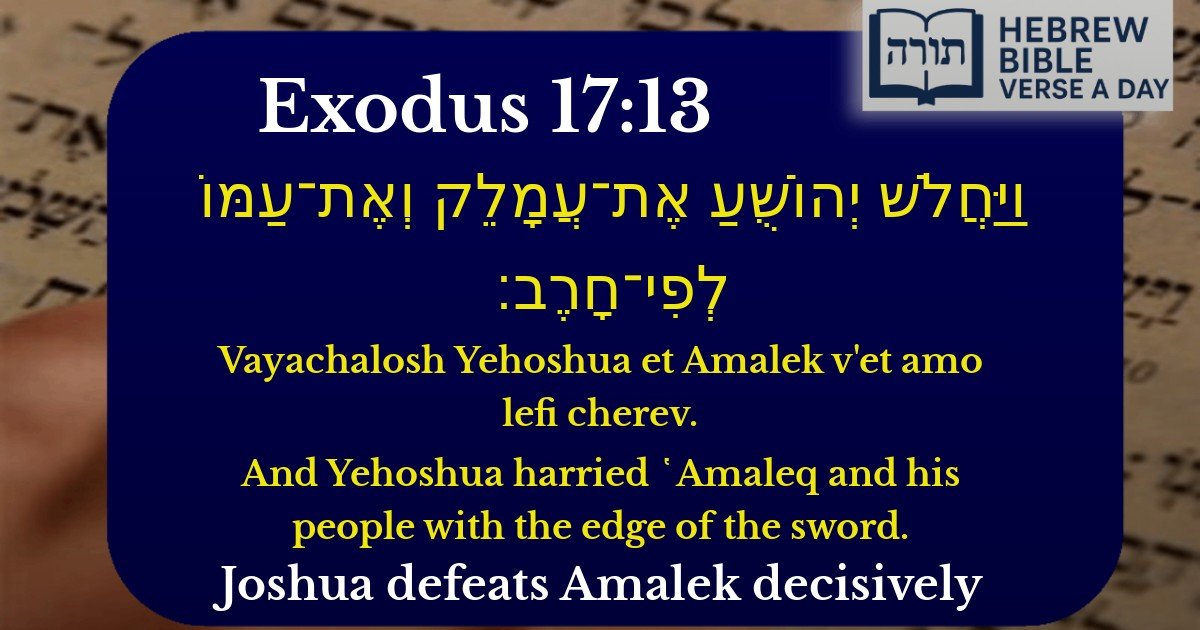

Verse Context (Shemot 17:13)
This verse describes Yehoshua's military victory over Amalek during the battle at Refidim, as recounted in Parashat Beshalach. The battle followed Amalek's unprovoked attack on Bnei Yisrael, marking them as an eternal enemy (Devarim 25:17-19).
Grammatical Analysis
The term "וַיַּחֲלֹשׁ" (vayachalosh) is derived from the root ח.ל.ש, which Rashi explains as meaning "to weaken" or "to subdue." This suggests Yehoshua didn't merely defeat Amalek but systematically weakened their military power.
Military Strategy
Rambam (Hilchot Melachim 5:1) notes that the phrase "לְפִי־חָרֶב" (with the edge of the sword) implies a targeted military engagement rather than indiscriminate slaughter. The Malbim adds that this phrasing indicates Yehoshua focused on Amalek's combatants while minimizing collateral damage.
Spiritual Dimensions
Halachic Implications
The Mechilta derives from this verse that Amalek's unique status as an eternal enemy requires special military response, later codified in halacha (Rambam, Hilchot Melachim 5:4-5). The phrase "his people" indicates this obligation extends to all Amalekites, not just combatants.
Historical Perspective
Ibn Ezra notes this was the first military test for the young nation, establishing Yehoshua's leadership credentials. The victory's partial nature (not complete annihilation) foreshadows future conflicts with Amalek throughout Jewish history.