Frequently Asked Questions
Q: What does Exodus 21:1 mean when it says 'set before them'?
A: Rashi explains that 'set before them' means the laws must be taught clearly and thoroughly, like a set table ready for eating. The Torah should be presented in an orderly and understandable way so people can properly observe the mitzvot.
Q: Why does the Torah introduce laws with 'these are the judgments'?
A: The Midrash teaches that the word 'judgments' (mishpatim) refers to logical, ethical laws that human intellect would arrive at even if not commanded. This distinguishes them from 'chukim' (statutes), which are Divine decrees beyond human understanding. Both are equally binding.
Q: What is the significance of the laws beginning right after the Ten Commandments?
A: The Talmud (Makkot 24a) notes that just as the Ten Commandments were given at Sinai, these civil laws were also given at Sinai. This teaches that both ritual and civil laws are Divine commandments, not man-made systems. Proper interpersonal conduct is fundamental to Torah living.
Q: How do these laws apply to us today?
A: Rambam (Hilchot Sanhedrin 24:10) rules that while we can't currently enforce all these laws without the Sanhedrin, their ethical principles remain eternally valid. For example, the detailed laws about damages teach us to be careful with others' property and safety in all generations.
Q: Why does the verse say 'before them' and not 'to them'?
A: The Kli Yakar explains 'before them' emphasizes that judges must lay out all arguments clearly before deciding. It also teaches that Torah must be accessible to all - placed 'before their eyes' through proper education, not reserved for scholars alone.


Introduction to the Verse
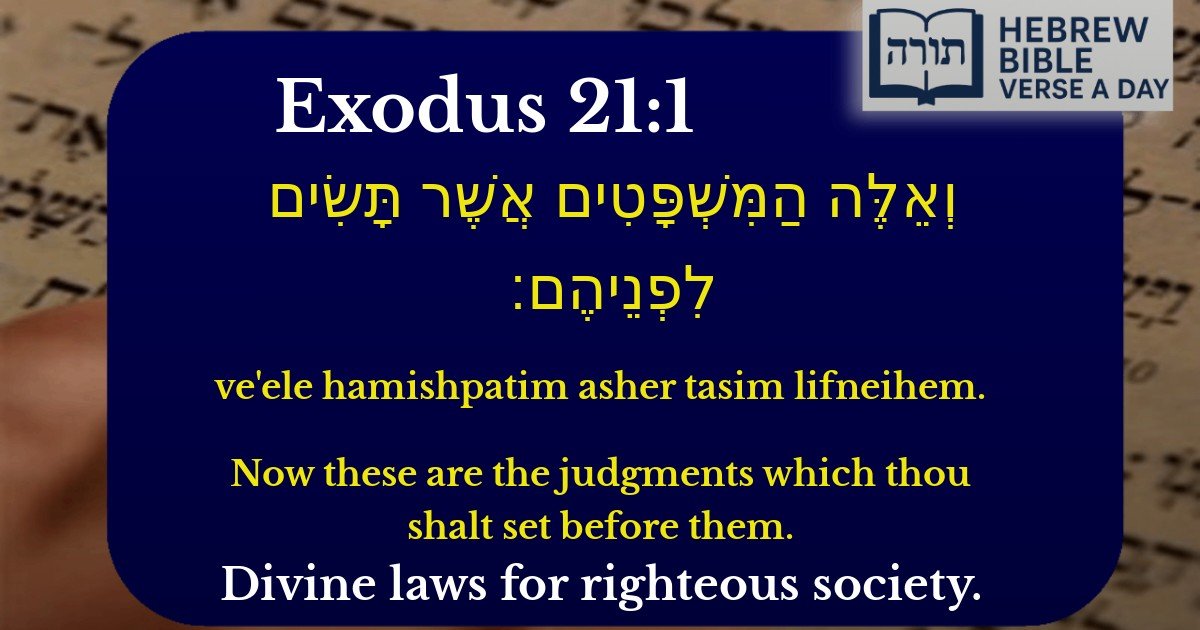
The verse "וְאֵלֶּה הַמִּשְׁפָּטִים אֲשֶׁר תָּשִׂים לִפְנֵיהֶם" (Shemot 21:1) introduces the section of Mishpatim (civil and ethical laws) following the revelation at Har Sinai. The placement of these laws immediately after the Aseret HaDibrot underscores their centrality in Torah.
Rashi's Explanation
Rashi comments on the word "וְאֵלֶּה" (and these), noting that it connects the Mishpatim to the preceding commandments. Just as the Ten Commandments were given at Sinai, so too were these civil laws. This teaches that both ritual and civil laws are of Divine origin.
Regarding "תָּשִׂים לִפְנֵיהֶם" (set before them), Rashi explains that Moshe was instructed to teach the laws clearly and systematically, like a set table ready for eating. This implies that Torah must be presented in an accessible and orderly manner.
Rambam's Perspective
In Mishneh Torah (Hilchot Talmud Torah 1:11), Rambam emphasizes that a teacher must ensure students comprehend the material thoroughly. The phrase "לִפְנֵיהֶם" suggests that laws must be taught with clarity and patience, allowing students to grasp both the general principles and finer details.
Talmudic and Midrashic Insights
Chassidic Interpretation
The Baal Shem Tov teaches that "לִפְנֵיהֶם" also refers to setting the laws before one's own face—internalizing them personally before teaching others. True justice requires the teacher to embody the laws in thought, speech, and action.