Frequently Asked Questions
Q: What does Exodus 21:5 mean when it talks about a servant choosing to stay with his master?
A: Exodus 21:5 describes a Hebrew servant who, after serving for six years (as mentioned in the previous verses), has the option to go free in the seventh year. However, if he declares his love for his master, his wife, and his children, he can choose to remain a servant forever. This shows the Torah's balance between personal freedom and voluntary commitment. Rashi explains that this teaches the value of loyalty and love, even in difficult circumstances.
Q: Why would a servant choose to stay with his master instead of becoming free?
A: According to Jewish tradition, a servant might choose to stay with his master out of deep loyalty, love for his family (since his wife and children may remain with the master), or because he has built a meaningful life in that household. The Talmud (Kiddushin 22a) discusses that this decision reflects a bond of trust and mutual respect, showing that servitude in the Torah is not always oppressive but can be a relationship of devotion.
Q: What lesson can we learn from Exodus 21:5 today?
A: This verse teaches the importance of commitment and responsibility. Even when given the chance for personal freedom, the servant prioritizes his relationships—his master, wife, and children. The Rambam (Hilchos Avadim 3:14) explains that this highlights the Torah's emphasis on valuing human connections over mere personal gain. Today, this reminds us to cherish and uphold our commitments to family and community.
Q: How was the servant's ear pierced in this law (related to Exodus 21:5-6)?
A: If the servant chose to stay, he would be brought to the doorpost, and his master would pierce his ear with an awl (Exodus 21:6). Rashi explains that the ear is pierced because it 'heard at Mount Sinai' that the Jewish people are meant to serve Hashem, not human masters—yet this servant chose to remain in servitude. The doorpost is symbolic, as it recalls the Exodus from Egypt (where doorposts were marked with blood), reminding him of his true freedom.
Q: Does Exodus 21:5 apply to modern times?
A: While the formal laws of Hebrew servitude do not apply today (as the Talmud explains, these laws were specific to certain historical and economic conditions), the ethical principles remain relevant. The verse teaches about loyalty, love for family, and making responsible choices. The Midrash (Mechilta) connects this to broader ideas of serving Hashem with devotion, showing that spiritual commitment is timeless.

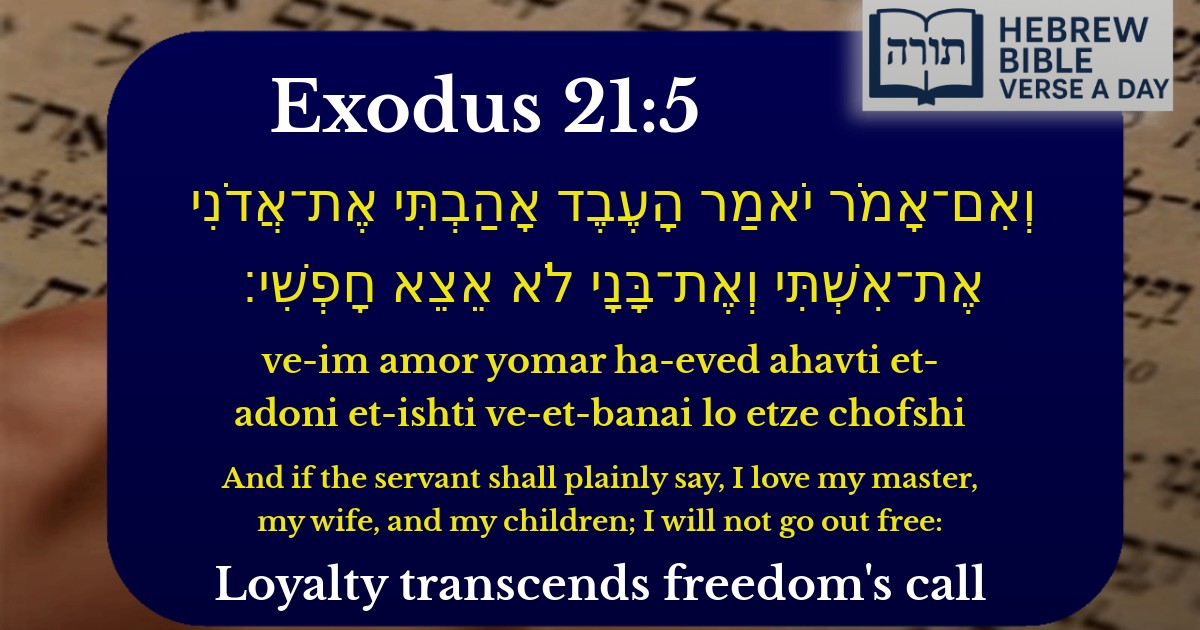

The Servant's Declaration of Love
The verse (Shemot 21:5) describes a Hebrew servant who, upon completing his six years of servitude, chooses to remain with his master rather than go free. Rashi explains that this declaration—"I love my master, my wife, and my children"—reveals the servant's deep attachment to his master's household. The repetition of "אָמֹר יֹאמַר" ("shall plainly say") emphasizes the sincerity and deliberateness of his decision.
Halachic Implications
The Rambam (Hilchos Avadim 3:13) elaborates on the halachic process: the servant must express this declaration before a Beit Din (Jewish court) and undergo the ritual of having his ear pierced with an awl at the doorpost (as described in the subsequent verse). This act symbolizes his commitment to perpetual servitude, as the ear that heard Har Sinai proclaim, "For the Children of Israel are servants to Me" (Vayikra 25:55), now chooses human servitude over divine service.
Midrashic Insights
The Mechilta (Mishpatim 3) questions why the servant mentions loving his wife and children, since they technically belong to his master (as per the laws of an eved ivri). It answers that this reflects his moral and emotional bond, transcending legal ownership. The Sforno adds that the servant's love for his master stems from the master's righteous conduct, which inspired the servant to willingly remain.
Philosophical Dimensions