Frequently Asked Questions
Q: What does Exodus 21:20 mean when it says 'he shall be surely punished'?
A: The verse teaches that if a master strikes his servant (Hebrew 'eved' or 'amah') with a rod and the servant dies as a result, the master must be punished. According to Rashi and the Talmud (Sanhedrin 52b), this means the master is subject to the death penalty, just as if he had killed any other person, showing the Torah's value for human life.
Q: Why does the Torah specify punishment for killing a servant?
A: The Torah emphasizes that even servants have rights and their lives are sacred. Rambam (Hilchos Rotzeach 2:14) explains that this law demonstrates that servants are not mere property—they are human beings created in G-d's image. The verse comes to counter the ancient mindset that masters had unlimited power over servants.
Q: Does this law apply today if someone harms their employee?
A: While the specific case deals with servants in biblical times, the principle applies today regarding employers and workers. The Talmud (Bava Kamma 83a) derives from this verse that causing harm to others is always forbidden. Modern halacha (Jewish law) strictly prohibits physical abuse or endangering workers in any way.
Q: Why does the verse mention being struck 'with a rod' specifically?
A: Rashi explains that the 'shevet' (rod) was a common disciplinary tool, but the Torah sets limits—even justified discipline must never be excessive or life-threatening. The Mekhilta (a halachic midrash) notes that this teaches us that any instrument causing death would make the perpetrator liable, not just a rod.
Q: What lesson can we learn from Exodus 21:20 about power dynamics?
A: The verse teaches that those in positions of authority (masters, employers, leaders) must never abuse their power. The Sforno comments that this law reminds us that no human has absolute dominion over another—only G-d has ultimate authority. We must treat all people with dignity, regardless of social status.

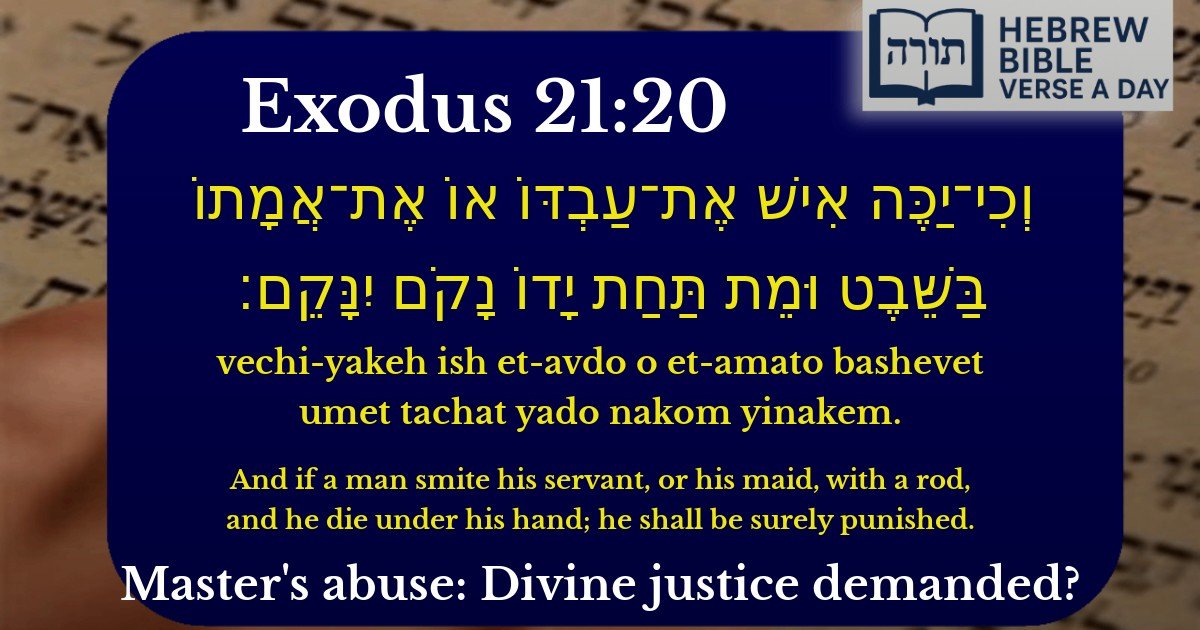

Literal Interpretation (Peshat)
The verse (Shemot 21:20) addresses the case where a master strikes his Hebrew servant or maidservant with a rod, resulting in their death. The Torah mandates that the master "shall surely be punished" (נָקֹם יִנָּקֵם), indicating capital punishment (Rashi, based on Sanhedrin 52b). This law underscores the severity of taking a life, even within the master-servant relationship.
Legal Context (Halacha)
According to Rambam (Hilchot Rotzeach 2:14-15), this law applies specifically to a eved ivri (Hebrew servant), not a Canaanite slave. The Talmud (Sanhedrin 52b) clarifies that the phrase "under his hand" implies immediate death from the beating, excluding cases where the servant dies after a delay. The punishment is administered by Beit Din (court of law) if witnesses testify to the act.
Moral and Ethical Dimensions (Derash)
The Midrash (Mechilta d'Rabbi Yishmael) highlights the ethical imperative here: even though the servant is temporarily under the master's authority, excessive cruelty is forbidden. The phrase "with a rod" suggests that while mild discipline is permitted (as in Mishlei 23:13-14), lethal force is strictly prohibited. This aligns with the broader Torah principle of human dignity (Tzelem Elokim).
Comparative Analysis
Practical Implications
The Shulchan Aruch (Choshen Mishpat 420:31) cites this verse as a basis for prohibiting excessive physical discipline, even in educational or disciplinary contexts. The Rema adds that one who kills through such actions is subject to earthly and heavenly judgment, reinforcing the sanctity of life.