Frequently Asked Questions
Q: What does 'burning for burning, wound for wound, bruise for bruise' mean in Exodus 21:25?
A: This verse is part of the Torah's laws about damages and compensation. It teaches the principle of proportional justice - that the punishment or compensation should match the injury caused. Rashi explains that this means the offender must pay monetary compensation equivalent to the damage inflicted (based on Talmud, Bava Kamma 83b).
Q: Why is Exodus 21:25 important in Jewish law?
A: This verse establishes a fundamental principle in Jewish civil law (Halacha) about personal injury cases. The Rambam (Hilchot Chovel Umazik 1:3) explains that these laws teach us about taking responsibility for harming others and making proper restitution. It shows Judaism's emphasis on justice and fairness in interpersonal relationships.
Q: How does 'wound for wound' apply today according to Jewish tradition?
A: The Talmud (Bava Kamma 83b) explains that this doesn't mean literal physical retaliation, but rather financial compensation. Today, Jewish courts would require the offender to pay for medical expenses, pain, embarrassment, lost wages, and healing costs (based on Rambam's Hilchot Chovel Umazik). This shows Judaism's emphasis on repairing harm rather than vengeance.
Q: What can we learn from the repetition in 'burning for burning, wound for wound'?
A: The Midrash (Mechilta) notes that the repetition teaches that each type of injury requires its own specific evaluation and compensation. A burn is different from a wound or bruise in terms of pain and healing. This teaches us to be precise in matters of justice and recognize that different harms require different remedies.
Q: Does Exodus 21:25 mean we should take revenge?
A: No, Jewish tradition strongly opposes personal revenge. The Talmud (Sanhedrin 49a) explains these verses are about court-administered justice, not personal retaliation. The Torah elsewhere (Vayikra 19:18) commands 'Do not take revenge.' These laws are about restoring balance through proper legal channels, not about personal vengeance.

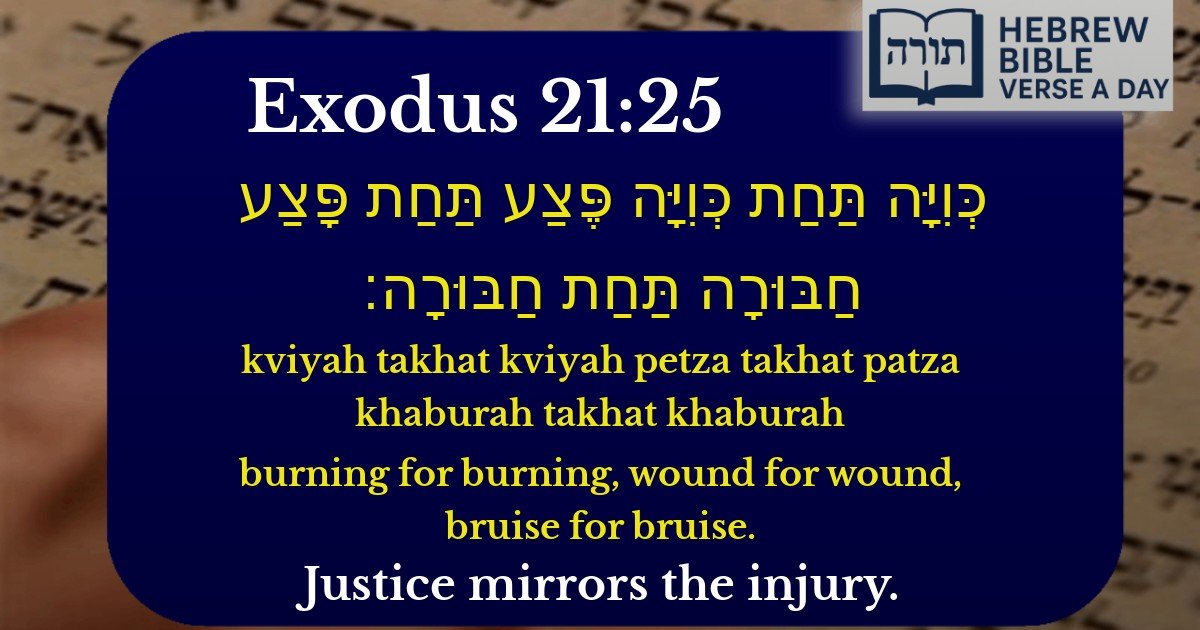

Interpretation of "כְּוִיָּה תַּחַת כְּוִיָּה" (Burning for Burning)
This verse from Shemot 21:25 is part of the Torah's laws regarding damages (nezikin), specifically addressing the principle of proportional compensation for bodily injuries. The phrase "burning for burning, wound for wound, bruise for bruise" establishes the concept of middah k'neged middah (measure for measure) in cases where one person injures another.
Rashi's Explanation
Rashi (on Shemot 21:24) explains that this verse is not to be taken literally as requiring physical retaliation (lex talionis), but rather refers to monetary compensation. He cites the Talmud (Bava Kamma 83b), which states that the court assesses the value of the injury, including five categories of damages:
Rambam's Legal Perspective
Rambam (Hilchot Chovel U'Mazik 1:3-5) elaborates that the Torah's wording emphasizes the severity of causing bodily harm. The repetition of injuries ("burning," "wound," "bruise") teaches that each type of damage must be evaluated separately for compensation. He emphasizes that monetary payment is always required, not physical retaliation, as the Torah values human dignity and justice.
Midrashic Insight
The Mechilta (on Shemot 21:24) connects this verse to the broader ethical principle that one who causes harm must fully rectify their actions. The Midrash teaches that the phrase "תַּחַת" ("in place of") implies precise accountability—the offender must compensate in a manner that truly addresses the damage caused, whether physical, emotional, or financial.
Halachic Application
In practical halacha, as codified by the Shulchan Aruch (Choshen Mishpat 420), these verses form the basis for detailed laws of damages. Courts must carefully assess:
This ensures that justice is tailored to each unique case, reflecting the Torah's nuanced approach to interpersonal laws.