Frequently Asked Questions
Q: What does Exodus 21:26 mean when it says a master must free a servant if he injures their eye?
A: This verse teaches that if a master causes permanent damage to a servant's eye (or other body parts, as discussed in the surrounding verses), the servant must be set free as compensation. This reflects the Torah's emphasis on human dignity and fair treatment, even for servants. Rashi explains that this law applies even if the injury was accidental, showing how seriously the Torah takes bodily harm.
Q: Why is this law about injuring a servant important in the Torah?
A: This law is important because it establishes limits on how servants could be treated, showing that even those in servitude have basic rights. The Rambam (Hilchos Avadim 5) explains that this prevents cruelty and reminds us that all people are created in G-d's image. The Talmud (Kiddushin 24b) discusses how this law was revolutionary in ancient times when servants typically had few rights.
Q: What can we learn from Exodus 21:26 about how to treat others today?
A: We learn that causing harm to others - whether physical, emotional, or financial - carries serious consequences. The verse teaches responsibility for our actions and the importance of making proper amends. The Sforno notes that this law applies even if the servant wasn't particularly valuable to the master, teaching that every person's wellbeing matters equally before G-d.
Q: Does this verse mean Jewish law allowed slavery?
A: The Torah's system of servitude was fundamentally different from what we think of as slavery. As this verse shows, servants had legal protections and rights. The Talmud (Kiddushin 22a) explains that acquiring a Jewish servant was more like hiring a long-term employee, with strict rules against mistreatment. The Torah actually aims to limit and regulate servitude while moving society toward greater freedom.
Q: How does this law about injuring a servant connect to other Torah laws?
A: This law is part of the 'Mishpatim' (laws) section following the Ten Commandments, showing how abstract principles (like 'do not murder') translate into practical laws. It connects to the broader Torah value of 'ואהבת לרעך כמוך' (love your neighbor as yourself - Leviticus 19:18). The Midrash (Mechilta) links this to the idea that we must be especially careful not to oppress those under our authority.

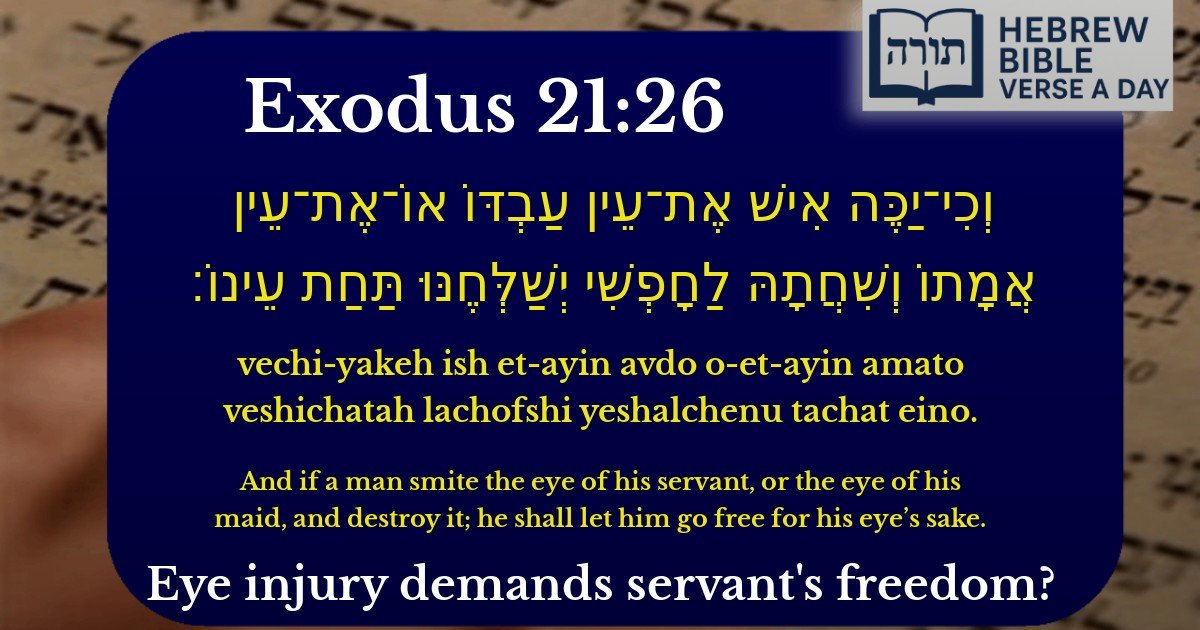

Verse Context in the Torah
The verse (Exodus 21:26) appears in Parshat Mishpatim, which details civil and ethical laws following the revelation at Sinai. This specific law addresses the treatment of Hebrew indentured servants (eved ivri) and the consequences for a master who causes permanent injury.
Literal Interpretation (Peshat)
Rashi explains that if a master strikes his servant’s eye (or any other limb) and destroys its function, the servant must be set free immediately as compensation for the injury. The phrase "לַחָפְשִׁי יְשַׁלְּחֶנּוּ" ("he shall let him go free") is absolute—the servant gains complete freedom, not merely monetary compensation.
Legal Implications (Halacha)
The Rambam (Hilchot Avadim 2:12-14) elaborates on this law:
Moral and Ethical Lessons (Derash)
The Mechilta and Midrash Tanchuma emphasize the Torah’s sensitivity to human dignity:
Broader Philosophical Insight
The Sefer HaChinuch (Mitzvah 42) connects this law to the idea that every person is created in the Divine image (tzelem Elokim). Harming another’s body is akin to defacing that sanctity, warranting the master’s loss of rights over the servant.